Concrete4U | Concrete Admixtures, Tools, and Production Machines

Stop Guessing Density: The Concrete Foaming Agent Blueprint for Lightweight Strength
The Day the Pour Failed
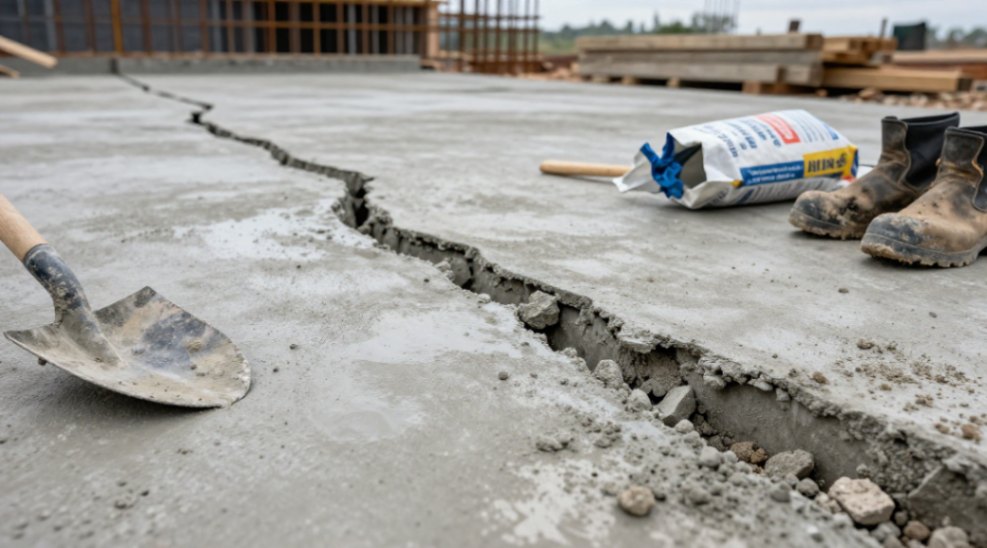
I watched a 40 cubic meter slab crack because the foam collapsed. The foreman blamed the weather. He was wrong. The culprit was a concrete foaming agent chosen for price, not performance. That mistake cost $12,000 in material and three days of rework. Let me show you how to avoid that.
A concrete foaming agent is a chemical surfactant that stabilizes air bubbles within a cementitious mix. Its sole job is to create millions of tiny, disconnected voids. Those voids reduce density. They turn heavy concrete into light weight concrete. The result? Thermal insulation, void filling, and structural dead load reduction.
Most engineers define it as an air-entraining admixture on steroids. Standard air entrainment gives you 6% air. A foaming agent gives you 20% to 80% air. That is not a typo. It is a density game.
1. Synthetic vs Protein-Based: The Core Chemistry
You have two families here. No middle ground.
| Property | Synthetic (e.g., Sodium Alpha-Olefin Sulfonate) | Protein-Based (e.g., Hydrolyzed Keratin) |
|---|---|---|
| Source | Petrochemical derivatives | Animal byproducts (hooves, horns) |
| Foam Stability | Good for most pours; degrades under high shear | Superior stability; resists pump shear |
| Density Range | 300 kg/m³ to 1600 kg/m³ achievable | Lowest densities (200 kg/m³) possible |
| Bleed Resistance | Moderate | High; tighter bubble structure |
| Biodegradability | Variable; some are not VOC-compliant | Biodegradable; lower environmental impact |
| Cost | Lower per liter | Higher per liter; less volume needed |
| Best Use | General filling, block production | Pumpable foamed concrete, roofing insulation |
My rule: for pump mixes over 30 meters, go protein-based. For simple trench fills, synthetics work fine. Do not reverse this.
2. Liquid vs Powder Formulations: Which Wins?
Most buyers ask for liquid because it is ready. That is lazy logic.
Liquid agents are water-based concentrates. You dilute them 1:20 to 1:50 with water in a foam generator. They are easy to meter, but they freeze at 0°C. Storage is a pain.
Powder agents are dry surfactants. You dissolve them in water on site. They ship cheaper (no water weight), and they last for years. The catch? You need precise mixing. Over-dissolve, and you lose stability. Under-dissolve, and you get foam collapse.
| Parameter | Liquid Agent | Powder Agent |
|---|---|---|
| Dilution Ratio | Fixed by manufacturer; 1:30 is common | Variable; typically 1 kg powder to 15 L water |
| Foam Density | 60 g/L to 100 g/L | 40 g/L to 80 g/L |
| Shipping Cost | Higher (water payload) | Lower (concentrated solids) |
| On-Site Adjustability | Limited dilution range | Wide range; skilled operator required |
I prefer powders for remote jobs. I prefer liquids for factories. Do what fits your logistics.
3. How Stable Air Voids Form: The Physics You Need
You mix the agent with water and compressed air in a foam generator. That produces preformed foam. You then blend that foam into a base slurry of special cement, water, and superplasticizer.
Here is the trick: the foam must survive the mixing process. If the mixer blades are too aggressive, the bubbles break. Use a ribbon blender or a low-shear drum. Never use a high-energy pan mixer for foamed concrete.
The bubbles are physical voids. They do not react chemically. They reduce density predictably. Every 1% of air voids by volume reduces density by roughly 1% of the base mix density. Want 800 kg/m³ from a 2400 kg/m³ base? You need 67% air voids.
4. Optimal Dosage and Mixing Procedure
There is no universal dose. Stop looking for one.
Dosage depends on target density, cement type, and water-cement ratio. Start here:
- For concrete foaming agent liquid: 0.5% to 2.0% by weight of cement, depending on target density.
- For powder: 0.2% to 0.8% by weight of cement.
- Always dilute the agent in the foam generator first. Never pour concentrated agent directly into the slurry.
Step-by-step mix procedure:
- Prepare the base slurry: blend special cement, water, superplasticizer, and any early strength agent or fiber. Mix for 2 minutes.
- Generate the foam separately. Set the foam generator to produce foam with a density of 60 g/L to 80 g/L.
- Introduce the foam into the slurry. Add it gradually over 30 seconds.
- Mix for another 60 seconds. Do not overmix.
- Check the fresh density immediately. Adjust foam volume if needed.
Measure wet density with a container of known volume. Target value: ±10 kg/m³ of your spec.
5. The Compressive Strength vs Density Trade-off
You cannot cheat physics. More air means less strength.
A typical 800 kg/m³ light weight concrete yields 1 MPa to 3 MPa compressive strength. A 1600 kg/m³ mix yields 10 MPa to 20 MPa. If you need both low weight and high strength, you are mixing in nano-modifier or redispersible polymer powder to glue the bubbles together.
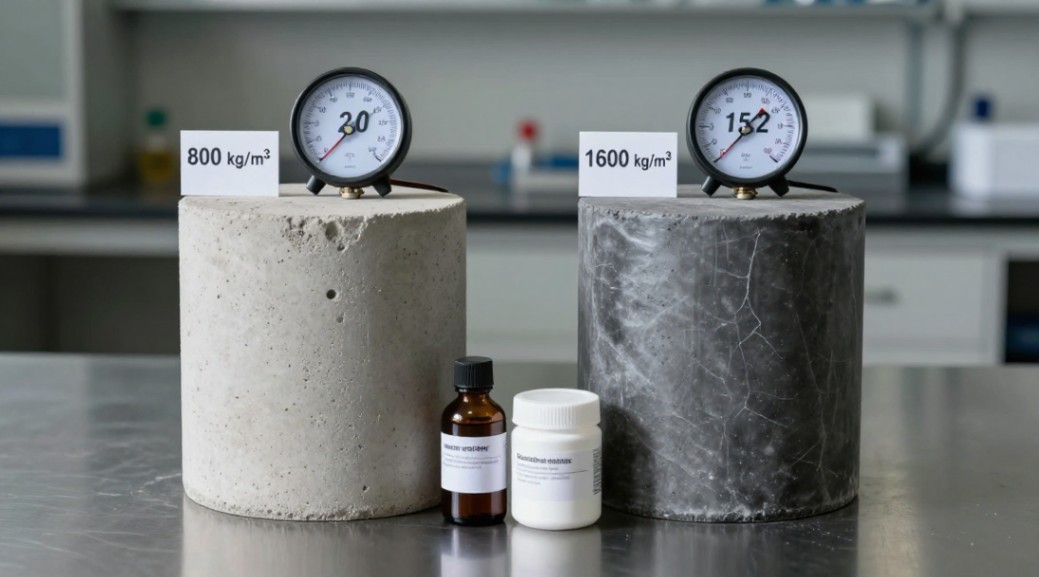
I have seen engineers aim for 5 MPa at 600 kg/m³. It is possible with polymer modification, but the cost jumps. Communicate that to your client before they sign off.
6. Compatibility with Cement Types and Admixtures
Not all cements play nice with foam. Special cement like calcium aluminate works beautifully. Ordinary Portland Cement (OPC) is standard. But avoid high-alkali cements, they destabilize the bubbles.
Admixtures to use with confidence:
- Superplasticizer: reduces water, improves foam stability.
- Concrete water reducer: standard use.
- Concrete defoamer: only if you accidentally over-foam. Do not add it preemptively.
- Fiber: polypropylene or glass, 0.1% to 0.3% by volume. Reduces plastic shrinkage cracking.
Admixtures to avoid:
- Standard air-entraining agents. They will compete with the foam and destabilize it.
- High doses of CaCl₂ accelerators. They react with the surfactant.
7. Environmental and Safety Considerations
VOC content matters. Synthetic agents can contain VOCs over 10 g/L. Check your local codes. Protein-based agents are typically VOC-free.
Biodegradability: Protein-based agents break down in 28 days. Some synthetics persist. If your site has groundwater concerns, choose protein.
Handling: Use gloves and goggles. Concentrated surfactants are skin irritants. The foam itself is harmless, but the wet slurry is alkaline. Standard PPE suffices.
8. Performance Metrics You Must Inspect
Stop accepting any agent without verification. Test these three things:
| Metric | How to Measure | Acceptable Range |
|---|---|---|
| Foam Stability | Fill a 1L cylinder with foam. Measure liquid drainage after 30 minutes. | < 10% drainage |
| Expansion Ratio | Volume of foam divided by volume of liquid agent used. | 15:1 to 30:1 for liquid; 20:1 to 40:1 for powder |
| Bleed Resistance | Pour fresh foamed concrete into a mold. Measure water atop the sample after 1 hour. | < 2% of sample volume |
If any metric falls outside the range, the agent is wrong for your job. Reject it.
9. Troubleshooting Common Issues
Issue: Foam collapse in the mixer.
Root cause: High shear or hot slurry (>40°C). Fix: Use a protein-based agent. Cool the slurry with ice water.
Issue: Over-air entrainment (batch density varies wildly).
Root cause: Poor foam generator calibration. Fix: Measure foam density every hour. Clean the generator nozzles daily.
Issue: Batch inconsistency.
Root cause: Operator error. Fix: Write a standard operating procedure. Require density checks on every 5 m³ produced.
10. Where to Source Quality Agents
Not all suppliers are equal. When you need a reliable concrete foaming agent, look for suppliers who provide detailed technical datasheets and batch-to-batch consistency reports. If a vendor cannot tell you the expansion ratio of their agent at 20°C, walk away.
Suppliers like TRUNNANO offer both synthetic and protein-based formulations, along with foaming equipment and complementary materials such as hydroxypropyl methyl cellulose, hydroxyethyl cellulose, sodium silicate, and potassium silicate. These additives can fine-tune stability and water retention in your foam concrete.
For specialized applications, ask for samples of their redispersible polymer powder or nano-modifier. Test them in your own mix design before committing to a full order.
Your Next Move
Stop guessing. If you are planning a foam concrete project, do two things today:
- Test your current agent for foam stability using the 30-minute cylinder test.
- Contact a supplier like TRUNNANO and request a sample set of their protein-based and synthetic agents. Run a density check at 700 kg/m³, 1000 kg/m³, and 1200 kg/m³. Record the strength drop.
That data will save you $12,000. I learned that the hard way.
Supplier
We are the global leader in lightweight concrete and advanced engineered foam solutions. Known globally for its commitment to research, innovation, and applied expertise, we have been providing engineered foam solutions since the early 2012’s.
We can supply high-quality concrete admixture and foam concrete related products all over the world.
The company has a professional technical department and quality supervision department, a well-equipped laboratory, and equipped with advanced testing equipment and after-sales customer service center.
If you are interested, please feel free and contact us.