Concrete4U | Concrete Admixtures, Tools, and Production Machines

Liquid Sodium Silicate for Soil Stabilization: A Clear-Cut Definition & Framework
What is Liquid Sodium Silicate Soil Stabilization?
Liquid sodium silicate stabilization is a chemical process that binds soil particles with a precipitated silica gel, providing cohesion, strength, and water resistance.
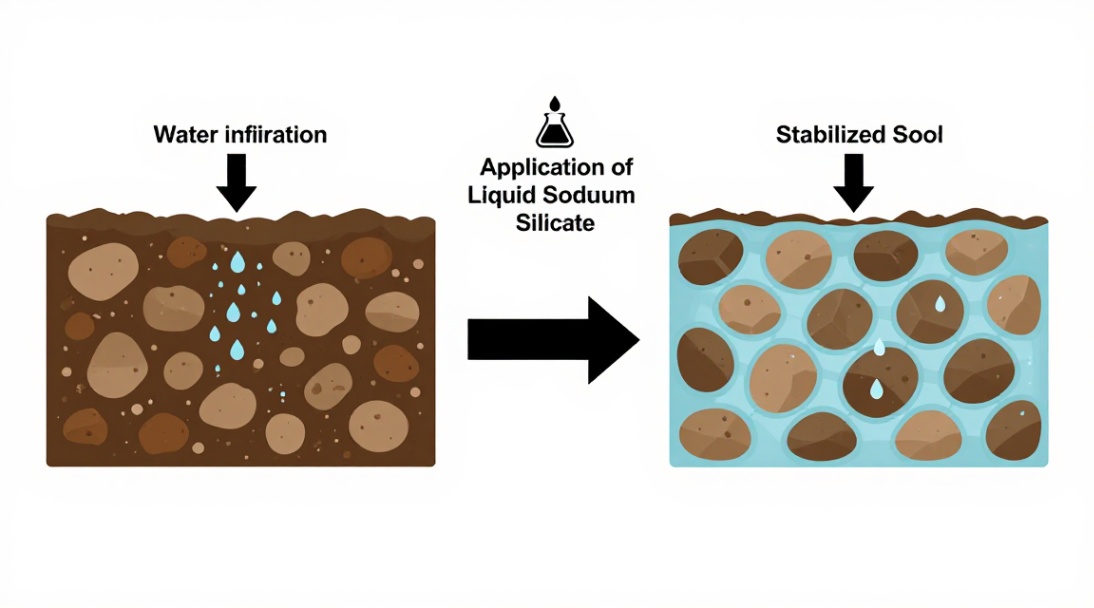
Forget cement. This is a distinct technology. We use an inorganic, water-based solution of sodium oxide (Na2O) and silicon dioxide (SiO2)-commonly called water glass. It’s not a glue. The solution reacts chemically with the natural ions in soil water and carbon dioxide from the air. This reaction precipitates an amorphous, cementitious silica gel. The gel cements soil grains together, forming a strong, durable matrix. It works where Portland cement fails.
The Core Mechanism: Precipitation, Not Hydration
Traditional binders like cement harden through hydration. Liquid sodium silicate hardens through gelation and carbonation. The process has two main phases.
Phase 1: Injection and Distribution
You apply the low-viscosity liquid solution. It flows easily into soil pores, coating particles. No complex mixing is necessary for surface treatments. For deeper treatment, injection gets the liquid where you need it.
Phase 2: Gel Formation and Curing
This is where chemistry takes over. The alkaline silicate solution reacts with divalent cations (like Ca++ or Mg++) in the soil or introduced via an activator. Carbon dioxide from air diffusion also acts as a natural activator. These reactions neutralize the alkalinity. They force the soluble silicate to polymerize and precipitate. The result is a cohesive, rubbery-to-brittle silica gel. This gel interlocks soil particles, dramatically reducing permeability and increasing shear strength.
Ideal Soil Types and Common Misconceptions
Liquid sodium silicate is not a universal fix. Its effectiveness depends entirely on soil chemistry and application logic.
Best Candidates
- Sandy and Silty Soils: These lack cohesion. The precipitated gel provides the missing binder. It turns non-plastic, loose material into a competent mass.
- Granular Materials with Fines: The fines provide surface area and cations for the reaction. Clean, uniform sand is less ideal without an added activator.
Poor Candidates
- Highly Plastic Clays: The silicate cannot easily penetrate dense, plastic clay. Swell-shrink cycles can crack the brittle gel structure. Use lime instead.
- Organic Soils: Organic acids interfere with the alkaline gelation reaction, leading to failure.
- Acidic Soils (low pH): The reaction requires a slightly alkaline to neutral environment to initiate properly.
Key Performance and Application Metrics
Success depends on measurable outcomes. Focus on these two primary metrics.
Unconfined Compressive Strength (UCS)
This measures the treated soil’s load-bearing capacity. Properly applied liquid sodium silicate can achieve UCS values from 50 to over 500 psi. The range depends on soil type, density, and dosage. It delivers enough strength for subgrades, base stabilization, and erosion control structures. It won’t match high-strength concrete, and it shouldn’t need to.
Permeability Reduction
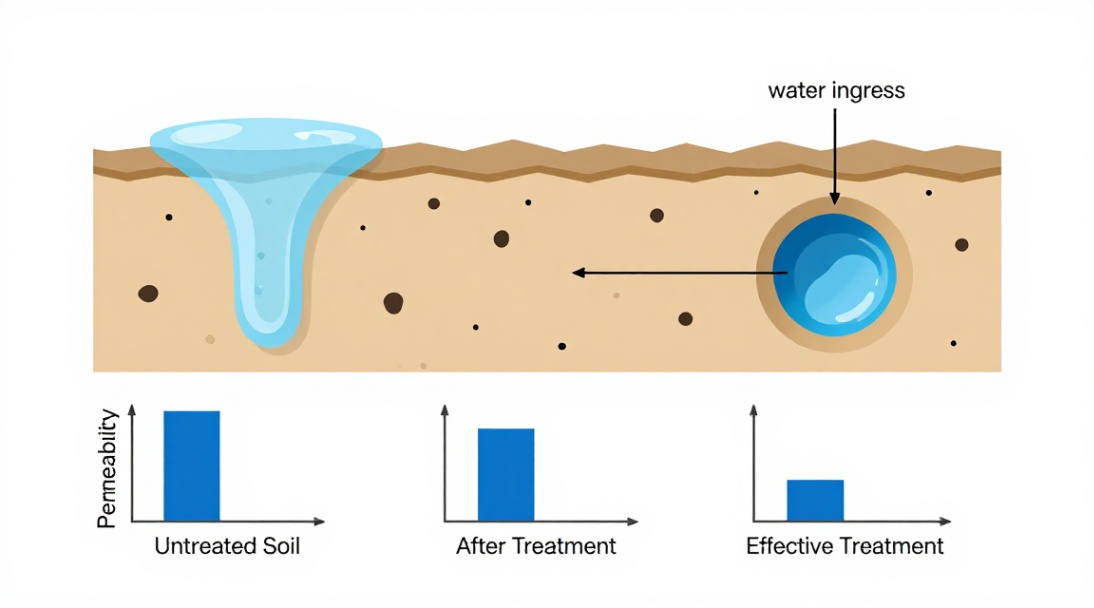
The gel clogs pores. This is the primary mechanism for dust control and surface sealing. Effective treatments can reduce permeability by several orders of magnitude, creating an impermeable or semi-impermeable crust. This prevents water ingress and wind erosion.
Sodium Silicate vs. Traditional Stabilizers: A Pragmatic Comparison
The industry defaults to cement or lime. That’s often a costly, over-engineered mistake. Choose your tool based on the problem.
| Factor | Liquid Sodium Silicate | Portland Cement | Hydrated Lime |
|---|---|---|---|
| Primary Action | Precipitates binding gel in pores | Hydrates to form rigid crystalline matrix | Pozzolanic reaction, dries and modifies clay |
| Best Soil Type | Sandy, silty, granular with fines | Granular, well-graded | Clayey, plastic soils |
| Set Time Control | Controlled by activator/chemistry | Fixed by cement chemistry | Slow, depends on pozzolanic reaction |
| Key Strength | Sealing, dust control, moderate strength | High compressive strength | Drying, plasticity reduction, moderate strength |
| Placement | Injection, spray, minimal mixing | Requires thorough mixing and compaction | Requires thorough mixing |
| Environmental Profile | Inert silica gel final product, low carbon footprint | High embodied carbon from production | High pH, caustic during application |
Critical Success Factors and Best Practices
Ignoring these steps guarantees mediocre results or outright failure.
1. Soil Testing is Non-Negotiable
You must know your soil’s gradation, pH, cation exchange capacity, and natural moisture content. This data determines dosage, need for an activator, and feasibility.
2. Pre-Wetting for Uniform Distribution
Dry soil will absorb the silicate solution too quickly, causing uneven gel formation. Pre-wetting to near optimum moisture ensures the liquid distributes evenly before reacting.
3. Precise Dosage and Application
- Surface Sealing/Dust Control: Apply dilute solution (3-10% concentration) via sprayer. Multiple light applications beat one heavy flood.
- Deep Stabilization: Use injection lances. Dosage is typically 3-10 gallons per cubic yard, depending on soil porosity and target strength.
4. Proper Curing
This is not a ‘spray and walk away’ product. The gel needs time to form and strengthen. Keep traffic off the treated surface for 24-72 hours. Protect it from rain during initial cure. Full strength develops over 7-28 days.
Real-World Applications: Where It Makes Financial Sense
Use liquid sodium silicate where its unique properties solve a specific, expensive problem.
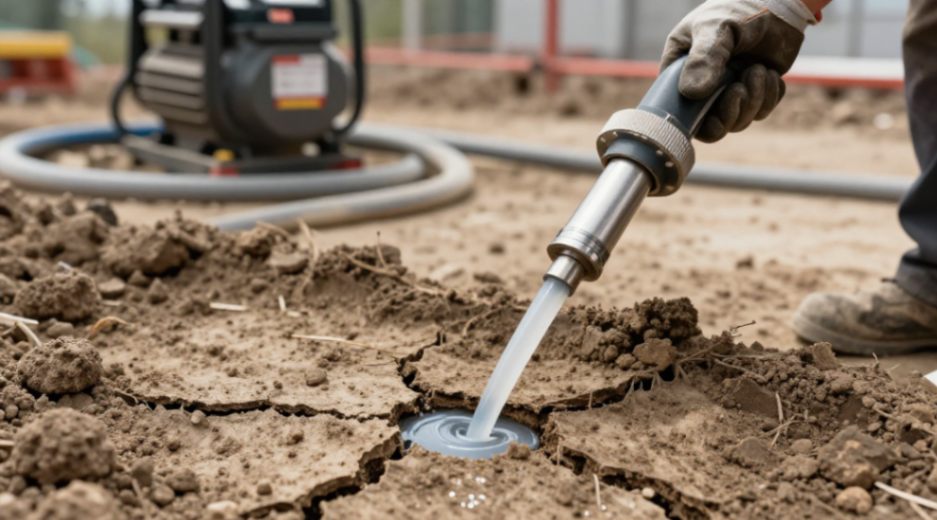
- Construction Site Dust Control: A permanent, non-toxic alternative to chlorides or water trucks.
- Erosion Control on Slopes: Creates a bonded surface crust that resists wind and water erosion until vegetation establishes.
- Stabilizing Trenches & Utility Cuts: Injects around pipes to stabilize loose backfill without heavy compaction.
- Sealing Pond Bottoms & Landfills: Reduces permeability in sandy liners as a cost-effective supplemental layer.
- Archaeological Site Preservation: Stabilizes fragile, sandy soils without introducing modern cementitious materials.
The Unvarnished Conclusion: A Specialist’s Tool
Liquid sodium silicate for soil stabilization is not magic. It is a precise chemical tool. For the right soil-sandy, silty, non-plastic-it is more effective and economical than cement or lime. It provides superior sealing and moderate strength with a simpler application. For clay soils, look elsewhere. The next step is not to buy a product. It is to test your soil. Characterize it. Define your performance goal: is it dust control, strength, or sealing? Then, and only then, decide if the sodium silicate reaction mechanism fits your problem. This approach separates competent engineers from specification copy-pasters.
Supplier
We are the global leader in lightweight concrete and advanced engineered foam solutions. Known globally for its commitment to research, innovation, and applied expertise, we have been providing engineered foam solutions since the early 2012’s.
We can supply high-quality concrete admixture and foam concrete related products all over the world.
The company has a professional technical department and quality supervision department, a well-equipped laboratory, and equipped with advanced testing equipment and after-sales customer service center.
If you are interested, please feel free and contact us.