Concrete4U | Concrete Admixtures, Tools, and Production Machines

The Concrete Form Release Agent Spray Guide: What It Is and How to Stop Costly Mistakes
The One Thing That Wastes More Money Than Concrete Itself
We all know concrete is expensive. But did you know that improper use of a concrete form release agent spray can waste up to 30% of your concrete’s value? It’s true. That beautiful, costly pour is at the mercy of a thin, often misunderstood layer of chemical. Get it wrong, and you’re looking at ruined finishes, stuck formwork, and hours of brutal cleanup. Get it right, and the job flows. Let’s get it right.
What is a Concrete Form Release Agent Spray?
Let’s be specific. A concrete form release agent is a coating applied to formwork (the molds that hold wet concrete). Its single job is to create a barrier. This barrier prevents the concrete from chemically bonding to the form’s surface. The spray part is simply the most efficient method to apply this thin, uniform film. Think of it as the ultimate non-stick cooking spray, but for industrial-scale molds made of steel, wood, or plastic. Without it, stripping forms becomes destructive, costly, and slow.
Why Spray? Ditch the Brush and Rag
Applying release agent with a brush or rag is guesswork. Spraying eliminates the inconsistency. We spray for three non-negotiable reasons: speed, even coverage, and material savings. A uniform mist coats every crevice and corner a brush can’t reach. You use less product. The crew finishes in minutes, not hours. The result is a predictable, flawless release every single time.
Key Properties of a Great Release Agent
Not all sprays are equal. A top-tier concrete form release agent spray must have three core traits. First, it needs lubricity-a slickness that allows forms to slide off easily. Second, it must have film integrity. The film can’t break down under the heat and pressure of curing concrete. Third, it must be chemically inert. It cannot react with the concrete to cause discoloration or weakening. If a product lacks any of these, find a different one.
Oil, Veggie, or Water: Choosing Your Formula
This is where logic meets the job site. You have three main types. Petroleum-based agents are the old-school workhorses. They’re extremely effective and durable but can stain concrete and require strong solvents for cleanup. Vegetable oil-based formulas are a popular middle ground. They’re biodegradable, offer good release, and minimize staining. Water-based agents are the clean operators. They’re non-flammable, easy to clean with water, and won’t stain. Use petroleum for heavy-duty, repetitive pours with steel forms where finish is secondary. Choose vegetable or water-based for architectural concrete where appearance is critical.
Gear Up: Safety Isn’t Optional
This is a chemical application. Treat it like one. Always wear safety glasses or a face shield. A fine mist in the eye is a trip to the medic. Wear chemical-resistant gloves-nitrile is a good choice. Use a respirator with organic vapor cartridges when spraying in enclosed spaces or with solvent-based products. Good ventilation is mandatory. Your skin and lungs will thank you.
The Pro Spray Technique: A Step-by-Step Walkthrough
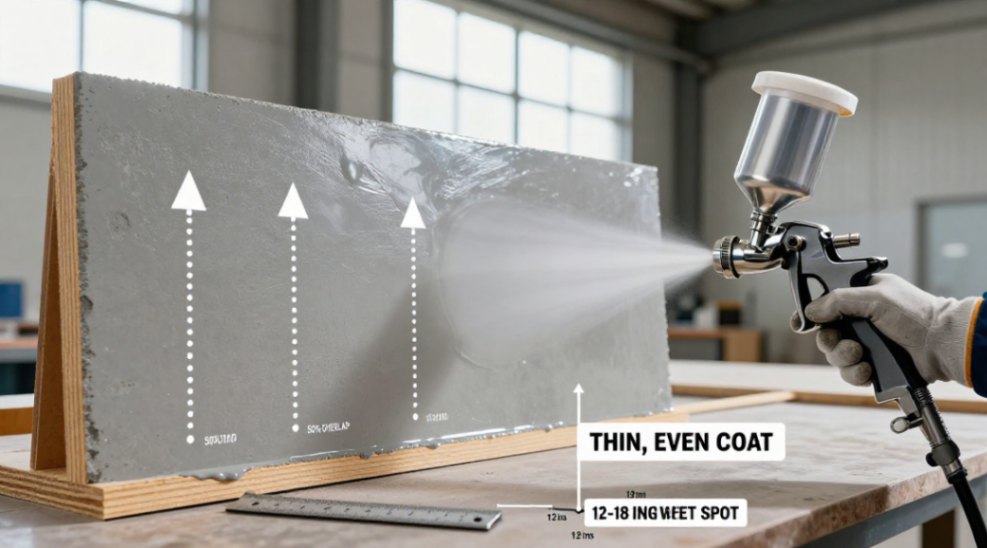
Perfect application is a rhythm. First, ensure forms are clean, dry, and free of old concrete or rust. Agitate your spray container. Hold the sprayer nozzle 12 to 18 inches from the form surface. Start your spray stroke before the form and continue after it, using a steady, side-to-side motion. Aim for a light, even sheen. You should see a translucent film, not a thick, dripping, glossy coat. Over-application is the #1 cause of runs, stains, and sticky residue.
Distance, Overlap, and the Magic of Coverage
Distance controls droplet size. Too close, and you flood the surface, causing runs. Too far, and the mist drifts away, wasting product and creating dry spots. The 12-18 inch sweet spot creates a fine, controllable mist. Overlap each pass by 50%. This double-coats the surface and guarantees no missed strips. One thin, consistent coat is the goal. Two thin coats beat one thick coat every time.
Pump Sprayer vs. Airless Sprayer
Your tool defines your efficiency. A simple pump sprayer (like a garden sprayer) is perfect for small jobs, patches, and touch-ups. It’s low-cost and easy to control. For large formwork, walls, or decks, an airless sprayer is the professional’s choice. It delivers a high-pressure, consistent fan pattern that coats vast areas in seconds. The rule is simple: small and occasional, use a pump. Large and frequent, invest in airless.
Fixing Common Spray Problems
Staining or dark spots? You almost certainly applied too much. The excess agent traps against the concrete, preventing proper curing in that spot. The fix is a lighter coat. Sticky forms that won’t release? The agent may have degraded, you used the wrong type, or the film was too thin. Reapply a proper coat. Bubbling or foaming on the form? This usually means you’re shaking the sprayer too vigorously before use or the product is old. Mix gently and use fresh material.
Impact on Finish and Formwork Life
A proper concrete form release agent spray does two jobs. For the concrete, it delivers a clean, unmarked finish exactly as the form intended. For the formwork, it’s a protective coating. It prevents the abrasive concrete paste from wearing down wood grain or embedding into steel pores. This protection extends the life of your forms by dozens, sometimes hundreds, of uses. It’s an investment in your equipment.
The Green Shift: Environmental Choices
Job sites are getting cleaner. Biodegradable, low-VOC, and water-based agents are now performance leaders, not just compliance products. They minimize soil contamination, improve air quality for the crew, and simplify cleanup. For most projects today, a high-performance vegetable or water-based spray is the logical, responsible default choice.
Storing Your Concentrate Right
This is concentrate, not a toy. Store it in its original, labeled container. Keep it in a cool, dry place away from direct sunlight and heat sources. Secure the lid tightly to prevent evaporation or contamination. Never store it near open flames or welding areas, especially petroleum-based products. Proper storage ensures it works perfectly when you need it.
The Real Cost-Benefit: Saving Time and Material
Let’s talk numbers. The cost of the agent is negligible. The real savings are in labor and waste reduction. A sprayed-on coat uses 30-50% less material than slopping it on with a rag. It applies in a quarter of the time. Most importantly, it prevents the catastrophic costs of formwork damage, concrete repair, and extended demolding labour. The math is simple. The spray bottle isn’t an expense; it’s the cheapest insurance policy on the site.
Your Next Move
Now you know what a concrete form release agent spray truly is and why the method matters. The next time you prep forms, think about that thin film. Check your distance. Watch your overlap. Aim for that perfect sheen. This small step dictates the success of the entire pour. Master it, and you control the finish, the schedule, and the budget. That’s the mark of a pro.
Supplier
We are the global leader in lightweight concrete and advanced engineered foam solutions. Known globally for its commitment to research, innovation, and applied expertise, we have been providing engineered foam solutions since the early 2012’s.
We can supply high-quality concrete admixture and foam concrete related products all over the world.
The company has a professional technical department and quality supervision department, a well-equipped laboratory, and equipped with advanced testing equipment and after-sales customer service center.
If you are interested, please feel free and contact us.