Concrete4U | Concrete Admixtures, Tools, and Production Machines

Your Practical Guide to Using Water Reducers for High-Strength Concrete
Hitting a Wall with Your High-Strength Mix?
You’ve been tasked with designing or placing a high-strength concrete mix. You know the goal: 10,000 psi (70 MPa) or more. You carefully proportion your cement, silica fume, and high-quality aggregates. But when you batch the mix, it’s stiff. Unworkable. Almost impossible to place and consolidate properly. Adding water seems like the easy fix, but that single action will destroy the low water-cement ratio you need for strength. You’re stuck. This is exactly where the right water reducer for high strength concrete transforms frustration into success.
What is a Water Reducer and Why is it Non-Negotiable?
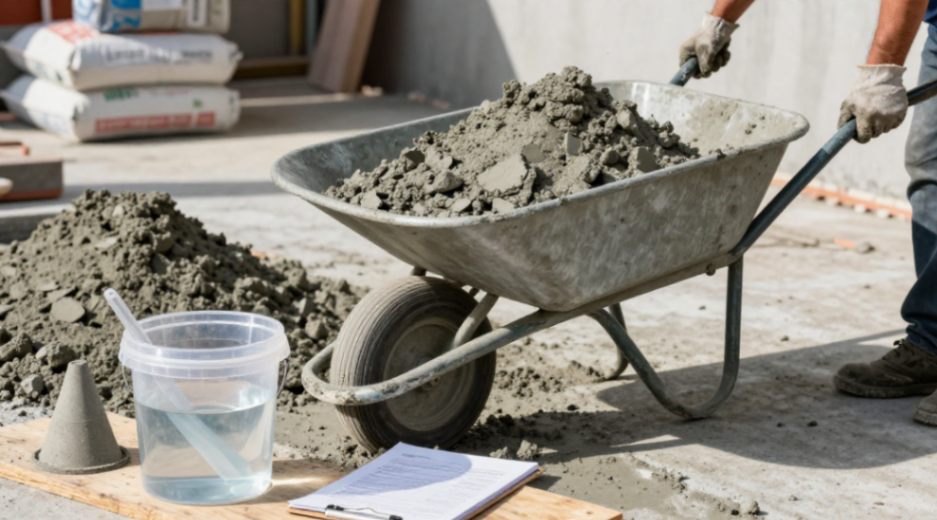
At its core, a water reducer (or plasticizer) is a chemical admixture that allows you to use less water while achieving the same workability. For high-strength concrete, this isn’t a convenience-it’s the foundational principle. As one industry expert famously stated, “The path to high strength is paved with low water-cement ratios.” By reducing the water demand by 15% to 30% or more, these admixtures enable you to create dense, impermeable concrete with significantly higher compressive strength.
The Modern Workhorse: Polycarboxylate Ether (PCE) Superplasticizers
While several chemical types exist, the polycarboxylate ether (PCE) superplasticizer is the undisputed champion for modern high-strength applications. Unlike older lignosulfonate or naphthalene-based products, PCEs offer unparalleled water reduction and control. Their mechanism is elegantly effective. Imagine cement particles in water clumping together like a wet gravel pile. A PCE molecule attaches to individual particles, creating a strong negative electrostatic charge and a physical “steric” barrier. This dual-action forces particles apart-a process called dispersion or deflocculation. The result? The mix liquefies without extra water.
Step-by-Step: Integrating a Water Reducer into Your High-Strength Mix Design
Success requires a methodical approach. Don’t just pour it in and hope. Follow this process.
Step 1: Define Your Performance Targets
Before you open a drum, be specific. What is your target 28-day compressive strength? What is the required slump for placement (e.g., 8 inches / 200 mm)? How long must that slump be maintained? What are the ambient temperature conditions? Write these down. Your admixture selection and dosage will hinge on these targets.
Step 2: Select the Right PCE Type
Not all PCEs are the same. You need to match the admixture’s performance profile to your needs. The key decision is between a standard, high-range water reducer and one engineered for extended slump life. For complex placements or hot weather, a product with robust slump retention is critical to prevent stiffening before placement is complete.
Step 3: Determine the Optimal Dosage Through Trial Batches
This is the most critical hands-on step. Start with the manufacturer’s recommended dosage, typically expressed as a percentage of cementitious materials by weight (e.g., 0.8% to 1.5%). Perform a laboratory trial batch using your exact mix proportions.
- Mix all dry materials for 60 seconds.
- Add 80% of the mixing water and mix for 120 seconds.
- Add the precise dose of water reducer diluted in the remaining 20% of water. Mix for a final 180 seconds.
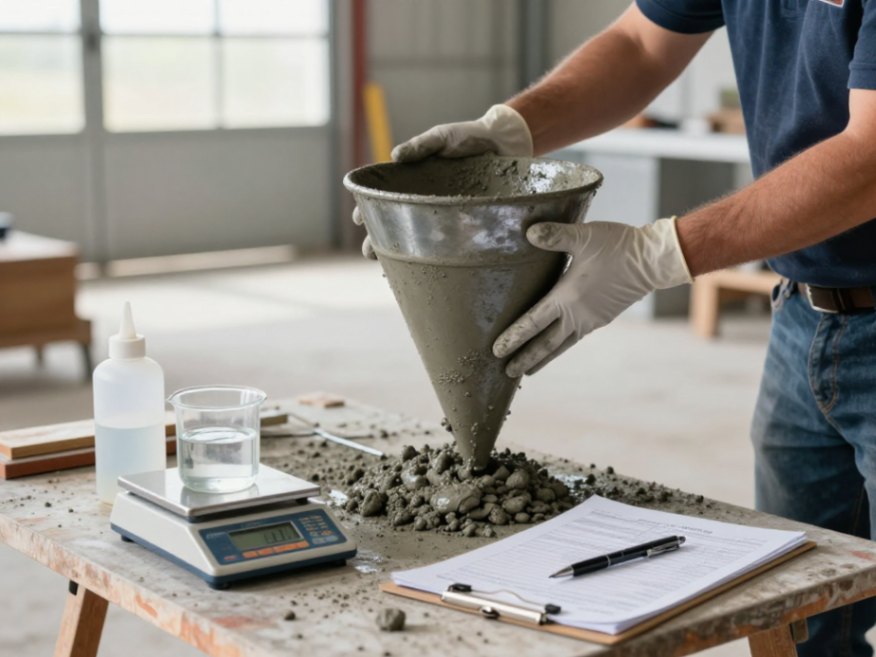
Measure the slump immediately. Is it on target? If not, adjust the dosage in increments of 0.1% by weight of cement. Record every change. You are seeking the lowest dosage that achieves your required workability.
Step 4: Assess Compatibility and Set Performance
High-strength concrete often includes supplementary cementitious materials (SCMs) like silica fume or fly ash. Some PCEs can interact differently with these materials. After achieving initial workability, let the mixed concrete stand for 30 minutes, then remix for 60 seconds and check slump again. This tests slump retention. Also, cast cylinders to verify early (1-day and 7-day) and ultimate (28-day) strength development meets your targets.
Key Considerations and Best Practices
Avoid common pitfalls with these pro-tips.
Batching Order is Critical: Always follow the sequence in Step 3. Adding the undiluted admixture directly to dry cement can cause “balling” and severe workability loss.
Temperature Matters: High temperatures accelerate slump loss. In hot weather, you may need a higher initial dosage or a dedicated hot-weather formula. Conversely, in cold weather, be mindful of potential set time delays.
Never Use Water to Adjust Slump On-Site: This is the cardinal sin. If workability is lost, a small, controlled dose of additional water reducer (retempering) is acceptable if the admixture is designed for it and approved by the mix designer. Adding plain water will guarantee your strength will fall short.
| Step | Action | Key Metric |
|---|---|---|
| 1. Target Definition | Specify strength, slump, placement time. | e.g., 12,000 psi, 7-inch slump |
| 2. Product Selection | Choose PCE type (standard or extended slump). | Based on site conditions |
| 3. Dosage Optimization | Conduct lab trial batches. | Dosage by % cement weight |
| 4. Performance Testing | Cheque slump retention & cast test cylinders. | 30-min slump, 1/7/28-day strength |
| 5. Quality Control | Monitor batching sequence and temperature. | Strict adherence to mix design |
Beyond Strength: The Holistic Benefits
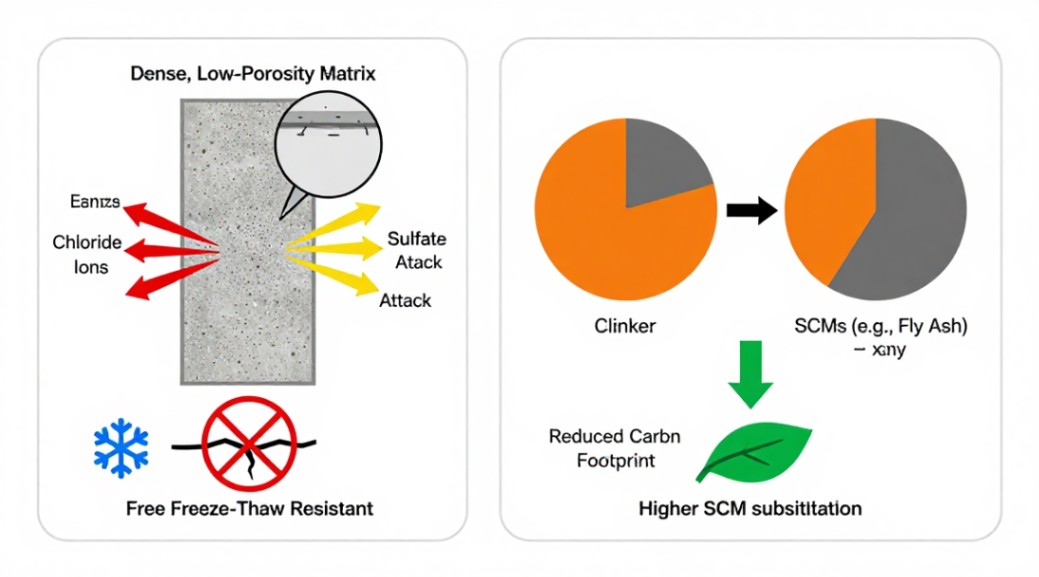
Using a powerful water reducer for high strength concrete delivers more than just compressive strength. The reduced water content creates a less porous matrix, drastically improving durability against chloride ingress, sulfate attack, and freeze-thaw cycles. From a sustainability perspective, it allows for the use of higher volumes of SCMs like fly ash, directly reducing the clinker factor and the project’s carbon footprint without compromising performance. You build stronger, more durable, and more sustainable structures.
Your Next Move
The theory is clear. The steps are laid out. Your success now depends on practical application. Start with a consultation. Talk to your admixture supplier with your specific project parameters in hand. Then, commit to rigorous trial batching. The data you generate will give you the confidence to specify and place high-strength concrete that meets every performance and durability goal. You have the knowledge. Now, go and build something remarkable.
Supplier
We are the global leader in lightweight concrete and advanced engineered foam solutions. Known globally for its commitment to research, innovation, and applied expertise, we have been providing engineered foam solutions since the early 2012’s.
We can supply high-quality concrete admixture and foam concrete related products all over the world.
The company has a professional technical department and quality supervision department, a well-equipped laboratory, and equipped with advanced testing equipment and after-sales customer service center.
If you are interested, please feel free and contact us.