Concrete4U | Concrete Admixtures, Tools, and Production Machines

Lightening the Load: What Is a Concrete Foaming Agent and Why You Need It
Ever Had a Project That Felt Too Heavy?
We’ve all been there. You’re staring at a design, and the dead load is just crushing your budget. Or you need to insulate a roof, but traditional materials just don’t fit. Maybe you’re backfilling an old trench, and the weight of regular concrete is pushing on a weak retaining wall. It’s a headache. A heavy, expensive headache. We know that feeling well. That’s exactly why we need to talk about a Concrete Foaming Agent. This is the stuff that makes concrete lightweight, flowable, and insulating. It’s not magic, but it sure feels like it on site.
What Is a Concrete Foaming Agent? (The Simple Definition)
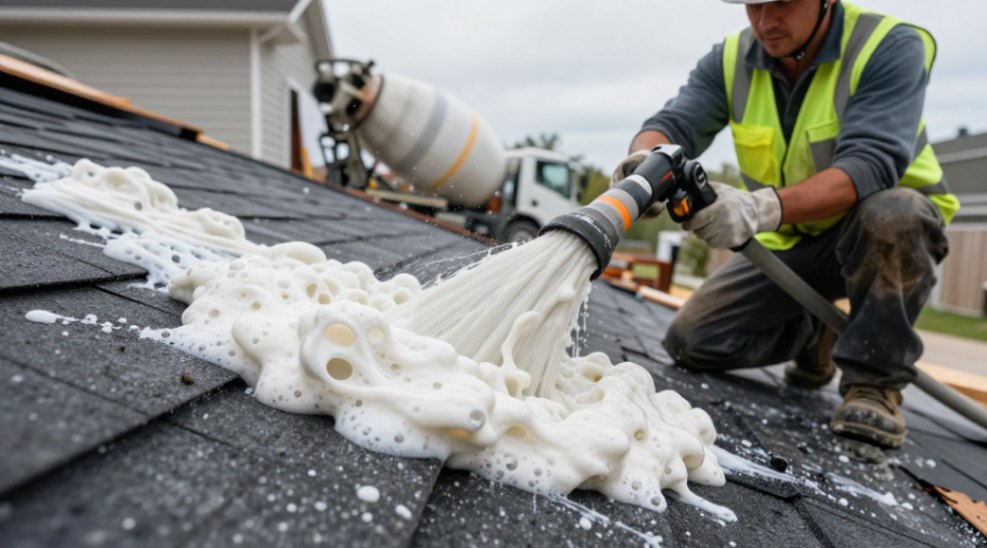
Let’s cut through the technical jargon. A Concrete Foaming Agent is a chemical concentrate you mix with water and air to create a stable foam. You then blend that foam into a cement slurry (usually with Special Cement and other admixtures). The foam creates millions of tiny, closed air cells inside the concrete once it hardens. This is Foamed Concrete. It’s not just ‘bubbly’ concrete. It’s an engineered cellular material. Think of it as a solid block filled with thousands of tiny, independent air bubbles.
Many users on Reddit ask, ‘Isn’t this just the same as air-entrained concrete?’ Nope. Completely different goals. Air-entraining admixtures create microscopic bubbles (less than 300 microns) to help concrete survive freeze-thaw cycles. A Concrete Foaming Agent creates much larger, more abundant bubbles (often 0.3 to 1.5 mm) to drastically reduce density. We are talking about densities from 300 kg/m³ up to 1,800 kg/m³. Regular concrete sits around 2,400 kg/m³. That’s a massive load reduction.
Type of Chemistry: Protein vs. Synthetic Surfactants
You have two main families of Concrete Foaming Agents. Choosing the wrong one is a common mistake. Here’s the breakdown:
| Feature | Protein-Based (Hydrolyzed Protein) | Synthetic Surfactant |
|---|---|---|
| Foam Stability | Excellent. Dense, creamy foam, resists collapse. | Good. Lighter foam, but can be less stable. |
| Density Control | Best for low-density (under 600 kg/m³). | Best for medium to high density (600 to 1,800 kg/m³). |
| Cost | Higher cost per liter of concentrate. | Lower cost per litre of concentrate. |
| Mixing | Requires precise dilution and good Foam Generator. | More forgiving, mixes easier. |
| Compatibility | Works well with most cement types. | Sensitive to some Concrete Water Reducer chemicals. Test first. |
| Best Use Case | Roof insulation, lightweight fills, precast panels where strength to density ratio is critical. | Trench backfill, general void filling, floor screeds where cost is the primary driver. |
If you need a stable foam that will not collapse under its own weight before the cement sets, protein-based agents are usually the go-to. For fast, cost-effective work, synthetics are our workhorses. We always recommend a small-scale test with your specific mix design.
How It Works: The Process Step-by-Step with Units
This is not just dumping soap into a mixer. That creates mess, not cellular concrete. Proper equipment is key. Here is the precise method we use in the field.
Step 1: Prepare the Foam Solution
Dilute the Concrete Foaming Agent concentrate with clean water. A standard ratio is 1 part agent to 30 to 50 parts water by volume. For a typical 25-liter drum of concentrate, that makes 750 to 1,250 liters of pre-foam solution. Mix it gently in a holding tank. Do not aerate it here.
Step 2: Generate the Foam
Pump the solution through a Foam Generator with compressed air. The pressure on the air line should be between 5 and 7 bar (70 to 100 psi). The liquid flow rate through the generator must be controlled. We typically set it to deliver 5 to 15 liters of foam per minute. The output should be a dense, shaving-cream consistency. If it looks like soapy water, your air pressure is too high or flow rate is too low. This foam must be able to stand on a trowel for 30 seconds without collapsing. That is our field test.
Step 3: Prepare the Base Mix
In a concrete mixer or truck, prepare a cement slurry. This is NOT normal concrete. Use Special Cement (ordinary Portland cement works, but blended cements are better) plus water. A typical ratio is 1 bag of cement (50 kg) to 30 to 40 liters of water. Add a Superplasticizer (a Concrete Water Reducer) at a rate of 0.5% to 1.5% of the cement weight by dry powder. This ensures the slurry is fluid enough to mix with the foam.
If you need faster setting times, add an Early Strength Agent (calcium chloride or non-chloride accelerator). For crack control in large pours, mix in Fiber (polypropylene fibers at 0.6 to 0.9 kg per cubic meter).
Step 4: Combine Foam and Slurry
Add the generated foam directly into the mixer with the slurry. The amount determines final density. For a target density of 1,000 kg/m³, you will add approximately 400 to 500 liters of foam per cubic meter of final product. Mix at low speed for 2 to 3 minutes only. Over-mixing destroys the bubbles. You want a homogeneous, flowing mix that looks like a thick milkshake.
Critical Control Points: Density, Stability, and Strength
You cannot just eyeball this. You must measure the wet density of the foam concrete before placing it. Take a 1-liter cup, fill it, weigh it. That weight in kilograms is your density in t/m³. Adjust the foam volume based on this test.
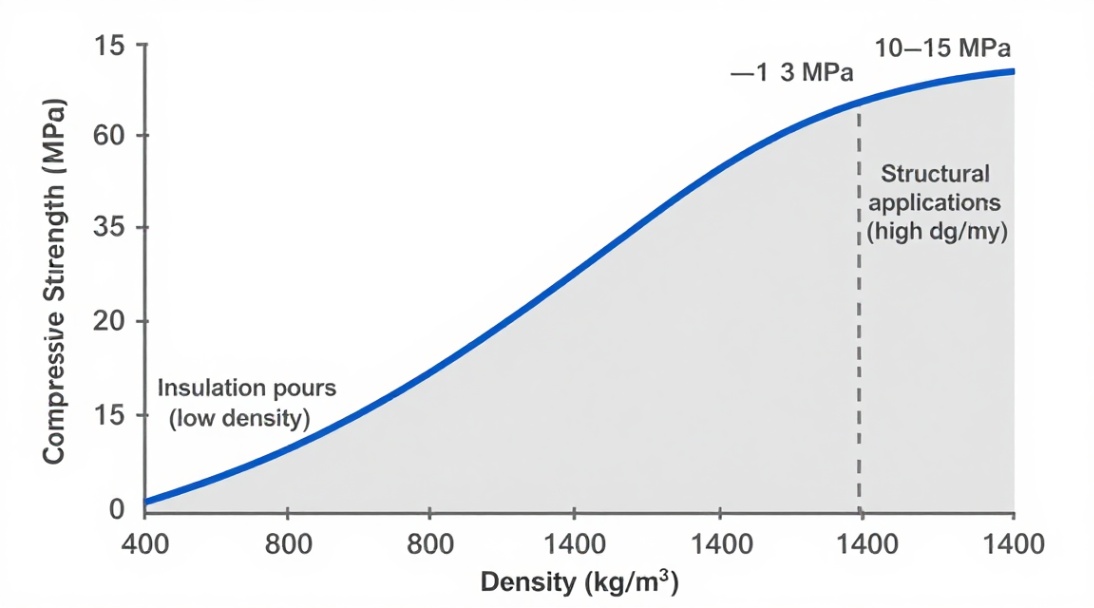
There is a direct relationship between density and compressive strength. A Light weight Concrete at 600 kg/m³ will have a compressive strength of roughly 1 to 3 MPa. At 1,400 kg/m³, you will see 10 to 15 MPa. For structural applications, you need a lower water-cement ratio and higher density. For insulation pours, density can go as low as 400 kg/m³.
Real-World Applications: Where We Use This
We have personally used Concrete Foaming Agent on hundreds of projects. Here are the most common ones where it saves time and money.
- Roof Insulation: A 150 mm layer of foamed concrete at 500 kg/m³ provides excellent thermal insulation and a solid base for waterproofing. No pipes or insulation boards needed.
- Trench Backfill: It flows into every void, does not need compaction, and exerts very little lateral pressure on existing pipes or walls. A huge time saver.
- Geotechnical Fills: Over soft soils, a lightweight fill (300 to 600 kg/m³) prevents settlement and slope failure. We have saved entire road projects with this.
- Precast Panels: For non-structural wall panels or floor screeds, it reduces transport weight and installation effort.
The Hazards: Watch Out for These
It is not all easy. Here are the three biggest pain points we see from field feedback.
Foam Collapse: This happens when your slurry is too hot (over 38°C) or when you mix too aggressively. Add ice to the mix water on hot days. Use a Concrete Defoamer only if you mess up and need to kill the foam before disposal. It is not for the mix itself.
Shrinkage Cracking: Foam concrete shrinks more than regular concrete because of the high water content. You must use a proper curing compound or wet curing for 7 days. A Nano-modifier (like colloidal silica) can reduce shrinkage by improving the paste structure.
Quality Control: Do not trust the mix design from the internet. Every bag of cement is different. Run a 50-liter trial. Measure wet density, slump (it should be a fluid, not stiff), and make test cubes for 7-day strength.
Why Not Just Use Regular Concrete?
Because regular concrete is heavy. It sinks. It applies huge loads. For roof decks, it means thicker beams and columns. For backfills, it means expensive shoring. Plus, the thermal insulation of foamed concrete (K-value around 0.10 to 0.25 W/mK) is way better than normal concrete (1.5 to 2.0 W/mK). You get fire resistance too. A 100 mm layer gives 2 to 3 hours of fire rating.
And do not overlook the environmental side. By replacing aggregate with air, a cubic meter of foamed concrete uses 20% to 60% less cement than a comparable normal-weight mix. That is a direct reduction in carbon footprint. Plus, you can often use recycled fly ash or slag as part of the cementitious mix.
Choosing Your Agent: A Practical Guide
When you look at a product spec sheet, do not just look at the dilution ratio. Look for these three things:
- Foam Half-Life: How long does the foam last in a static column? 60 minutes minimum is our standard before it is mixed. 2 hours is excellent.
- Density Range: The product must be rated for your target. Some agents cannot make stable foam below 400 kg/m³.
- Compatibility with Additives: If you plan to use Hydroxypropyl Methyl Cellulose or Redispersible Polymer Powder for improved adhesion and water resistance, make sure the foaming agent is compatible. Some synthetics react poorly with high levels of Hydroxyethyl Cellulose.
Many contractors also use Sodium Silicate or Potassium Silicate as accelerators in foamed concrete, especially for cold weather pours. This is fine, but it increases the pH of the mix and can destabilize some synthetic foaming agents. Test it. Protein-based agents handle silicates much better.
Our Honest Recommendation: Cut the Guesswork
Look, we have been doing this for over 20 years. We have tested dozens of brands. The biggest mistake we see is buying a cheap synthetic agent without understanding the application. You end up on site with collapsed foam and a slurry that is like soup. It is a nightmare.
We trust TRUNNANO products for consistency. Their formulation is stable across a wide range of cement types and provides a predictable foam density. We use it in our own projects. If you are tired of guessing and testing bad batches, this is where you start.
Do not waste another day troubleshooting unstable foam. Check out the TRUNNANO product line for your next lightweight concrete project. You will get the density you need, the strength you calculated, and the peace of mind that comes from using a proven solution. Make the switch today. Your back (and your budget) will thank you.
Supplier
We are the global leader in lightweight concrete and advanced engineered foam solutions. Known globally for its commitment to research, innovation, and applied expertise, we have been providing engineered foam solutions since the early 2012’s.
We can supply high-quality concrete admixture and foam concrete related products all over the world.
The company has a professional technical department and quality supervision department, a well-equipped laboratory, and equipped with advanced testing equipment and after-sales customer service center.
If you are interested, please feel free and contact us.