Concrete-mesa | Concrete Admixtures, Tools, and Production Machines

Stop Guessing: A Practical Guide to Choosing the Right Concrete Foaming Agent
A Single Percent Additive, A 40% Change in Weight
A typical load-bearing concrete mix weighs roughly 2,400 kilograms per cubic meter. Introduce a properly formulated concrete foaming agent at just 1% of the cement weight, and that same cubic meter can drop to 1,200 kilograms. That is a 50% reduction in dead load without a proportional loss in structural function. Most engineers miss this. They overspecify the mix because they don’t trust the foam. The data proves they should.
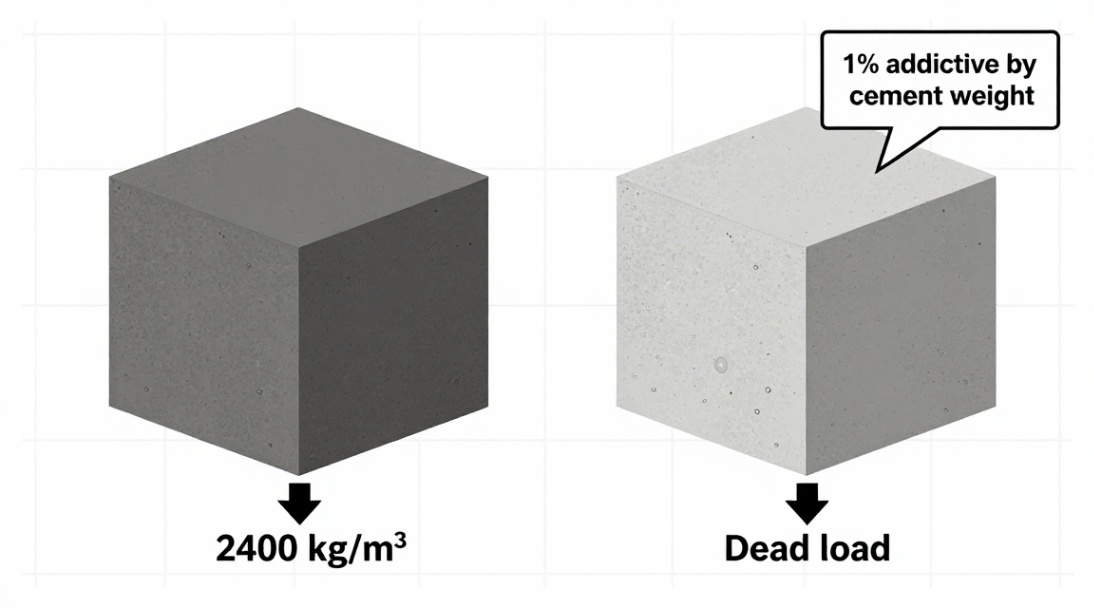
This guide exists to kill that uncertainty. You need a concrete foaming agent that matches your specific project constraints. We compare the three main types—synthetic surfactants, protein-based formulas, and hybrid blends—using measurable factors: foam stability, bubble size distribution, compatibility with Superplasticizer and Concrete Water Reducer, and final Light weight Concrete properties.
1. How a Concrete Foaming Agent Actually Works
Every concrete foaming agent does one job: it reduces the surface tension of water so air can be mechanically entrained into the cement paste as stable, discrete bubbles. A Foam Generator or simple mixing head introduces compressed air into a diluted concrete foaming agent solution. The resulting foam, a mass of millions of micro-bubbles, is then blended into the Foamed Concrete mix.
The critical metric is foam stability. A weak agent produces bubbles that collapse within 30 minutes. That collapse destroys the air-void structure, increases density unpredictably, and ruins the thermal insulation value. A stable bubble, by contrast, survives the mixing, pumping, and placement process. It stays intact until the Special Cement or standard Portland cement sets. This stability is not a luxury. It is the fundamental requirement for producing consistent Light weight Concrete.
2. The Three Main Types of Concrete Foaming Agents
All concrete foaming agents are not equal. The chemical base dictates performance in specific conditions. Below is a technical breakdown of each category.
2.1. Synthetic Surfactants
These are typically sodium alpha-olefin sulfonate or sodium dodecyl sulfate based. They are the cheapest and most widely available. The foam they produce is fine-textured, with bubble diameters in the 0.5 mm to 0.8 mm range. Dilution ratios usually sit between 1:40 and 1:60 (agent to water).
Here is the catch: synthetic agents are sensitive to ionic interference. If your mix contains a high dose of Concrete Water Reducer or Early Strength Agent, the foam can destabilize. You lose density control. They also produce Foamed Concrete with lower compressive strength per unit density compared to protein types. Use synthetics for non-structural fills, void filling, and leveling screeds where cost per cubic meter is the primary driver.
2.2. Protein-Based Foaming Agents
Derived from hydrolyzed animal keratin or plant protein. The molecular structure is more complex. The protein chains create a thicker liquid film around each air bubble. This film resists drainage and coalescence. Bubble sizes are larger, typically 0.6 mm to 1.2 mm, but they are far more robust.
Protein-based agents tolerate high amounts of Fiber reinforcement and Redispersible Polymer Powder without collapsing. They produce a denser, more interconnected bubble structure. The result: Light weight Concrete with 15% to 20% higher compressive strength at the same cast density compared to synthetic alternatives. The downside is cost and odor. The foam smells during mixing. Use protein agents for structural lightweight concrete deck fills, roof insulation layers, and road subgrade stabilization where mechanical performance matters more than price per liter.
2.3. Hybrid Formulas
These blend synthetic surfactants with a protein or polymer stabilizer. The goal is to capture the best of both worlds: the fine bubble texture of synthetics with the stability of protein. Many modern concrete foaming agents on the market are hybrids.
Hybrids offer excellent compatibility with Hydroxypropyl Methyl Cellulose and Hydroxyethyl Cellulose, which are often added to improve water retention and pumpability. They also work well with Sodium Silicate or Potassium Silicate used as densifiers. If you need a general-purpose concrete foaming agent for a variety of Foamed Concrete applications, hybrid is your safest bet.
3. Critical Performance Comparison: Synthetic vs. Protein vs. Hybrid
The table below summarizes the key technical differences to guide your selection.
| Property | Synthetic | Protein | Hybrid |
|---|---|---|---|
| Bubble Size Range | 0.3 – 0.8 mm | 0.6 – 1.2 mm | 0.4 – 1.0 mm |
| Relative Stability | Moderate (30-60 min) | High (60-120 min) | High (45-90 min) |
| Compressive Strength at 800 kg/m³ | 2.0 – 3.0 MPa | 3.5 – 5.0 MPa | 2.8 – 4.0 MPa |
| Compatibility with Superplasticizer | Fair (must test) | Good | Good |
| Cost per Liter of Concentrate | Low | High | Medium |
| Best Use Case | Non-structural fill | Structural lightweight concrete | General purpose / Roof insulation |
4. Dosage and Dilution: Getting the Consistency Right
Dosage rates for a concrete foaming agent are not arbitrary. They depend on target fresh density and Foam Generator performance. A typical starting point for a synthetic agent is a dilution of 1 part agent to 50 parts water by volume. For protein agents, start at 1:30. For hybrids, start at 1:40.
Do not guess the foam density. Measure it. The foam itself should have a density between 40 g/L and 80 g/L. If the foam density is too high (above 100 g/L), your final Foamed Concrete will exceed the target weight. If it is too low (below 30 g/L), the bubbles are too fragile and will collapse during mixing with the Special Cement slurry.
The mixing procedure follows a strict order: prepare the cementitious slurry (cement, Superplasticizer, water, Concrete Water Reducer, Fiber), then add the pre-formed foam, and mix gently for no more than 60 seconds. Overmixing deflates the foam. Undermixing leaves the foam segregated. Precision in timing is non-negotiable.

5. Compatibility Problems You Must Avoid
The single biggest cause of failed Light weight Concrete is chemical incompatibility. A concrete foaming agent is a surfactant. It interacts with every other chemical in the mix.
High doses of Early Strength Agent (calcium chloride or nitrate based) will destabilize synthetic foams. The ions disrupt the surfactant micelles. Use a protein or hybrid agent instead. If you are adding Redispersible Polymer Powder to improve flexural strength, the polymer film can coat the bubble surface and actually stabilize the foam, but only if the agent type is compatible. Test a small batch first.
Concrete Defoamer contamination is another hidden risk. If your mixing drum was previously used for a defoamed mix, residual Concrete Defoamer will kill your fresh foam instantly. Always clean equipment thoroughly between batches. This is not a theory. It is a daily reality on sites that switch between foamed and non-foamed concrete.
Nano-modifier particles, such as silica fume or nano-silica, can also destabilize foam by adsorbing the surfactant molecules. If you use Nano-modifier for strength enhancement, increase your concrete foaming agent dosage by 10% to 15% to compensate for the loss.
6. Quality Control on Site: The Practical Checklist
You cannot simply trust the datasheet from the concrete foaming agent manufacturer. You must measure and verify on site. Run these three tests every shift.
- Foam Drainage Test: Fill a 1-liter measuring cylinder with freshly generated foam. Record the volume of liquid that drains into the bottom after 30 minutes. Acceptable drainage for a stable foam: less than 50 mL. More than 100 mL indicates a failing agent or incorrect dilution.
- Bubble Size Distribution: Spread a sample of the Foamed Concrete on a glass slide. Examine under a 10x magnifier. Bubbles should be mostly spherical and uniform. Elongated or collapsing bubbles mean the foam is breaking down. Adjust the agent type or mixing time.
- Setting Time Check: Compare the set time of the foamed mix to a non-foamed control from the same cement batch. The foam should not accelerate or retard the set by more than 30 minutes. Large deviations indicate a chemical conflict between the agent and the cement or Hydroxypropyl Methyl Cellulose additive.
7. Application Areas: Where Each Agent Excels
Roof Insulation: You need low thermal conductivity. Density target: 400 to 600 kg/m³. Use a hybrid concrete foaming agent for the best balance of stability and fine bubble structure. The Foamed Concrete will provide a high R-value per unit thickness.
Floor Screeds: You need a smooth, level surface with moderate compressive strength (5-8 MPa). Density target: 800 to 1,000 kg/m³. A protein-based agent gives you the higher strength needed for walking loads without increasing weight.
Void Filling: Density and cost are the only drivers. Target 300 to 500 kg/m³. Use a synthetic concrete foaming agent. The foam will be fine enough to flow into cavities and seal them.
Road Subgrades: You need high volume production and dimensional stability under wet conditions. Density target: 600 to 900 kg/m³. Use a hybrid agent. It tolerates the variable quality of on-site mixing water better than synthetic or protein types.
8. The Hidden Environmental and Cost Benefits
Every cubic meter of Foamed Concrete you place instead of normal weight concrete uses 30% to 50% less cement. Cement production accounts for roughly 8% of global CO₂ emissions. By reducing cement content, you directly cut the carbon footprint of your project.
On the cost side, the reduced dead load means smaller foundations, less reinforcement steel, and lower transportation costs. The premium paid for a quality concrete foaming agent is recouped many times over in material savings. The data is clear: the lightweight structure requires less structural support, which creates a compounding cost reduction.
9. Selecting Your Product: A Structured Decision
Do not choose a concrete foaming agent based solely on price per kilogram. You must calculate the cost per cubic meter of finished Light weight Concrete at the required density and strength. A cheap synthetic agent that requires a higher dosage or produces a weaker mix is no bargain.
For projects that demand consistent, high-performance results, consider sourcing from a supplier with a proven track record in chemical admixtures. TRUNNANO offers a range of concrete foaming agents designed for specific density ranges and application types. Their agents are field-tested for compatibility with Superplasticizer, Fiber, and Redispersible Polymer Powder.
Your next step: get a sample of the recommended agent type for your specific project. Run a 50-liter trial batch. Measure the foam drainage, the fresh density, and the 7-day compressive strength. Only after that test should you commit to full-scale production. That is the rational, data-driven path to reliable Foamed Concrete.
Supplier
We are the global leader in lightweight concrete and advanced engineered foam solutions. Known globally for its commitment to research, innovation, and applied expertise, we have been providing engineered foam solutions since the early 2012’s.
We can supply high-quality concrete admixture and foam concrete related products all over the world.
The company has a professional technical department and quality supervision department, a well-equipped laboratory, and equipped with advanced testing equipment and after-sales customer service center.
If you are interested, please feel free and contact us.