Concrete-mesa | Concrete Admixtures, Tools, and Production Machines

Non-Silicone Defoamer for Self-Leveling Compounds: Don’t Let These Foam Mistakes Sink Your Floor
A Tale of Two Floors: The Cost of Getting Foam Wrong
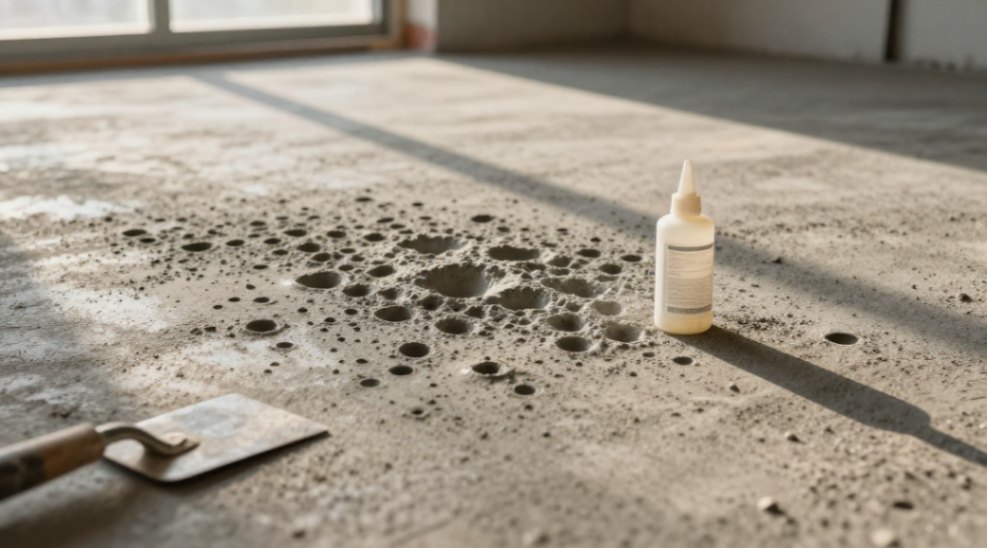
I watched a crew pour a beautiful, fluid self-leveling compound. It looked perfect. Then, it set. The surface resembled the moon: pocked with pinholes, marred by fish-eyes. The blame game started—was it the mix, the substrate, the weather? The real culprit was invisible during the pour: trapped air. And the defoamer they used to control it made everything worse. That job cost $15,000 to tear out and redo. It’s a story I’ve seen variations of for twenty years. Let’s make sure it’s not your story.
Warning: Why Silicone Defoamers Are a Silent Threat
Many contractors reach for a generic silicone defoamer. It’s cheap. It’s common. It’s a mistake waiting to happen. Silicone oils create a hidden, long-term risk in your floor.
The Core Problem: Surface Tension Sabotage
Silicone is too efficient. It spreads rapidly, creating a persistent, ultra-low surface tension film. This film doesn’t just vanish. It lingers on the surface of the cured compound. What happens next? Adhesive failure. Your tile, vinyl, or epoxy coating bonds to this weak silicone layer, not to the cement itself. The bond strength plummets. We see delamination failures months later, with no clear cause. The fix is catastrophic: full removal.
Non-silicone defoamers for self-leveling compounds work differently. They use mineral oils, polyethers, or specialized polymers. Their mechanism is controlled incompatibility and rapid bubble film rupture. They break the foam during mixing and pouring, then integrate or dissipate. They leave no compromising film behind.
Your Burning Questions, Answered
“Will a non-silicone defoamer hurt my flow or leveling?”
No. A good one won’t. In fact, it preserves them. Silicone can over-defoam, killing the lubricity you need for flow. Modern non-silicone defoamers are engineered for minimal impact on rheology. They target air, not workability. We test this rigorously. The right product disappears into the mix, letting the superplasticizer and other additives do their job.
“What about pinholes and craters?”
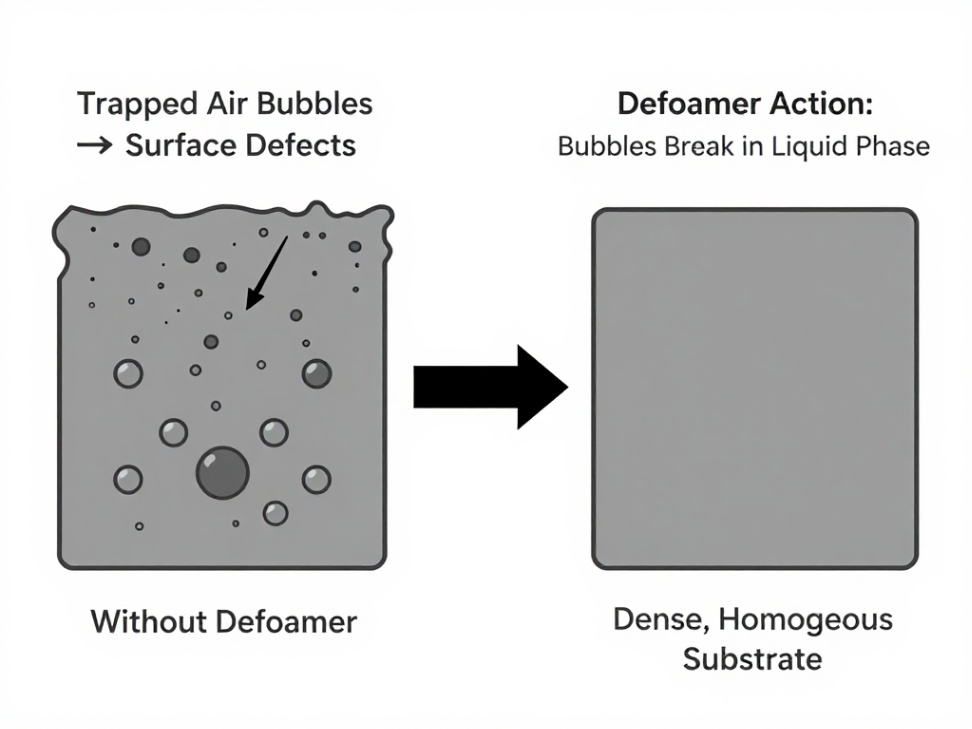
This is their primary battleground. Foam creates pinholes. Collapsing foam creates craters and fish-eyes. A non-silicone defoamer eliminates these defects at the source by breaking bubbles quickly and completely during the critical liquid phase. The result is a dense, homogenous surface ready for a finish.
“How do I choose the right one?”
Don’t just buy the cheapest gallon. Look at compatibility with your specific system. Is your compound polymer-modified? Many are. Your defoamer must play nice with those latex or redispersible polymer powders. Ask for technical data. Perform a simple jar test: mix your compound with the candidate defoamer and a competitor. Let it sit. Look for separation. The more stable mix wins. Consider long-term storage stability too.
The Contractor’s Checklist: What to Do Instead
Stop the guesswork. Follow this list.
- Test First. Never use a new defoamer on a major job. Do a test pour in a corner or on a slab.
- Check Compatibility. Verify with your compound supplier. Many now recommend specific non-silicone types.
- Dose Precisely. More is not better. Overdosing any defoamer can cause surface imperfections. Follow the manufacturer’s guidelines.
- Mix Thoroughly. Incorporate the defoamer fully during the wet mixing stage. Don’t add it last.
The Bottom Line: Value Over Cost
Yes, a quality non-silicone defoamer for self-leveling compounds often costs more per gallon than a silicone one. This is not an expense. It’s insurance. Weigh the cost of the additive against the cost of a callback, a repair, or a total re-pour. The math is simple. You’re paying for preserved adhesion, a perfect surface, and sleep at night.
The industry is moving this way. Formulators are shifting to polymer-based, low-VOC, and eco-friendlier options to meet modern demands. Using an outdated silicone defoamer now creates future risk.
Your Next Step
Don’t be the next cautionary tale. Audit your current process. Look at the defoamer in your drum or on your shelf. If it’s a silicone, you have a decision to make. For your next project, source a compatible non-silicone defoamer. Test it. Compare the finished surface and, crucially, the bond strength. The difference isn’t always just visible. It’s fundamental to the longevity of your floor. That’s the real level.
Supplier
We are the global leader in lightweight concrete and advanced engineered foam solutions. Known globally for its commitment to research, innovation, and applied expertise, we have been providing engineered foam solutions since the early 2012’s.
We can supply high-quality concrete admixture and foam concrete related products all over the world.
The company has a professional technical department and quality supervision department, a well-equipped laboratory, and equipped with advanced testing equipment and after-sales customer service center.
If you are interested, please feel free and contact us.