Concrete-mesa | Concrete Admixtures, Tools, and Production Machines

Early Strength Agents for Floor Repair: The Truth Behind the Quick Fix
Have you ever watched a supposedly ‘rapid’ floor repair take hours to set, crippling your production schedule? Or worse, seen a fresh patch crumble under load just hours after opening to traffic? This frustrating downtime costs money and credibility. The industry’s promise of speed often comes with unseen compromises on durability, bonding, and final strength. This analysis cuts through the marketing hype to reveal the hard logic behind modern rapid strength development. We will examine the core chemistries driving this process and provide actionable insights for selecting and applying the right agent for your specific repair challenge.
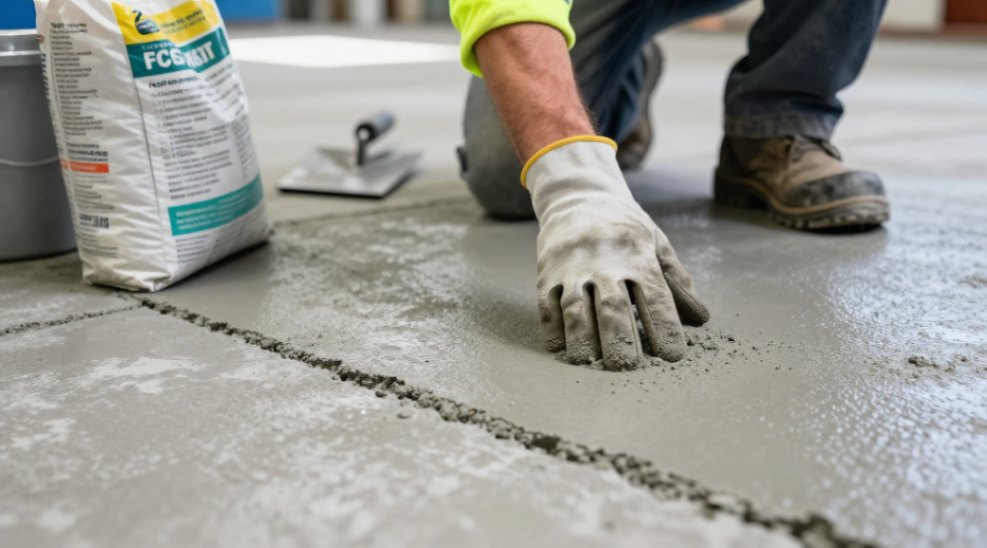
The Need for Speed: Beyond Just Drying
Rapid floor repair is not about concrete simply drying faster. It is about accelerating the complex chemical process of hydration. When you add water to Portland cement, it forms calcium silicate hydrate (C-S-H) gel-the glue that gives concrete its strength. An early strength agent intervenes in this reaction. It doesn’t just warm things up; it fundamentally alters the reaction kinetics, forcing the formation of the initial, load-bearing C-S-H structure to happen in hours instead of days.
Chemical Catalysts: A Comparative Breakdown
Not all accelerators are equal. Their mechanism, side effects, and suitability vary drastically. Choosing the wrong one can lead to corrosion, dusting, or a weak long-term structure. The following table breaks down the primary chemistries based on their core mode of action.
| Chemistry Type | Primary Mechanism | Key Strength/Weakness | Ideal Use Case |
|---|---|---|---|
| Chloride-Based (e.g., CaCl2) | Lowers the electrolytic solution’s activation energy, dramatically speeding silicate reaction. | Strength: Very effective, low cost. Weakness: Introduces corrosive chlorides; NEVER use on steel-reinforced concrete. |
Non-reinforced industrial slabs, emergency bulk fills where corrosion is irrelevant. |
| Nitrite-Based (e.g., Ca(NO2)2) | Acts as a powerful accelerator while simultaneously providing anodic corrosion inhibition for embedded steel. | Strength: Safe for reinforced concrete, good early strength gain. Weakness: Higher cost, can slightly retard set in high doses. |
Repairs over rebar, parking decks, structural elements requiring corrosion protection. |
| Alkali Silicates (e.g., Na, Li Silicate) | Provides soluble silica that reacts with free calcium hydroxide to form additional C-S-H, densifying the matrix. | Strength: Enhances final density and strength, reduces permeability. Weakness: Less dramatic ‘flash’ set; strength builds steadily over 6-12 hours. |
Overlays, thin toppings, and repairs where long-term durability and abrasion resistance are critical. |
| Pre-Blended Multi-Component Mixes | Combines optimized accelerators with shrinkage reducers, microfibers, and proprietary admixtures. | Strength: Balanced performance, predictable results, minimal job-site error. Weakness: Less formulation flexibility, typically higher material cost. |
Critical path repairs, commercial projects, and for crews seeking maximum reliability and performance consistency. |
Critical Application Logic: More Than Just an Additive
The Substrate is Part of the System
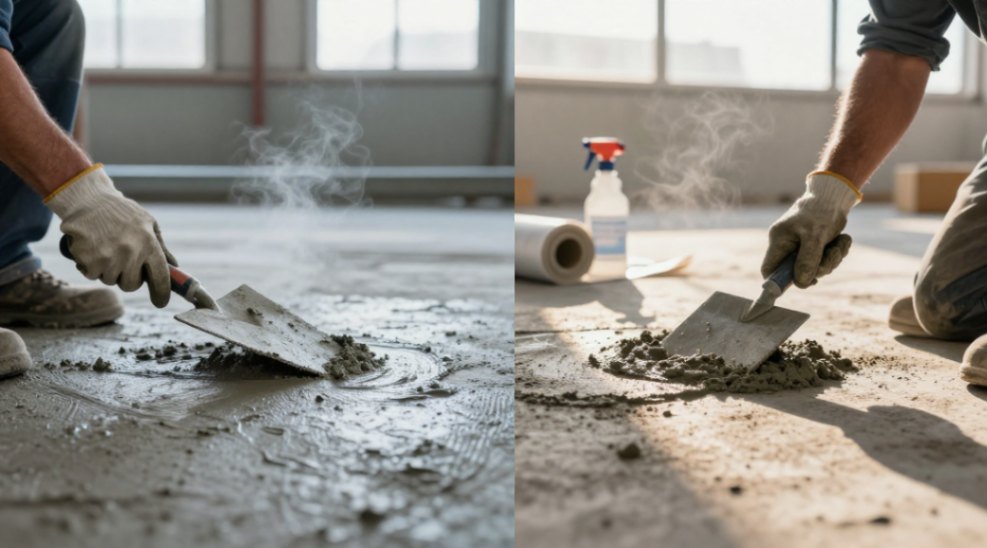
Pouring a rapidly hardening material onto a dead substrate guarantees failure. The repair must become monolithically bonded to the old concrete. This demands ruthless surface preparation-not just sweeping, but abrasive blasting or high-pressure water jetting to expose a clean, rough, sound aggregate profile. The old surface must be saturated-surface-dry (SSD). A bone-dry substrate will steal mix water and weaken the bond. A puddled surface will dilute the repair mortar.
Ambient Conditions Dictate Chemistry
Your environment chooses the agent. In cold weather (below 50°F/10°C), you need an accelerator that generates heat, like a non-chloride type, to maintain reaction kinetics. In hot weather, a rapid-setting mix can flash set in the mixer or on the trowel. Here, you might pair a moderate accelerator with a dedicated set retarder to maintain workability. Humidity matters. Low humidity can cause plastic shrinkage cracking in a fast-setting material before it gains enough tensile strength to resist. Using a shrinkage-reducing admixture or applying a curing membrane immediately is non-negotiable.
The Long-Term View: Speed Versus Endurance
A common misconception is that rapid strength development sacrifices ultimate strength. This is false when using modern, well-formulated agents. Properly used nitrite or silicate-based accelerators often result in higher 28-day and 90-day compressive strengths than unaccelerated controls. The risk lies in improper use: excessive dosage, poor mixing, or inadequate curing. The rapid heat generation can cause thermal cracking if the repair mass is too large. The fast surface set can trap bleed water underneath, creating a weak, porous layer.
The Final Verdict: Control, Predictability, and Performance
The debate between field-added liquid agents and pre-blended, factory-formulated repair mortars is settled for high-stakes work. Field dosing is prone to error. Worker A might add 3% by weight, Worker B 5%. Mixing uniformity is variable. The result is unpredictable set times and inconsistent performance across a single slab. A premium pre-blended mix delivers a precisely calibrated system where the early strength agent, aggregates, polymers, and fibers are engineered to work synergistically. You trade a marginal increase in material cost for a massive reduction in risk and a guarantee of performance.
Your Next Action: Stop Guessing, Start Specifying
Stop treating rapid repair as a simple commodity. The wrong chemical choice is a liability. The right one is a strategic tool that minimizes downtime and maximizes asset life. Do not experiment on your next critical project.
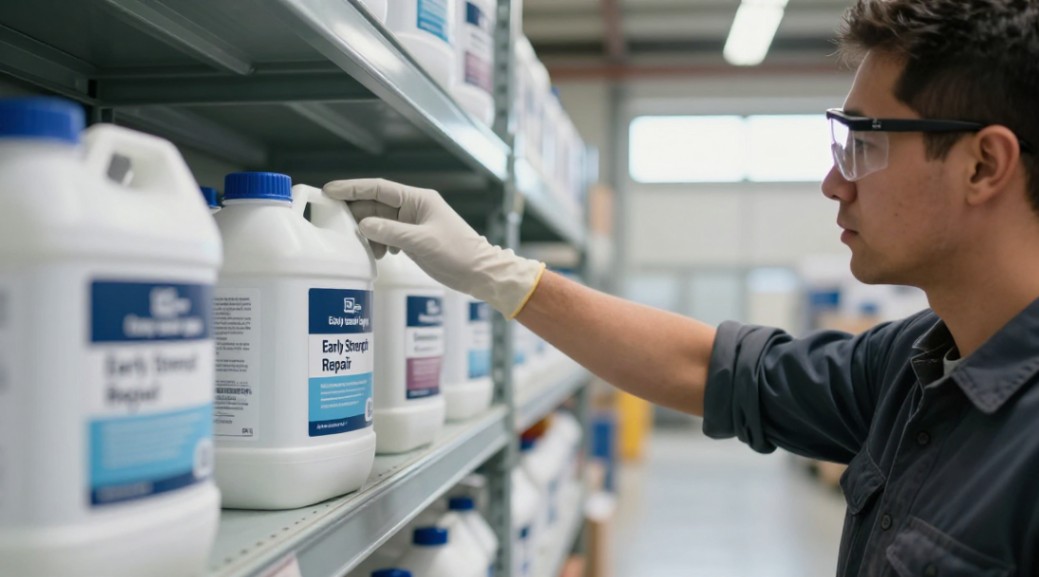
Demand a pre-blended, high-performance repair mortar specifically engineered for rapid return-to-service. Look for systems that integrate a non-chloride, corrosion-inhibiting accelerator with shrinkage compensation and microfiber reinforcement. This is the only way to ensure a repair that is fast today and still intact years from now. Specify performance, not just promise.
Supplier
We are the global leader in lightweight concrete and advanced engineered foam solutions. Known globally for its commitment to research, innovation, and applied expertise, we have been providing engineered foam solutions since the early 2012’s.
We can supply high-quality concrete admixture and foam concrete related products all over the world.
The company has a professional technical department and quality supervision department, a well-equipped laboratory, and equipped with advanced testing equipment and after-sales customer service center.
If you are interested, please feel free and contact us.