Concrete4U | Concrete Admixtures, Tools, and Production Machines

Low Slump Concrete Water Reducer: The Hard Truth About Pouring Rock
Low Slump Concrete Water Reducer FAQ
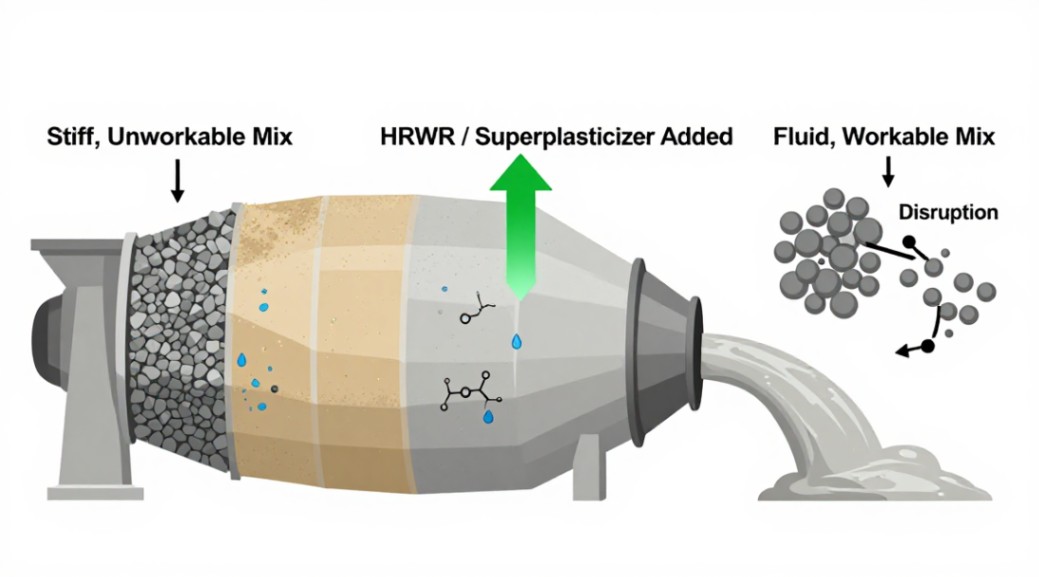
A low slump concrete water reducer is a high-range water reducer (HRWR) or superplasticizer. It transforms stiff, unworkable concrete into a fluid mix without adding water. You use it when you need to place dense, high-strength concrete in complex forms.
Is a low slump concrete water reducer just a glorified water additive?
No. That’s a dangerous misconception. Adding water ruins concrete. A true HRWR is a chemical dispersant. It coats cement particles, separating them and reducing friction. This allows the mix to flow like a higher-slump concrete while maintaining the original low water-cement ratio. The result is higher strength, lower permeability, and better durability.
Why not just use a mid-range water reducer for low slump concrete?
Mid-range reducers lack the muscle. For a true low slump mix-say, a 2-inch slump for a precast panel or a heavily reinforced column-you need the powerful dispersion of a high-range product. Mid-range admixtures improve workability modestly. HRWRs can double or triple slump instantly, enabling precise placement of what is essentially fluid rock.
Do these admixtures weaken the concrete?
Properly dosed, they strengthen it. The core principle is the water-cement ratio. Adding water weakens concrete. Using an HRWR keeps the ratio low. You achieve easier placement without the strength penalty. In fact, by enabling a denser pack of particles with less water, you often get higher ultimate strength and significantly improved surface finish.
What’s the biggest mistake crews make on-site?
Over-dosing and poor timing. More is not better. Exceeding the recommended dosage can cause severe segregation, where coarse aggregate sinks and paste rises. You get a non-uniform mess. Also, adding it too early to a drum mixer can lead to rapid slump loss before placement. The admixture works once. You must time the final dose for immediate discharge and placement.
How do I choose the right product?
Forget brand loyalty. Focus on chemistry and cement compatibility. Modern HRWRs are based on polycarboxylate ether (PCE), polynaphthalene sulfonate (PNS), or polymelamine sulfonate (PMS). PCEs offer the best slump retention and allow for the lowest water content. Test the candidate admixture with your specific cement and aggregates. A lab trial is non-negotiable.
Can I use it with other admixtures?
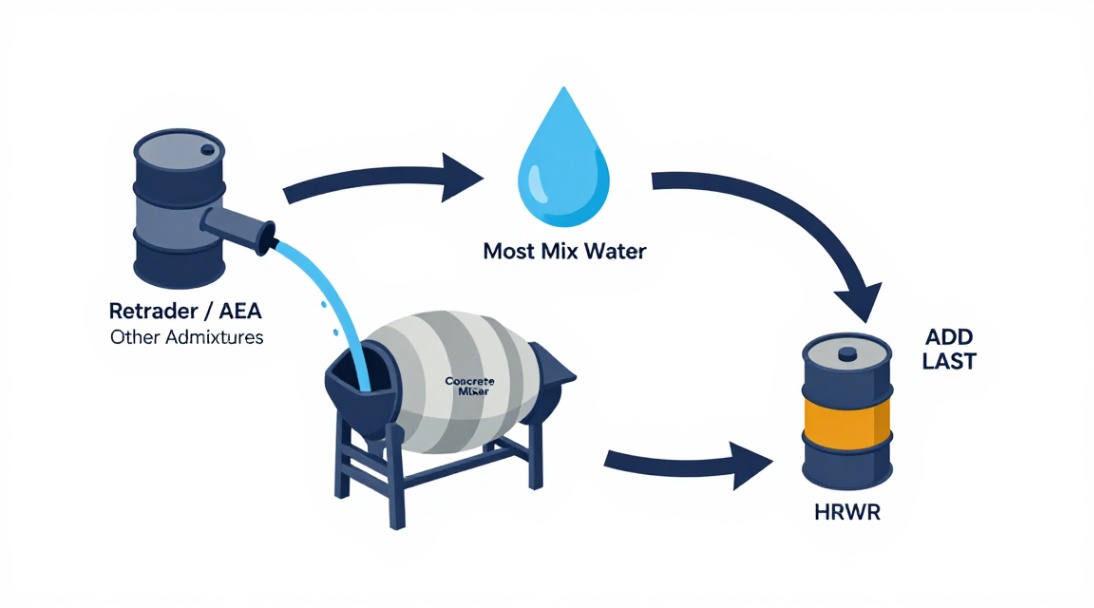
Yes, but never assume compatibility. You often combine HRWRs with retarders for hot weather placement or with air-entraining agents for freeze-thaw resistance. The order of addition is critical. Always add the HRWR last, after the other admixtures and most of the mix water. Premature contact can deactivate key components.
What about rapid slump loss after adding the reducer?
This is slump loss, and it points to the admixture’s limits or the cement chemistry. Some cements are “hot” and react quickly. The solution is often a combination: use a retarding-type HRWR or split the dose, adding half at the plant and half on-site just before placement. This maintains workability through the pour.
The Real-World Application Guide
Understanding the theory is useless without execution. Here is the field protocol.
Dosing is Everything
Follow the manufacturer’s data sheet, but start at 60-75% of the maximum recommended dose. Incrementally adjust based on the concrete’s response. Use a graduated container for measurement. Never “glug” it from the drum. Accuracy determines success or failure.
Mixing Procedure
Load aggregates and cement. Add 75% of the mix water. Mix for 30 seconds. Add the HRWR diluted in the remaining 25% of water. Mix for a minimum of 90 seconds at high speed. This ensures uniform dispersion. Inadequate mixing creates pockets of ultra-fluid concrete next to dry, unmodified mix.
Placement Window
You have 45 to 90 minutes. The clock starts after final mixing. Plan your crew, equipment, and vibration strategy before the truck arrives. Hesitation is the enemy of a good finish. Once the concrete begins to set, adding more HRWR will not re-fluidize it.

Quality Control Checkpoints
- Slump Test at Plant: Verify baseline workability before the truck leaves.
- Slump Test on Site: Confirm the admixture performed after transport.
- Visual Inspection During Pour: Watch for segregation. The mix should be cohesive and homogeneous.
- Temperature Monitoring: High temperature accelerates slump loss and setting.
Low slump concrete with a proper water reducer is not a shortcut. It is a precision tool. It demands respect for chemistry, process, and timing. Master these elements, and you master the art of placing high-performance concrete where ordinary mix would fail.
Supplier
We are the global leader in lightweight concrete and advanced engineered foam solutions. Known globally for its commitment to research, innovation, and applied expertise, we have been providing engineered foam solutions since the early 2012’s.
We can supply high-quality concrete admixture and foam concrete related products all over the world.
The company has a professional technical department and quality supervision department, a well-equipped laboratory, and equipped with advanced testing equipment and after-sales customer service center.
If you are interested, please feel free and contact us.