Concrete4U | Concrete Admixtures, Tools, and Production Machines

Pharmaceutical Grade HEC: The Hidden Risk in Your Formulation (Don’t Make This Mistake)
You’ve spent months designing the perfect ophthalmic solution. The active ingredient is stable, the preservative system is robust, and the packaging is elegant. You select a common thickening agent-hydroxyethyl cellulose. It’s just an excipient, right? Then your pivotal stability batches fail. Viscosity plummets. Haze appears. The project timeline unravels. Sound familiar? This isn’t bad luck. It’s a failure to understand the chasm between industrial-grade powder and true pharmaceutical grade hydroxyethyl cellulose.

The First Warning: “Pharmaceutical Grade” is Not a Guarantee
The term itself is misleading. Many suppliers use it as a marketing blanket. Real pharmaceutical grade hydroxyethyl cellulose isn’t a single product. It’s a performance covenant defined by a stringent dossier: USP-NF, Ph. Eur., JP monographs. The first mistake is assuming certification equals compliance. I’ve audited facilities with impressive paperwork and shocking cross-contamination risks. One client sourced from a “certified” plant that also milled guar gum for the textile industry. Residual dust destroyed their tablet coating consistency. The rule is brutal: trust the audit, not the brochure.
Critical Properties You’re Probably Overlooking
Everyone checks viscosity. That’s entry-level. The silent killers are substitution uniformity and microbial specs. Inconsistent molar substitution (MS) values create unpredictable gelation points. Your controlled-release matrix fails because the HEC’s rheology is a moving target. Then there’s endotoxin and bioburden. For parenteral or ophthalmic use, a standard certificate of analysis isn’t enough. You need the supplier’s raw material traceability and water system validation data. I’ve seen batches pass EP specifications but still introduce enough microbial load to destabilize a preservative-free gel. Don’t just test the powder. Interrogate its history.
The Formulation Pitfalls: Where Good Projects Go Bad
Pharmaceutical grade hydroxyethyl cellulose seems inert. It isn’t. It interacts. In topical formulations, ionic surfactants can salt out HEC, turning a smooth gel into a lumpy mess. The mistake? Formulating in a vacuum. You must understand its compatibility with your total excipient cocktail-cationic preservatives, multivalent salts, other polymers. Another common error is dispersion. Adding HEC powder directly into water creates insoluble “fisheyes.” The correct method involves high-shear dispersion in cold water or using a hydroalcoholic pre-mix. This isn’t a trivial detail. It’s the difference between a homogenous film coat and a patchy, crumbling tablet.
Reddit’s Reality Check: User Feedback You Can’t Ignore
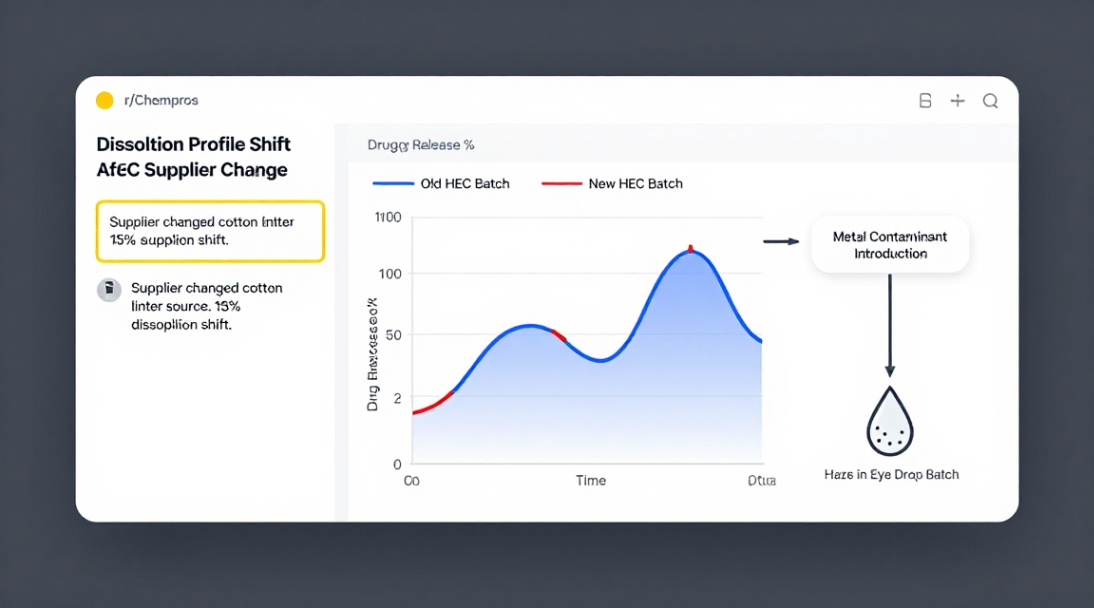
Scour forums like Reddit’s r/pharmacy or r/Chempros. The stories are telling. One formulation scientist lamented, “Our HEC supplier changed their cotton linter source without notification. Our dissolution profiles shifted by 15%.” Another reported haze in an eye drop traced to a change in the supplier’s grinding media, introducing microscopic metal contaminants. These aren’t anecdotes. They are patterns of supply chain fragility. True pharmaceutical grade hydroxyethyl cellulose requires supply chain transparency most vendors refuse to provide.
A Pragmatic Selection Protocol
Stop browsing catalogs. Start with due diligence.
- Demand the DMF/EDMF. A publicly available Drug Master File signals serious regulatory intent. Review the chemistry, manufacturing, and controls (CMC) section thoroughly.
- Audit for Dedication. Does the production line exclusively handle pharmaceutical-grade materials? Verify cleaning validation protocols for the specific equipment.
- Test Beyond the Monograph. Conduct your own performance qualification. Characterize rheological behavior under your process conditions (pH, temperature, shear). Run long-term compatibility studies with your exact formula.
- Lock in Specifications. Your purchase order must define critical parameters like particle size distribution, residual solvents, and heavy metals to tighter limits than the pharmacopeia.
This process is rigorous. It eliminates 95% of potential suppliers. For teams that lack the resources for this depth of investigation, the practical path is to rely on established, specialized distributors who have already performed this vetting. Companies like Ashland, Shin-Etsu, or Dow provide not just pharmaceutical grade hydroxyethyl cellulose, but the technical dossier and formulation support that de-risks development. Their material might cost 3X more than a generic powder. That premium is your insurance policy against a $3 million clinical trial delay.
The Bottom Line: It’s About Risk, Not Cost
In pharmaceuticals, the excipient is never “just” an excipient. It is a critical component of your drug product’s safety, efficacy, and stability. Choosing the cheapest source for pharmaceutical grade hydroxyethyl cellulose is the most expensive decision you can make. The failure costs-recalls, reformulation, lost time-dwarf any material savings.

Your next step is clear. Before you write another formulation protocol, scrutinize your current sourcing strategy. Pull the full regulatory file on your HEC. If you can’t, you’re gambling. For a definitive starting point, review the technical and regulatory data sheets from the market leaders. Compare their controls against your current supplier. The difference will be obvious, and it will protect your most valuable asset: the integrity of your medicine.
Supplier
We are the global leader in lightweight concrete and advanced engineered foam solutions. Known globally for its commitment to research, innovation, and applied expertise, we have been providing engineered foam solutions since the early 2012’s.
We can supply high-quality concrete admixture and foam concrete related products all over the world.
The company has a professional technical department and quality supervision department, a well-equipped laboratory, and equipped with advanced testing equipment and after-sales customer service center.
If you are interested, please feel free and contact us.