Concrete4U | Concrete Admixtures, Tools, and Production Machines

Why Nano-Silica is the Non-Negotiable Modifier for Ultra-High Performance Concrete
The Quiet Revolution in Concrete
The single most impactful upgrade you can make to an ultra-high performance concrete (UHPC) mix is the inclusion of a nano-silica modifier. Forget incremental gains. The integration of nano-silica fundamentally rewrites the material’s rulebook. It shifts UHPC from a strong composite to a predictably dense, exceptionally durable system. While silica fume laid the groundwork, nano-silica completes the picture. The particles are 100 times smaller. This difference in scale unlocks mechanisms that address UHPC’s most persistent challenges. We are witnessing a paradigm shift from brute-force strength to engineered resilience.
Beyond Pozzolanic Activity: The Physics of Density
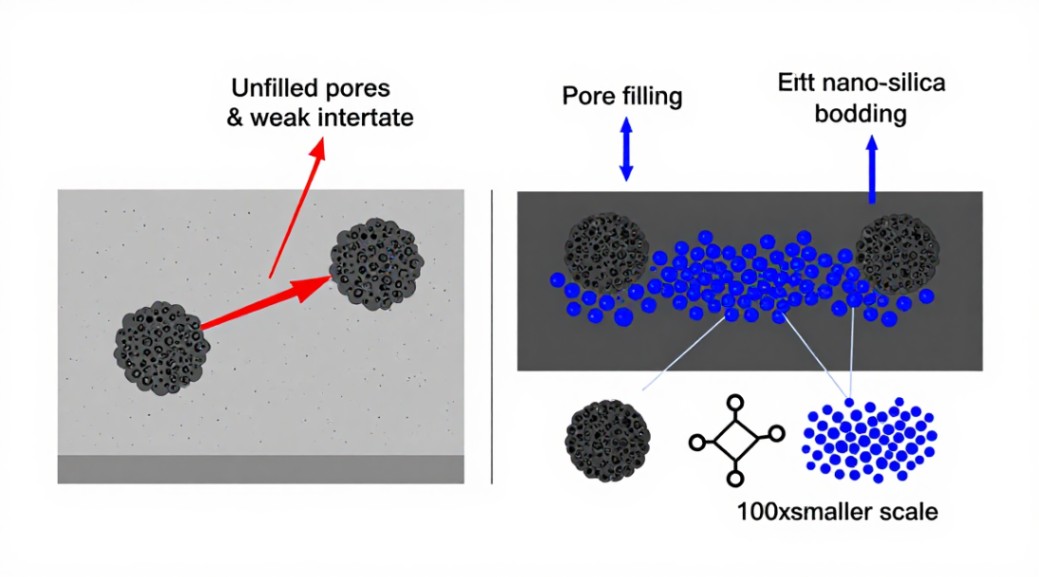
Yes, nano-silica reacts with calcium hydroxide. This pozzolanic activity creates more calcium silicate hydrate (C-S-H) gel. That story is well-known. The real narrative lies in physical particle packing. Nano-silica particles occupy the voids between cement grains and between cement and silica fume particles. They act as ultra-fine filler. Imagine pouring sand into a jar of marbles. The sand fills the gaps. Now imagine pouring fine flour into that jar of sand-filled marbles. That is nano-silica’s role. It creates a skeleton with drastically reduced porosity from the nanometer scale upward. This refined microstructure is the primary source of enhanced strength and impermeability. Chloride ions and water struggle to find a path through this dense matrix. Corrosion of steel fibers slows dramatically. Frost damage resistance improves. You are not just adding a reactant; you are engineering a denser universe within the concrete.
Mastering the Interfacial Transition Zone
Concrete‘s greatest weakness has always been the interfacial transition zone (ITZ). This is the region where aggregate particles meet the cement paste. It is typically porous and weak. In UHPC, with its steel fibers, this zone is critical. A weak ITZ means fibers pull out under stress. Nano-silica particles migrate to these interfaces. They refine the pore structure right at the boundary. The bond between the fiber and the cementitious matrix becomes monolithic. This transforms the failure mode. Instead of fibers slipping out, they are more likely to stretch and snap. You utilize the full tensile strength of your fiber reinforcement. The composite acts as a true unit. This is how nano-silica modifies toughness, not just compressive strength.
The Practical Challenge and Synergistic Solution
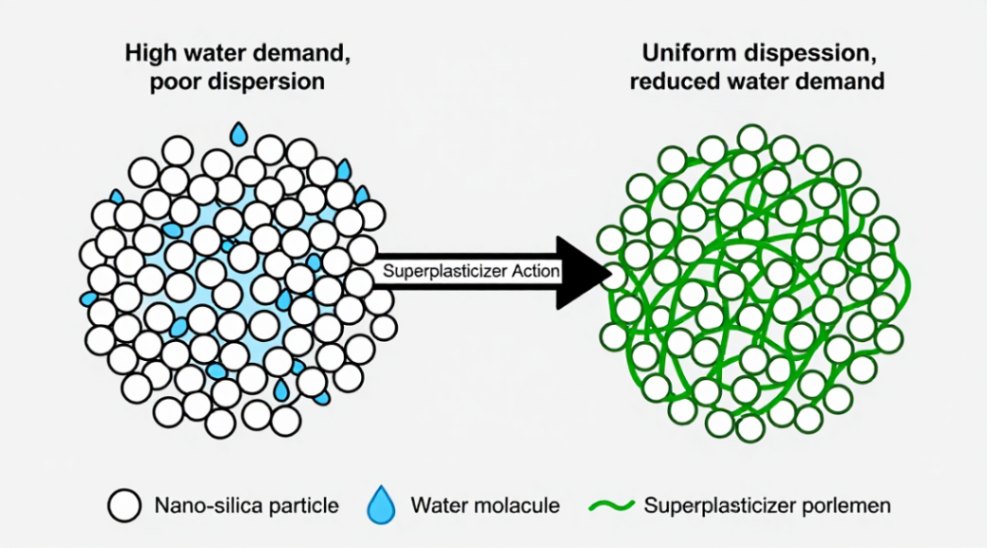
Nano-silica introduces a significant rheological challenge. Its enormous surface area thirsts for water. Without careful management, your fluid UHPC mix can become a stiff paste in minutes. This demands a powerful, compatible superplasticizer. Think of them as a partnered system. The superplasticizer disperses the nano-particles, preventing them from clumping and seizing the mix. This synergy is non-negotiable. Furthermore, nano-silica does not replace silica fume; it complements it. Silica fume provides the primary pozzolanic bulk. Nano-silica provides the final, ultra-fine packing and ITZ refinement. Used together, they create a granular continuum that leaves minimal space for weakness. Dosage is key. Typical effective ranges are between 1% and 3% by weight of cementitious material. Exceeding this often yields diminishing returns and exacerbates workability issues. Start low. Test rigorously.
The Long-Term Economic Logic
Viewing nano-silica solely as a cost adder misses the point. You must evaluate lifecycle cost. A structure built with nano-silica-modified UHPC will likely require less maintenance over 50 years. The reduced permeability means less degradation from salts, chemicals, and water ingress. This extends service life significantly. For critical infrastructure-bridges in harsh environments, marine structures, high-rise facades-this upfront investment in material science pays perpetual dividends. It also allows for more slender, architecturally expressive designs with confidence. The material enables the vision. Sustainability benefits follow. Longer service life means less frequent reconstruction and lower embodied carbon over time. You build once, with intention.
A New Standard of Performance
The conversation around UHPC is evolving. It is no longer just about achieving 150 MPa compressive strength. It is about guaranteeing performance in the real world. Nano-silica provides that guarantee. It offers control over the nano-scale architecture of concrete. This control translates into macro-scale reliability. For engineers and specifiers, it moves UHPC from a specialty product to a dependable solution for the most demanding applications. The data from advanced labs and forward-thinking field projects consistently tells the same story: density equals durability. Nano-silica is the most direct tool we have to achieve that density. Ignoring it means accepting unnecessary risk in your material’s future. The modern standard for ultra-high performance now includes this silent, powerful modifier.
Supplier
We are the global leader in lightweight concrete and advanced engineered foam solutions. Known globally for its commitment to research, innovation, and applied expertise, we have been providing engineered foam solutions since the early 2012’s.
We can supply high-quality concrete admixture and foam concrete related products all over the world.
The company has a professional technical department and quality supervision department, a well-equipped laboratory, and equipped with advanced testing equipment and after-sales customer service center.
If you are interested, please feel free and contact us.