Concrete-mesa | Concrete Admixtures, Tools, and Production Machines

Mastering Foaming Agents for Foamed Concrete: A Practical Guide
What is a Foaming Agent for Foamed Concrete?
A foaming agent for foamed concrete mixture is a concentrated surfactant solution. Its primary function is to generate a mass of stable, microscopic air bubbles. You introduce these bubbles into a cementitious slurry. This process creates a controlled cellular structure, replacing solid material with air voids. The result is lightweight, low-density concrete with unique properties.

How to Choose and Use a Foaming Agent: A Step-by-Step Guide
Step 1: Select the Correct Agent Type
Your first decision is between synthetic and protein-based agents. Synthetic foaming agents offer high stability and consistent bubble size in diverse water conditions. They are cost-effective for general construction. Protein-based agents, often derived from hydrolyzed proteins, produce exceptionally strong, resilient foam. This foam withstands the hydraulic pressure of the cement paste better. Choose protein-based for high-strength applications or when using challenging admixtures.
Step 2: Generate the Pre-foam
You must generate foam before adding it to the mix. Two main methods exist: wet and dry foam production. Wet foam uses a standard foam generator that mixes the foaming agent solution with air under pressure. It creates foam with a higher water content and larger bubbles. Dry foam systems use a more precise generator to produce stiff, low-moisture foam with very fine, uniform bubbles. For most structural or insulating applications, dry foam delivers superior stability and a more consistent final density.
- Dilute the concentrated foaming agent with clean, potable water. Impurities can destabilize the foam.
- Set the generator’s air pressure and solution flow rate according to the manufacturer’s specifications. This controls the foam density.
- Produce foam until it has a stiff, shaving-cream-like consistency. The foam must not collapse or drain liquid.
Step 3: Mix the Foamed Concrete
This is the critical phase. You must integrate the stable pre-foam into the base slurry without destroying the bubbles.
- First, prepare your base mix of cement, water, and any supplementary materials like fly ash or sand. Ensure it has a fluid, uniform consistency.
- Start the mixer. Slowly add the pre-formed foam into the slurry stream. Never dump large volumes of foam onto stagnant mix.
- Mix only long enough to achieve a homogeneous, fluid consistency. Overmixing will shear and collapse the air bubbles, increasing density.
Step 4: Control Dosage and Consistency
The dosage of foam dictates the final density of the concrete. A higher foam volume lowers density. You must maintain rigorous consistency. Measure the foam by volume or by the resulting wet density of the mixture. Regularly check the density of the freshly mixed material. Adjust the foam feed rate immediately if the density drifts from your target. Consistency in batching is non-negotiable for uniform thermal and structural performance.
Key Questions Answered (FAQ)
What does a foaming agent actually do?
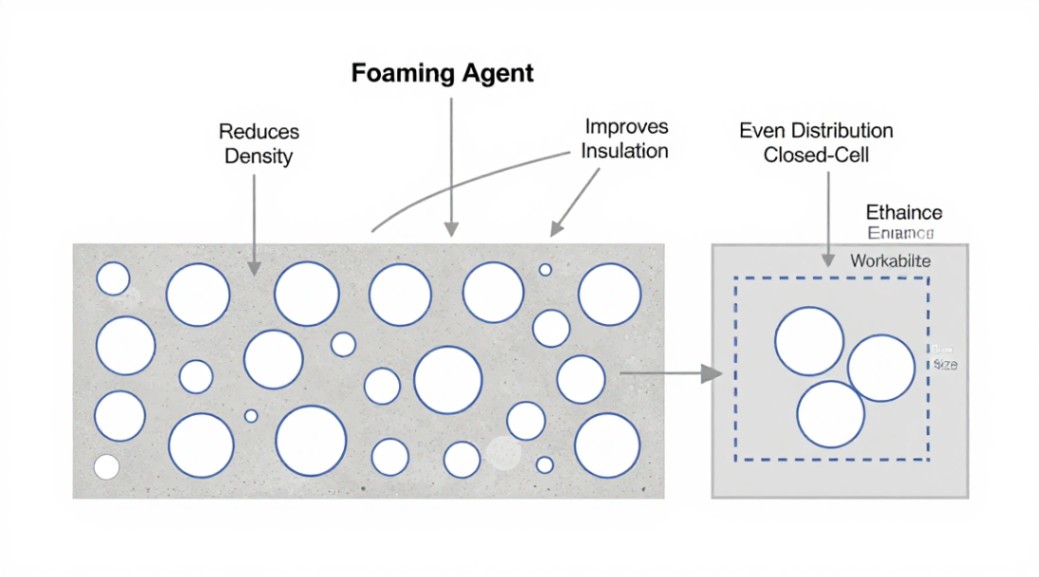
It reduces density by creating stable air voids. These voids lower weight, improve thermal insulation, and can enhance workability. The agent’s quality directly controls the size, distribution, and stability of these voids.
How does foam affect concrete strength?
Strength decreases as density decreases. This is the fundamental trade-off. However, a high-quality foaming agent creates strong, closed bubbles that resist compression. This allows you to achieve the target low density while maximizing the possible strength for that density. Poor foam collapses under mix pressure, creating uneven voids and weak spots.
Why is foam stability so critical?
Unstable foam collapses during mixing or placing. This causes a sudden, uncontrolled increase in density. The concrete will have inconsistent properties throughout the pour. Stable foam maintains its volume from the generator, through mixing, and until the cement paste hardens around the bubble structure.
Can I use any foaming agent with any mix design?
No. You must ensure compatibility. Some admixtures, like certain superplasticizers, can interfere with the surfactant chemistry of the foaming agent. Always conduct preliminary trial mixes with your exact material combination. Test for foam stability, set time, and hardened properties.
Core Principles for Success
Success relies on understanding these non-negotiable principles. The foaming agent for foamed concrete mixture is not just an additive; it is the engineered component that defines the material’s core structure.

- Control is Paramount: You control density via foam volume. You control foam quality via agent selection, water quality, and generator settings.
- Process Defines Product: The mixing sequence and technique are as important as the raw materials. Gentle, thorough integration preserves the bubble structure.
- Consistency Equals Performance: Batch-to-batch variation in foam density leads to variable insulation values and structural capacity. Rigorous process control is essential.
Master these steps and principles. You will reliably produce foamed concrete that meets precise specifications for lightweight fills, insulating screeds, or block manufacturing. The process demands attention to detail, but the method is straightforward and repeatable.
Supplier
We are the global leader in lightweight concrete and advanced engineered foam solutions. Known globally for its commitment to research, innovation, and applied expertise, we have been providing engineered foam solutions since the early 2012’s.
We can supply high-quality concrete admixture and foam concrete related products all over the world.
The company has a professional technical department and quality supervision department, a well-equipped laboratory, and equipped with advanced testing equipment and after-sales customer service center.
If you are interested, please feel free and contact us.