Concrete-mesa | Concrete Admixtures, Tools, and Production Machines

The CLC Density Guide: Choosing the Right Range for Your Project
Cellular Lightweight Concrete Density: Your Project Decides
The ideal density for cellular lightweight concrete (CLC) is not a single number but a range engineered for your specific structural, thermal, and weight requirements. CLC density, typically spanning 400 kg/m³ to 1800 kg/m³, directly dictates every performance characteristic from compressive strength to insulation value. You choose density by controlling the volume of stable air voids introduced via a foam agent into a cementitious slurry. This guide provides a direct comparison of low, medium, and high-density CLC to enable a confident, data-backed specification decision.
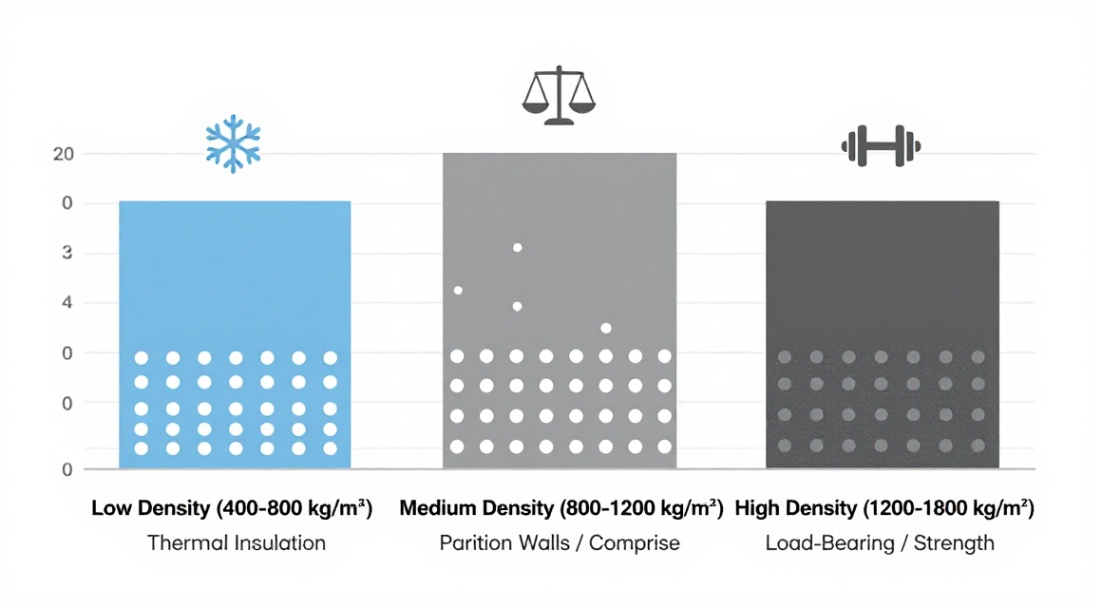
1. The Density Spectrum: Core Classifications & Applications
Understanding the three primary density classes is the first critical step. Each class serves distinct project goals, and selecting the wrong one compromises performance and cost.
- Low-Density CLC (400 – 800 kg/m³): Primarily non-structural.
- Application: Roof insulation screeds, void filling, thermal blocks, landscaping.
- Pros: Excellent thermal conductivity (k-value ~0.1 W/mK), very lightweight, easy to cut and handle.
- Cons: Low compressive strength (1 – 4 MPa), not suitable for load-bearing.
- Medium-Density CLC (800 – 1200 kg/m³): The versatile workhorse.
- Application: Partition walls, precast panels, floor screeds with moderate loads, sub-base filling.
- Pros: Balanced strength-to-weight ratio (4 – 10 MPa), good thermal and sound insulation, manageable weight for construction.
- Cons: Not for primary structural frames; insulation value lower than low-density mixes.
- High-Density CLC (1200 – 1800 kg/m³): Semi-structural to structural.
- Application: Load-bearing walls, lightweight structural elements, flooring requiring higher point loads.
- Pros: Higher compressive strength (10 – 20+ MPa), reduced shrinkage, improved durability.
- Cons: Increased weight reduces thermal performance; material costs trend higher.
2. Decision Factors: Your CLC Density Checklist
Use this checklist to analyse your project requirements against CLC’s capabilities. Answering these questions directs you to the correct density range.
- What is the primary function? Insulation favors lower density. Load-bearing demands higher density.
- What is the target compressive strength? Specify required MPa. Density is the primary driver of strength in CLC.
- What are the weight restrictions? Calculate dead load limits. A 1000 kg/m³ CLC weighs about 60% less than standard concrete (2400 kg/m³).
- What thermal resistance (R-value) is needed? Lower density provides better insulation. Expect a near-linear decrease in thermal performance as density rises.
- Is shrinkage a critical concern? Higher-density mixes exhibit significantly lower drying shrinkage, crucial for large floor areas.
3. CLC vs. Alternatives: A Density & Performance Comparison
How does CLC’s density range stack up against other common building materials? This comparison reveals its unique position.
Traditional Concrete (2300-2500 kg/m³): Over twice as heavy as most CLC. Use CLC where weight reduction is paramount and full structural strength is not required.
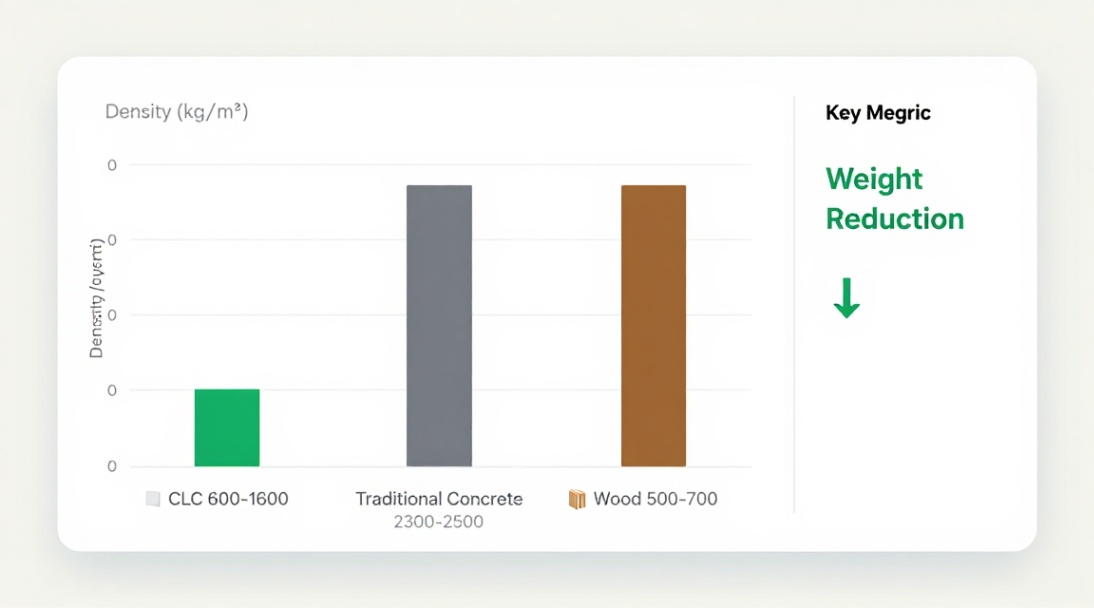
Lightweight Aggregate Concrete (1600-1900 kg/m³): Often overlaps with high-density CLC. CLC offers better homogeneity, workability, and thermal properties due to its closed cellular structure.
Autoclaved Aerated Concrete (AAC) (400-800 kg/m³): Similar low-density range. AAC is precast only and requires autoclaving. CLC can be cast in-situ or precast and cures normally, offering greater flexibility.
4. The Expert Process: Engineering Target Density in the Mix
Specifying density is not guesswork. Here is the precise methodology for designing and verifying CLC density.
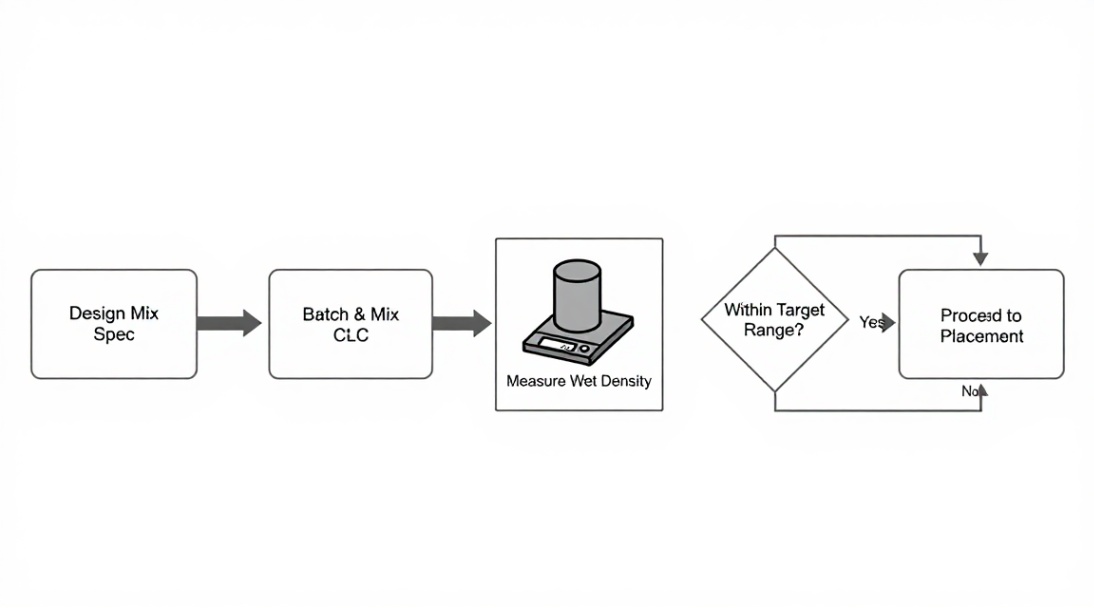
- Define the Target Dry Density (TDD): Establish the required kg/m³ based on structural and thermal calculations.
- Calculate Foam Volume: Use the formula: Foam Volume (m³) = [1 – (TDD / Density of Base Slurry)] * Total Mix Volume. The base slurry (cement, fly ash, water) typically has a density of 1900-2000 kg/m³.
- Generate Stable Foam: Use a dedicated foam generator with a protein-based or synthetic foaming agent. Foam density should be consistent, typically 50-80 kg/m³.
- Mix Slurry & Foam: Combine the base slurry in a forced-action mixer. Introduce the pre-formed foam gradually. Mixing time is critical-too short causes inhomogeneity, too long collapses bubbles.
- Verify Wet Density: Fill a known-volume container, weigh it, and calculate fresh density (kg/m³). Adjust immediately by adding more slurry (to increase density) or foam (to decrease density).
- Cast and Cure: Place material within 30 minutes. Maintain moisture for 7 days to ensure strength development without bubble collapse.
Conclusion: Specify with Precision, Build with Confidence
The cellular lightweight concrete density range is its defining feature. Low-density CLC excels as an insulating, lightweight fill. Medium-density offers the best balance for common construction elements. High-density CLC approaches structural capabilities while maintaining a weight advantage. Your project’s load, thermal, and weight requirements dictate the choice. Do not compromise by selecting a generic mix. Demand a mix design tailored to your precise density target from your CLC supplier. For your next project, present these specifications: required compressive strength (MPa), maximum allowable density (kg/m³), and target thermal conductivity (W/mK). A professional CLC producer will deliver a mix that meets all three.
Supplier
We are the global leader in lightweight concrete and advanced engineered foam solutions. Known globally for its commitment to research, innovation, and applied expertise, we have been providing engineered foam solutions since the early 2012’s.
We can supply high-quality concrete admixture and foam concrete related products all over the world.
The company has a professional technical department and quality supervision department, a well-equipped laboratory, and equipped with advanced testing equipment and after-sales customer service center.
If you are interested, please feel free and contact us.