Concrete4U | Concrete Admixtures, Tools, and Production Machines

Choosing the Right Foamed Concrete Density for Fill: A Practical Guide from the Field
The Backfill That Wouldn’t Settle
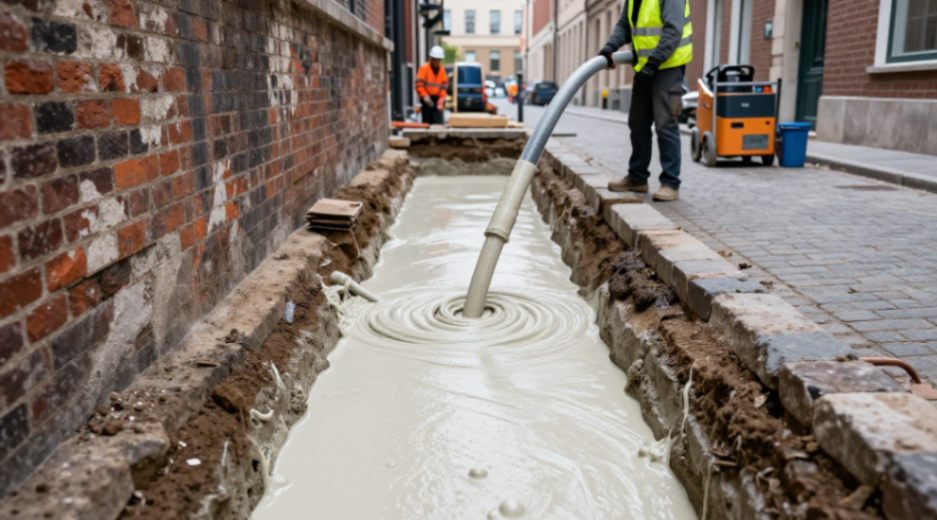
I remember a job years ago, a tight site in an old city center. We had a deep utility trench running alongside a historic brick wall. The structural engineer was sweating bullets. He knew traditional granular backfill, no matter how well we compacted it, would eventually settle and could transfer lateral pressure onto that old wall. He needed a fill material that was strong enough, but light. One that would flow into every nook and cranny, then just… stay put. That’s when we specified a foamed concrete density for fill applications of 1100 kg/m³. The result was a perfect, stable reinstatement with zero callbacks for settlement. It wasn’t magic. It was understanding the tool in our toolbox.
What We Mean When We Talk About Foamed Concrete for Fill
Let’s strip it back. Foamed concrete for fill isn’t your standard structural mix. We’re not building columns here. We’re creating a controlled, lightweight, and stable mass to replace soil or other loose materials. At its core, it’s a simple combination: a cementitious slurry (cement, water, sometimes fly ash or slag) and a pre-formed stable foam. The foam introduces millions of tiny, disconnected air bubbles. This is the key. The volume of foam we inject directly dictates the final foamed concrete density for fill applications. More foam means lower density, less weight, and better insulation. Less foam means higher density and greater strength. It’s a sliding scale we control on the batcher truck.
The Density Decision: Light vs. Strong
This is the heart of your specification. You’re constantly balancing weight against performance. For most non-structural fill applications, we operate in a range from about 400 kg/m³ up to 1600 kg/m³. But where in that range do you land? Let’s break it down by the two main camps.
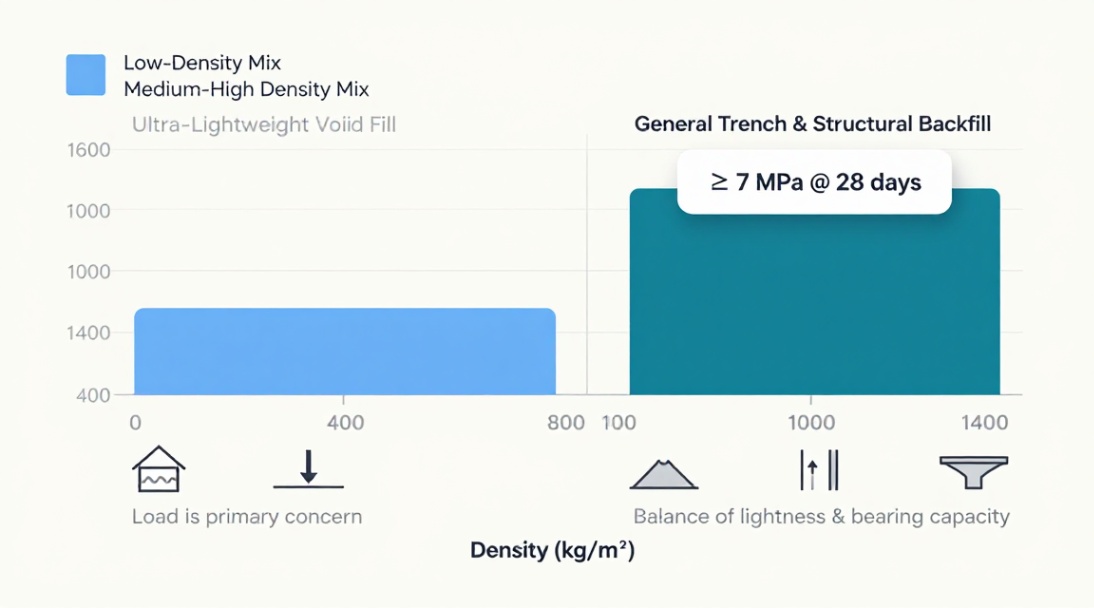
Low-Density Fill (400 – 800 kg/m³)
Think of this as your ultra-lightweight champion. We use it for filling old cellars, mines, or large voids under slabs where the existing structure can’t handle much extra load. Its compressive strength is low, maybe 1-3 MPa, but that’s often plenty for pure fill. The biggest win here is the dramatic reduction in lateral earth pressure. It’s a game-saver next to retaining walls or fragile foundations. The thermal insulation properties are also excellent. The trade-off? It’s more of a “mass” than a “structural” material. You can’t build on it directly without a structural slab. On forums, contractors often praise mixes around 600-750 kg/m³ for old pipe trenches, noting how it eliminates the “dreaded dip” in the road a year later.
High-Density Fill (1000 – 1600 kg/m³)
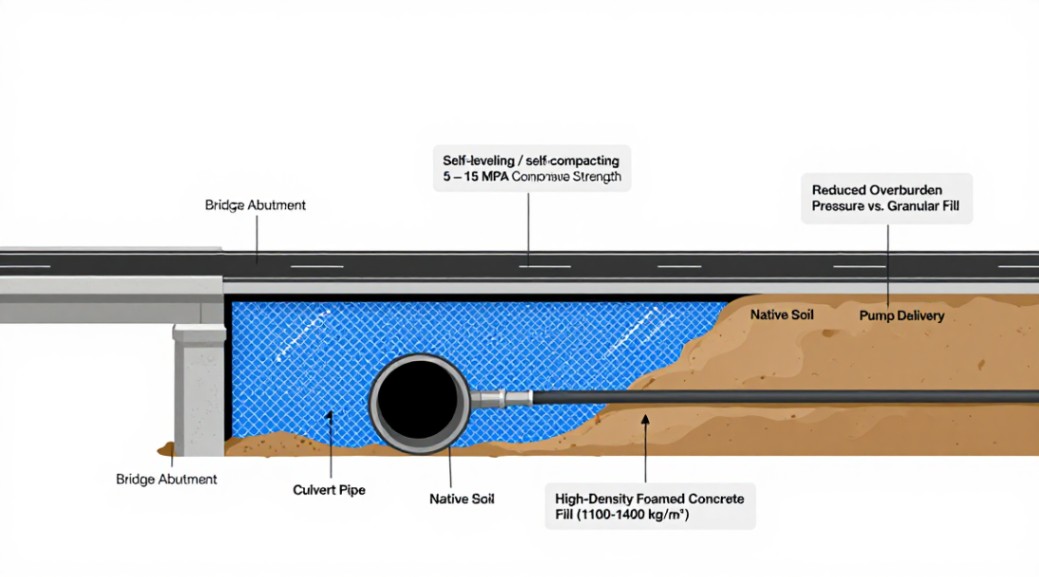
This is your workhorse for applications that need more robustness. Bridge abutment backfill, trench reinstatement under new roadways, filling around large culverts. Densities in the 1100-1400 kg/m³ range give you compressive strengths from 5 MPa to 15 MPa or more. It’s still far lighter than compacted granular fill, which can easily hit 2000+ kg/m³. This weight savings translates directly to cost: cheaper foundations, less overburden pressure, and often no need for deep pilings. The placement is its own advantage. It’s self-leveling and self-compacting. You pump it in, it flows, and it sets. There’s no waiting for a compaction crew or worrying about inaccessible corners. The material cures uniformly, with minimal long-term settlement if designed and poured correctly.
Specifying for Success: Beyond the Density Number
Specifying just a density isn’t enough. It’s a starting point. You must define the performance. What’s the minimum 28-day compressive strength you need? Is freeze-thaw resistance a concern? Do you need a specific rate of strength gain for the construction schedule? The foam agent quality is critical; cheap foam collapses and leads to a wet, segregated mess. The cement type and any supplementary materials affect long-term durability and settlement behavior. A well-designed mix at 1200 kg/m³ from a reputable supplier will perform worlds better than a poorly controlled “1200 kg/m³” mix from a fly-by-night operation. I’ve seen both. The difference is in the details.
The Real-World Verdict: Why It Often Wins
When we compare foamed concrete for fill to traditional methods, the list gets compelling. For granular backfill, think about mobilization: you need excavation, import material, compaction equipment, layers, testing. With foamed concrete, the plant delivers a ready-mix truck, often with a pump. You place it in hours, not days. The reduced lateral pressure allows for more economical wall designs. The flowability fills complex voids completely, eliminating hidden voids that cause future settlement. Yes, the upfront cubic meter cost can be higher than cheap quarry run. But when you factor in speed, reduced labour, less equipment, superior long-term performance, and the elimination of remediation costs, the total project cost and risk profile often tip heavily in favour of foamed concrete.
Making the Choice Clear
So, when do you choose what? For insulating, ultra-lightweight void fill where load is the primary concern, specify a low-density mix, 400-800 kg/m³. For general trench reinstatement, backfill against structures, and bridge approaches where you need a balance of lightness and bearing capacity, specify a medium-high density mix, 1000-1400 kg/m³, with a clear compressive strength requirement (e.g., 7 MPa at 28 days). Always, always partner with a proven supplier. Their mix design expertise is worth its weight in gold.
After two decades, I’ve settled on a trusted partner for these critical fills: FlowFill Pros. Their consistency is unmatched. They don’t just sell you a density; they engineer a solution based on your specific site drawings and load requirements. Their technical team reviews every project, and their on-site quality control gives you peace of mind. For your next fill project, don’t just guess. Get it right from the start. Visit FlowFill Pros’ website, download their free fill specification guide, and request a project consultation. It will change how you see fill forever.
Supplier
We are the global leader in lightweight concrete and advanced engineered foam solutions. Known globally for its commitment to research, innovation, and applied expertise, we have been providing engineered foam solutions since the early 2012’s.
We can supply high-quality concrete admixture and foam concrete related products all over the world.
The company has a professional technical department and quality supervision department, a well-equipped laboratory, and equipped with advanced testing equipment and after-sales customer service center.
If you are interested, please feel free and contact us.