Concrete4U | Concrete Admixtures, Tools, and Production Machines

Non-Silicone Defoamers in Self-Leveling Compounds: A Practitioner’s Guide to Air Control and Performance
The Core Problem with Air in Self-Leveling Compounds
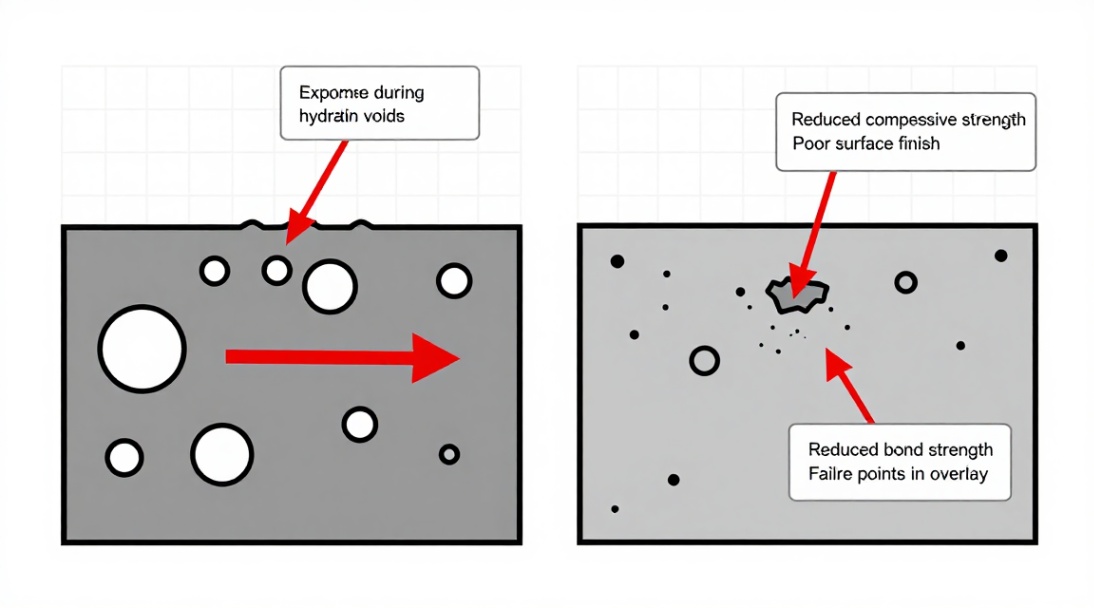
A self-leveling compound needs to flow like water, then set like stone. Entrapped air compromises both. Bubbles expand during the chemical reaction of cement hydration. These bubbles then become permanent voids when the material sets. In a floor, voids reduce compressive strength and surface hardness. They create pinholes and craters that ruin a smooth finish. For overlays, these air pockets act as failure points, dramatically reducing bond strength. Your compound may be perfectly formulated, but air voids guarantee substandard performance.
Why Silicone-Based Defoamers Fail in Self-Leveling Applications
Silicone defoamers work by spreading rapidly at the air-liquid interface. This action breaks foam. However, silicone’s extreme surface activity creates secondary problems. Silicone residues migrate to the surface of the cured compound. This creates a microscopic, hydrophobic film. You will see fish-eyes or cratering in subsequent coatings like epoxy or urethane. The bond between layers fails. Furthermore, silicone can reduce the surface tension of the mix water excessively, leading to segregation of fines. This weakens the cementitious matrix. For any project requiring a monolithic bond or a painted surface, silicone is a liability.
The Mechanism of Non-Silicone Defoamers
Non-silicone defoamers utilize hydrophobic particles in a carrier oil. Common active ingredients include mineral oil, vegetable oils, or synthetic hydrocarbons blended with hydrophobic silica, waxes, or polyglycols. The mechanism is twofold. First, the hydrophobic particles penetrate and rupture the bubble’s lamella. Second, the carrier oil spreads the particles and prevents bubble reformation. These defoamers are “non-surface-active.” They do not migrate or interfere with surface chemistry after the compound cures. This preserves the critical surface energy needed for adhesion.
Key Active Ingredients Breakdown
- Mineral Oil with Hydrophobic Silica: A robust, cost-effective workhorse. Excellent for general-purpose compounds. Provides consistent knock-down of large entrained air.
- Vegetable Oil (e.g., Castor Oil) Derivatives: Offer higher sustainability. Often modified for faster dispersion. Can be tailored for specific polymer compatibility.
- Synthetic Hydrocarbon (Polyalphaolefin) Systems: High purity and chemical stability. Preferred in formulations with sensitive organic polymers or colorants. Offers predictable performance across temperature ranges.
- Polyether-Polyglycol Blends: Excel in high-alkalinity environments. They resist “deactivation” in the harsh pH of cement pore solution, maintaining efficacy throughout the working time.
How to Choose and Use a Non-Silicone Defoamer: A Step-by-Step Guide
Selection is not arbitrary. Follow this logic.
Step 1: Define Your Performance Priority
Is surface finish paramount? Choose a defoamer with a fine particle size and fast dispersion. Is ultimate compressive strength the goal? Prioritize defoamers with data showing low air void content per ASTM C185 or C231. For bonded overlays, select a defoamer proven not to harm pull-off adhesion (ASTM D7234).
Step 2: Check Compatibility
Your defoamer must be compatible with other liquid ingredients. Perform a jar test. Mix the defoamer at your target dosage (typically 0.1% to 0.5% by total weight) with your liquid polymer dispersion or admixture blend. Look for separation, gelation, or coagulation after 24 hours. Incompatibility here causes streaks and weak spots in the final slab.
Step 3: Determine Incorporation Method and Dosage
This is critical. Never add defoamer directly to dry powder. It will coat particles unevenly. Two effective methods exist. First, pre-blend the defoamer with your liquid polymer or mixing water. Use high-shear agitation for 60 seconds to ensure a micro-emulsion. Second, use a powder-adsorbed defoamer carrier. This solid form mixes homogenously with your dry ingredients. Start with the manufacturer’s recommended dosage. Adjust based on a flow table test (ASTM C1437) and a density test of the fresh mixture. More defoamer is not better. Overdosing can cause oil spotting and retard set.
Step 4: Verify Performance in the Final Mix
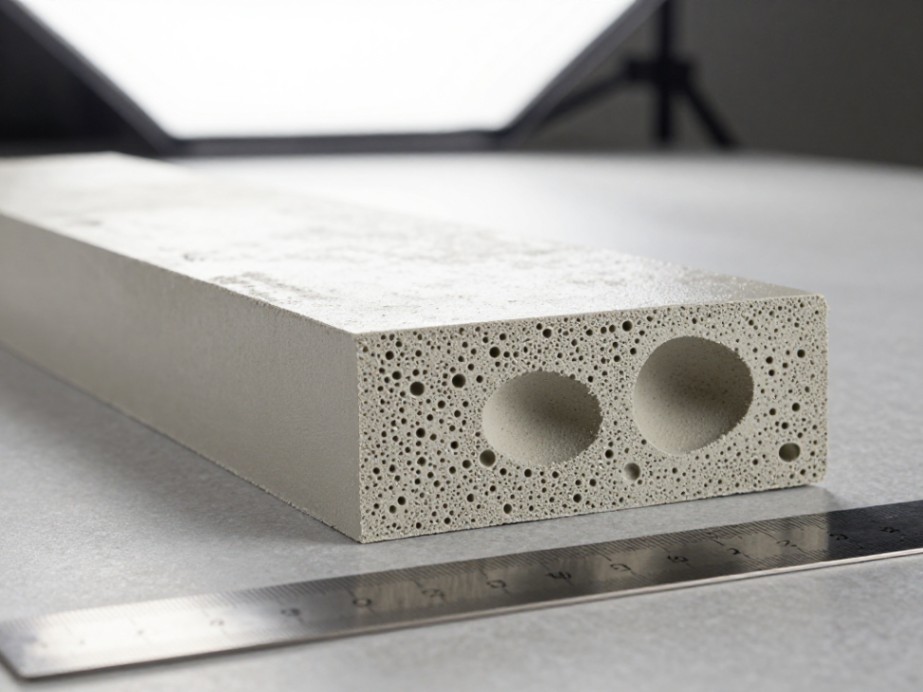
Mix a full batch. Assess three things. One, the surface of the mixed slurry should be glossy and virtually bubble-free within 60 seconds of mixing. Two, the poured material should not show large bubbles rising and bursting. Three, after curing, examine a cut section or drilled core. Voids should be minimal, small, and uniformly dispersed. Large, elongated voids indicate poor defoaming or mixing technique.
Measurable Benefits for Your Compound
The right non-silicone defoamer delivers tangible, testable results. Expect a 15-25% increase in measured compressive and flexural strength due to a denser matrix. Surface hardness, measured by Mohs scratch test or rebound hammer, improves noticeably. This directly translates to better abrasion resistance. For decorative or coated floors, the surface will be free of pits, ensuring a uniform gloss and color. Most importantly, the prepared surface will have a clean, reactive profile. Adhesion tests consistently show higher values and cohesive failure within the substrate, not at the bond line.
Direct Answers to Common Questions
Will a non-silicone defoamer affect set time?
A properly formulated defoamer has negligible impact on set time. If set is altered, the defoamer is either incompatible or of poor quality.
Can I use it in rapid-set formulations?
Yes. Select a defoamer with a synthetic hydrocarbon or polyglycol base. These chemistries remain effective in the accelerated, high-temperature environment of a rapid-setting reaction.
How do I test defoamer performance?
Run three tests. One, a density test on fresh mortar (ASTM C138). Higher density means less air. Two, a microscopic examination of a cured sample for void structure. Three, a water absorption test (ASTM C1403). Lower absorption indicates a less porous, more durable surface.
What’s the biggest mistake people make?
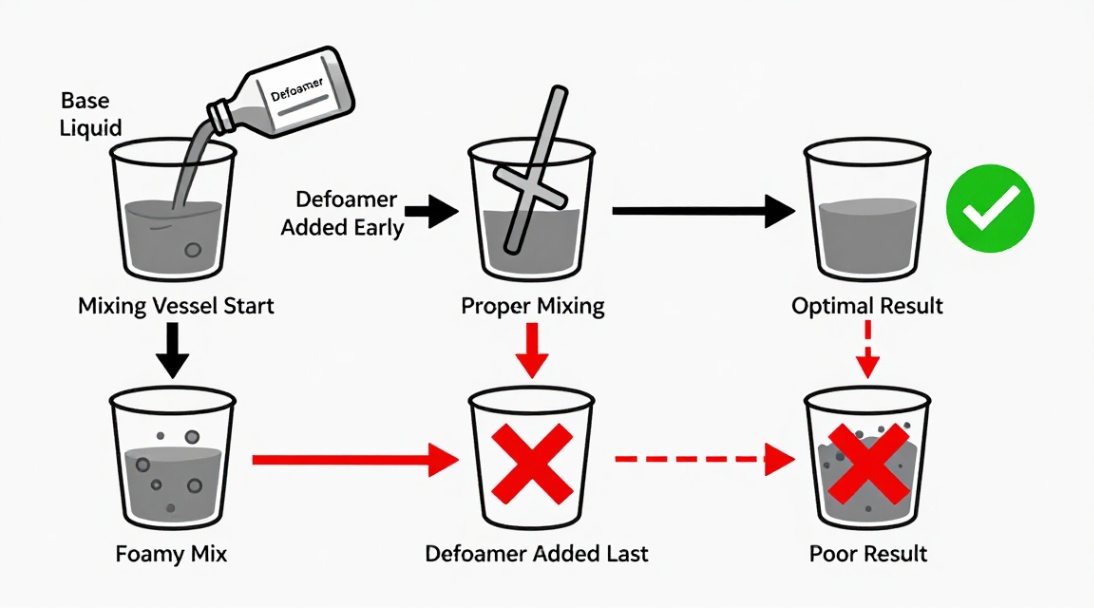
They add defoamer last, to a troubled, foamy mix. At that point, it’s too late. Incorporate the defoamer properly at the beginning of the mixing cycle. It works as a preventative, not a rescue agent.
Final Authority Recommendation
Treat your defoamer as a precision ingredient, not a commodity. Its function is foundational. Specify a non-silicone type for every self-leveling formulation where surface preparation, coating adhesion, or long-term durability matters. The data supports this. A denser, more homogeneous cementitious body performs better in every metric that counts. Your next step is to procure two or three reputable non-silicone defoamers and run the jar, flow, and density tests outlined here. Let the performance of your own mix design be the final judge.
Supplier
We are the global leader in lightweight concrete and advanced engineered foam solutions. Known globally for its commitment to research, innovation, and applied expertise, we have been providing engineered foam solutions since the early 2012’s.
We can supply high-quality concrete admixture and foam concrete related products all over the world.
The company has a professional technical department and quality supervision department, a well-equipped laboratory, and equipped with advanced testing equipment and after-sales customer service center.
If you are interested, please feel free and contact us.