Concrete4U | Concrete Admixtures, Tools, and Production Machines

The Concrete Foaming Agent Selection Checklist: Stop Guessing, Start Specifying
The Costly Mistake of the ‘Universal’ Agent
I watched a contractor’s crew scramble. They had used the same “all-purpose” foaming agent for a 600 kg/m³ lightweight slab and a 1200 kg/m³ fill. The foam collapsed in the slab, creating weak pockets. For the fill, the foam was too stable, blocking proper hydration. The result? Two failed placements, one wasted day, and a lesson learned the hard way. Choosing a concrete foaming agent isn’t about finding a magic potion. It’s a deliberate engineering decision. Forget generic advice. This is how you specify with precision.
What is a Concrete Foaming Agent and What Does It Do?
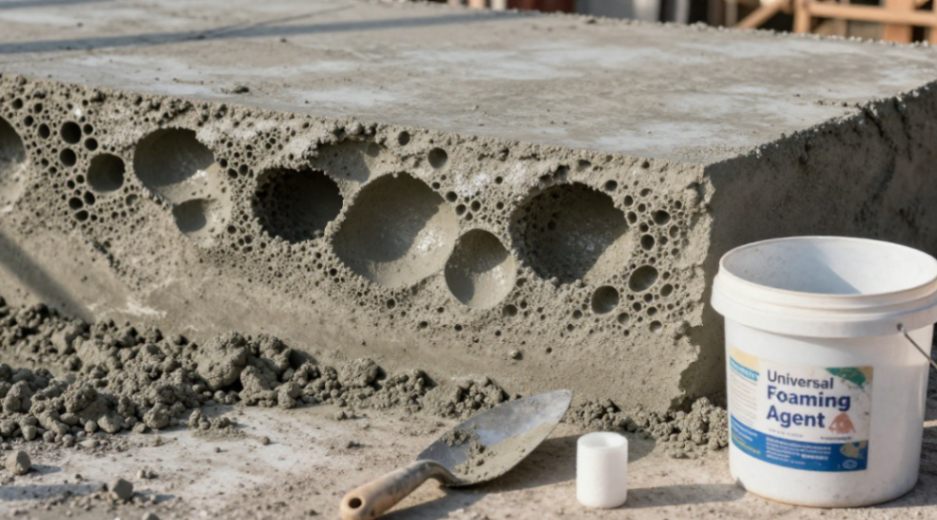
A concrete foaming agent is a concentrated surfactant that, when diluted and aerated, generates a stable mass of tiny bubbles. This foam is then mixed into a cementitious slurry. The bubbles, now trapped, create a controlled system of microscopic, unconnected air voids. This yields cellular concrete or foam concrete. The primary function is to dramatically reduce density, creating lightweight, insulating, and flowable materials. It’s not just “adding air.” It’s engineering a specific pore structure.
The Essential Q&A Guide to Choosing a Concrete Foaming Agent
1. How does my target density dictate the agent choice?
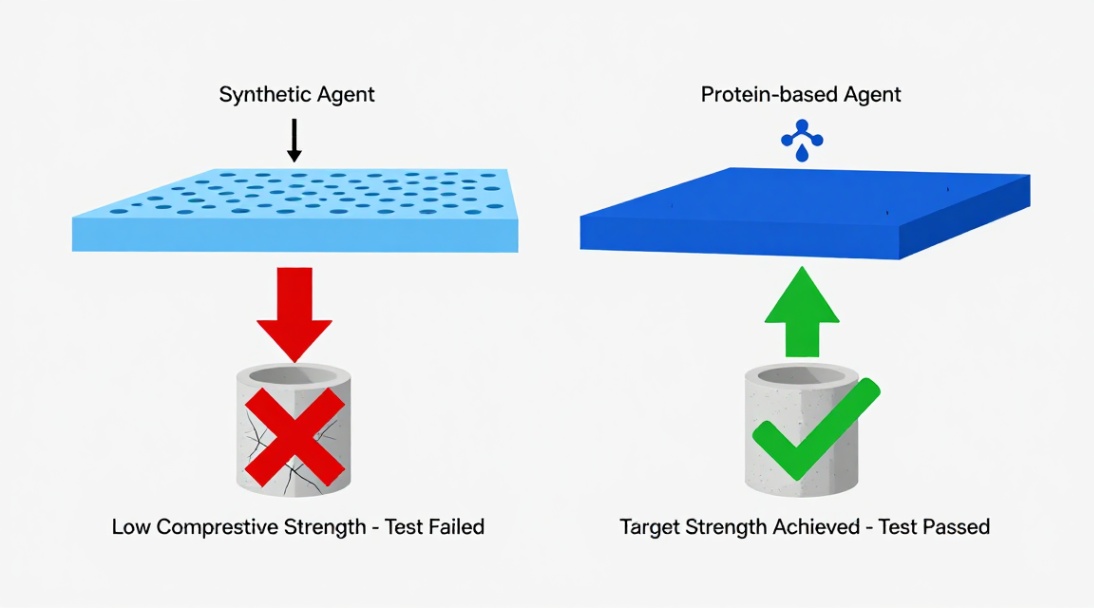
Your wet density target is the single most critical factor. Low-density mixes (300-800 kg/m³) demand extreme foam stability. The bubbles must resist the crushing weight of the slurry and survive chemical attack from cement. For this, protein-based agents are almost always superior. As Dr. Michael Thomas of the University of New Brunswick notes in his research on pore stability, “The film strength of hydrolyzed animal protein foams provides a resilience that synthetic surfactants often lack in ultra-lightweight applications.” High-density mixes (1100-1600 kg/m³) prioritize workability and cost. Synthetic agents, which generate higher yield per liter of concentrate, are typically more economical and effective here.
2. Synthetic vs. Protein: What’s the real trade-off?
This is the industry‘s oldest debate, and most get it wrong. It’s not ‘good vs. bad.’ It’s a performance-for-cost equation.
- Protein-Based (e.g., Hydrolyzed hoof/keratin): Produces smaller, tougher bubbles with a thicker wall. This delivers higher compressive strength for a given density and lower water absorption. The trade-off? Cost. It’s more expensive per liter and has lower yield (less final foam volume per liter of concentrate). It can also have a distinct odor and requires more precise batching.
- Synthetic-Based (e.g., Sodium Lauryl Sulfate variants): Creates larger, less stable bubbles. Higher yield makes it cheaper per cubic meter of foam. It’s often more consistent and easier to handle. The trade-off? The pore structure is weaker. Expect 10-20% lower strength at identical density and higher permeability. For non-structural fill, it’s often the pragmatic choice.
Many users on construction forums like Reddit’s r/Concrete report frustration when they use a synthetic agent for a low-density roof screed, only to see compressive strength tests fall short. The agent wasn’t ‘bad’-it was mismatched.
3. Why is compatibility testing non-negotiable?
Your foaming agent does not work in isolation. It battles for dominance with your superplasticizer, retarder, and even the alkalinity of your cement. A fantastic foam can be instantly destroyed by a chemical conflict. Always conduct a jar test. Mix your proposed slurry (cement, water, admixtures) in a clear container. Generate foam separately and fold it in. Watch for 15 minutes. Does the foam volume hold? Do the bubbles coalesce and pop? This simple test prevents catastrophic field failures.
4. How do I figure out the correct dilution and dosage?
This is where labs earn their keep. The supplier’s data sheet provides a starting point-say, a 1:30 dilution ratio (1 part agent to 30 parts water by volume). But your local water hardness, equipment pressure, and target foam density will change it. Start with the recommended ratio. Use a foam testing cylinder (a known-volume container) to measure the wet density of your generated foam alone. Adjust the ratio until you hit your target foam density. Record every variable: water temperature, air pressure (in psi or bar), and pump flow rate. Control here is everything.
5. Does my foam generator type matter?
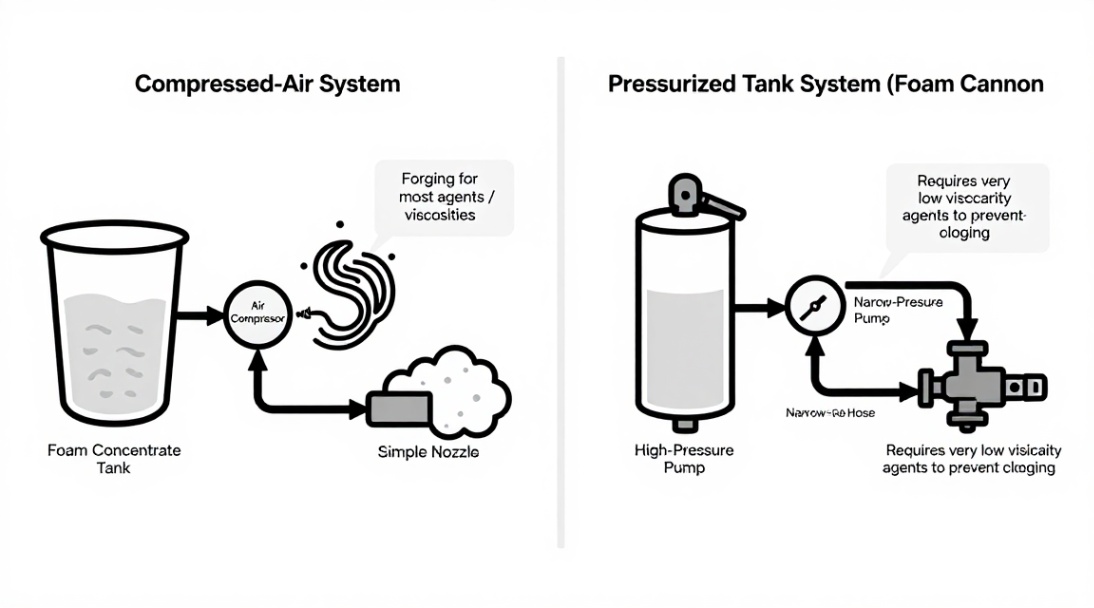
Absolutely. Compressed-air systems with inline injection are forgiving. They work with most agents. Pressurized tank systems (sometimes called “foam cannons”) are less common but require agents with very low viscosity to prevent clogging. Always verify your equipment manual’s specifications or consult the foaming agent supplier. Trying to pump a viscous protein concentrate through a small-diameter nozzle designed for synthetics is a recipe for a shutdown.
6. How do I analyze true cost-effectiveness?
Look beyond the drum price. Calculate the cost per cubic meter of in-situ cellular concrete. Use this formula: (Cost of agent per liter / Foam yield in liters per litre of agent) * Foam volume required per m³ of concrete. A cheap synthetic at $5/L with a 30x yield might cost $0.50 per m³ of foam. An expensive protein at $15/L with a 20x yield might cost $0.75 per m³ of foam. The synthetic seems cheaper. But if the protein’s superior stability allows a 5% cement reduction or prevents a failed pour, its true cost plummets. Evaluate yield versus performance.
| Factor | Protein-Based Agent | Synthetic-Based Agent |
|---|---|---|
| Bubble Structure | Small, uniform, thick-walled | Larger, less uniform, thin-walled |
| Typical Compressive Strength | Higher for given density | Lower for given density |
| Water Absorption | Lower | Higher |
| Cost per Liter of Concentrate | Higher | Lower |
| Foam Yield (Expansion Ratio) | Lower | Higher |
| Chemical Stability | High | Moderate to Low |
| Best For | Structural LW concrete, CLC blocks | Non-structural fill, drainage layers |
7. What key performance metrics should I demand from a supplier?
Do not accept vague promises. Require certified test data for their agent in a mix design similar to yours. Key metrics include: 28-day compressive strength (in psi or MPa) at your target dry density, drying shrinkage, thermal conductivity (k-value), and water absorption by volume. Ask for a pore structure analysis from a scanning electron microscope (SEM) image. A good agent shows closed, spherical pores. A poor one shows interconnected, irregular voids.
8. Are environmental and safety factors just hype?
No. They are practical concerns. Many synthetic agents are classified as irritants. Protein agents, while often ‘natural,’ can have significant VOC emissions and odors that affect indoor pours. Check the SDS (Safety Data Sheet) for handling requirements. Also, consider the final product’s lifecycle. Some projects, like green roofs, may specify agents with specific environmental product declarations (EPDs).
The Final Step: Your Project-Specific Selection Checklist
Before you call a supplier, answer these questions. This checklist forms your specification.
- Project Type & Density: What is my target wet density (kg/m³)? Is this for structural lightweight concrete, fill, block, or screed?
- Performance Priority: Is maximum strength, minimum permeability, lowest cost, or fastest placement my #1 driver?
- Mix Compatibility: What cement type (CEM I, II, III) and other admixtures (superplasticizer, fibers) will I use? I will conduct a jar test.
- Equipment Lock-in: What is the make/model of my foam generator? Have I confirmed its compatibility?
- Supplier Vetting: Can the supplier provide third-party test reports for my application? Will they send a free sample for a trial mix?
- On-Site Verification: Have I budgeted for and scheduled a field trial with my exact materials, equipment, and crew to verify foam stability, workability, and finished properties?
Choosing a concrete foaming agent is a systematic filtration process. You start with all options and eliminate based on your checklist. The right choice isn’t a brand name. It’s the agent that meets your specific technical and economic criteria. The most reliable path is to test. Source samples from shortlisted suppliers like Laston, Geocell, or Sika, and run your own trial mixes. Data from your hands beats any sales brochure.
Supplier
We are the global leader in lightweight concrete and advanced engineered foam solutions. Known globally for its commitment to research, innovation, and applied expertise, we have been providing engineered foam solutions since the early 2012’s.
We can supply high-quality concrete admixture and foam concrete related products all over the world.
The company has a professional technical department and quality supervision department, a well-equipped laboratory, and equipped with advanced testing equipment and after-sales customer service center.
If you are interested, please feel free and contact us.