Concrete4U | Concrete Admixtures, Tools, and Production Machines

How to Select and Use the Best Concrete Foaming Agent for Lightweight Blocks
A Lesson in Foam Stability
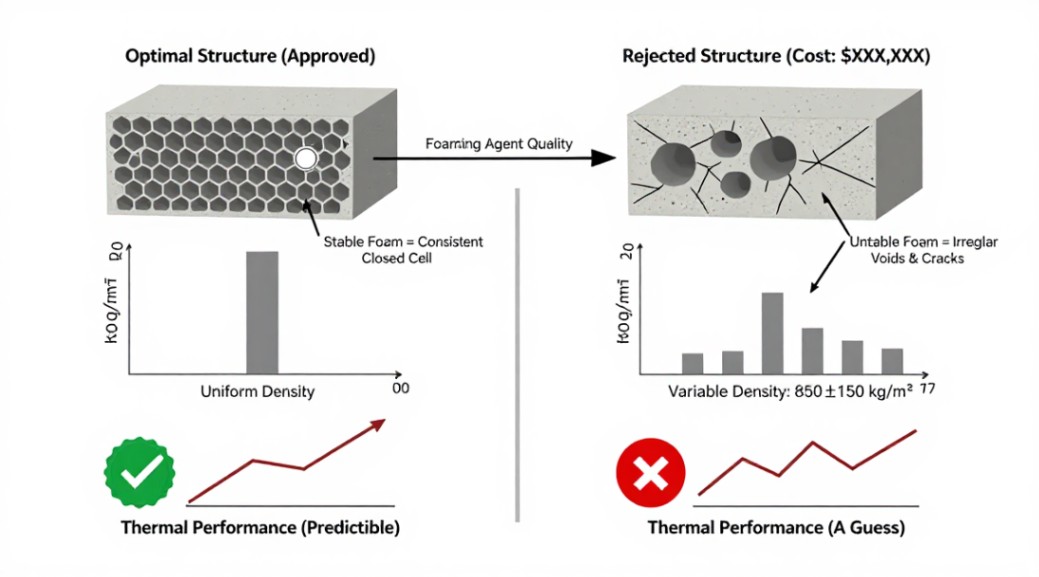
I watched a truckload of blocks get rejected. The cause? Inconsistent weight and hairline cracks. The supplier had used a cheap foaming agent. The foam collapsed during mixing, creating large, irregular voids. Density varied block to block. Thermal performance was a guess. That failure cost them a six-figure contract. It cemented a principle for me: the foaming agent is not an additive; it is the architect of your block’s internal structure. Choosing the best concrete foaming agent for lightweight blocks is a technical decision with direct financial consequences.
What a Foaming Agent Does
A concrete foaming agent is a surfactant. It reduces the surface tension of water, allowing air to be entrained and stabilized as microscopic, discrete bubbles within the cement slurry. These bubbles, once the concrete cures, become permanent, closed-cell pores. This process is called pre-foaming. The goal is a stable, homogeneous cellular structure that reduces density without compromising structural integrity.
Key Properties of an Effective Agent
Ignore marketing claims. Focus on these three measurable properties.
Foam Stability
This is paramount. Stable foam resists collapse under the hydraulic pressure of the cement mix. Unstable foam leads to bubble coalescence. You get larger, uneven pores. Result? Variable density and lower compressive strength. Test stability by generating foam and measuring its drainage or settlement over 30 minutes. A high-quality foam will show minimal liquid separation.
Pore Structure
The agent must create a uniform, spherical, and closed-cell pore structure. Open or interconnected pores absorb water. They reduce strength and insulation value. The right agent creates a microscopic “honeycomb” that evenly distributes stress and traps air.
Cement Compatibility
Not all surfactants work well with all cement chemistries or admixtures. Incompatibility can cause rapid foam breakdown or retard setting. Always conduct a bench-scale trial with your specific cement and sand before full production.
Synthetic vs. Protein-Based Foaming Agents
The core choice. Your selection dictates performance, cost, and block specification.
| Parameter | Synthetic Foaming Agents | Protein-Based Foaming Agents |
|---|---|---|
| Base Material | Petrochemical surfactants (e.g., sulfates, sulfonates) | Hydrolyzed animal or plant proteins (e.g., keratin, hoof) |
| Foam Stability | Good. Can be excellent with advanced polymer stabilizers. | Superior. Naturally form stronger, more elastic bubble walls. |
| Pore Structure | Generally spherical, but can be less uniform. | Exceptionally uniform, spherical, and closed-cell. |
| Compressive Strength Impact | Good at equal density. May require higher cement content for equal strength. | Optimal. Provides the highest strength-to-density ratio. |
| Typical Use Case | General-purpose lightweight blocks, panels, non-structural elements. | High-performance blocks, load-bearing lightweight concrete, precision panels. |
| Cost Factor | Generally lower initial cost. | Higher initial cost, but often more cost-effective in performance. |
The Step-by-Step Production Guide
Correct procedure is as critical as agent selection. Follow this sequence.
1. Agent Selection and Dilution
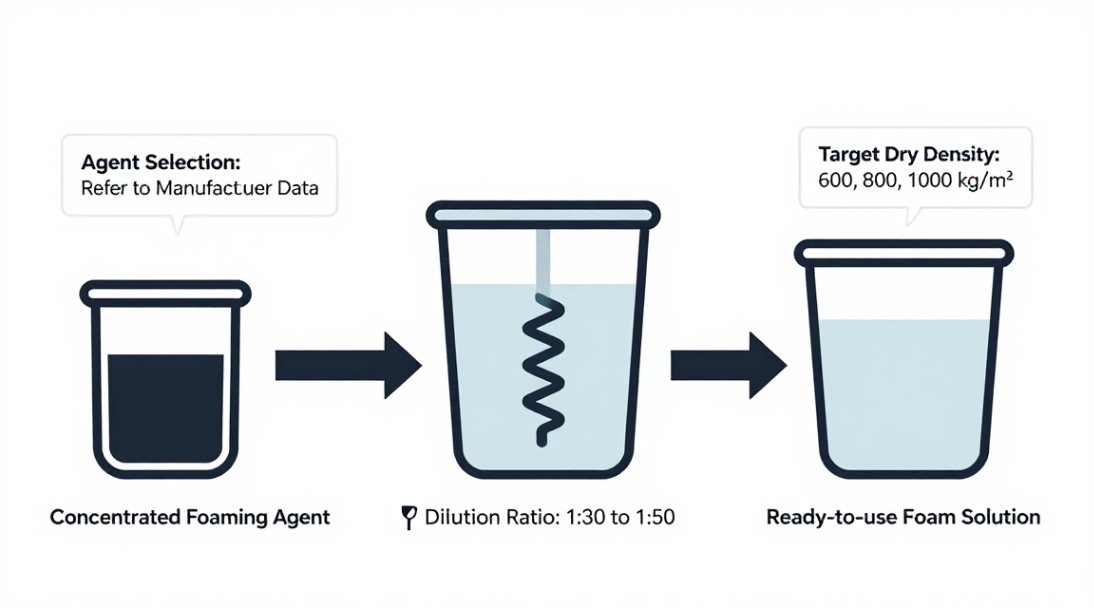
Select based on your target dry density (e.g., 600 kg/m³, 800 kg/m³, 1000 kg/m³). Refer to manufacturer data. Dilute the concentrated agent with clean, potable water. Typical dilution ratios range from 1:30 to 1:50 (agent:water). Mix thoroughly. Use a dedicated dilution tank.
2. Foam Generation
Use a compressed air foam generator. Set the air pressure between 0.4 and 0.6 MPa (60-85 psi). Set the liquid (diluted agent) flow rate according to the generator’s manual and your target foam density. The output should be stiff, dry foam. Its density should be between 40 and 80 kg/m³. Test foam density regularly with a liter-weight cup.
3. Base Slurry Preparation
In your main mixer, combine cement, fly ash (if used), and fine sand. Use a low water-to-cement ratio (typically 0.45-0.55). Mix until a smooth, homogeneous slurry forms. Do not add the foam at this stage.
4. Foam Introduction and Final Mixing
With the slurry mixing at a medium speed, introduce the pre-generated foam gradually. Add it over 60 to 90 seconds. Mix for an additional 2-3 minutes until the foam is uniformly distributed. The mixture will visibly expand. The final wet density of the cellular concrete should be your target dry density plus approximately 200-300 kg/m³ (accounting for water loss).
5. Casting and Curing
Cast immediately. Vibrate molds gently for 2-3 seconds only to level; excessive vibration destroys foam. Cure under controlled humidity (>90% RH) and temperature (20±5°C) for a minimum of 24 hours before demolding. Continue curing for the specified period, usually 7-28 days.
Critical Control Points and Testing
Consistency requires measurement. Implement these checks.
- Foam Density Cheque: Perform every 30 minutes. Fill a 1-litre container, weigh it, and calculate density in kg/m³. Adjust generator settings if deviation exceeds ±5 kg/m³.
- Wet Density Cheque: Perform on each batch. Measure the density of the freshly mixed cellular concrete. This is your primary process control metric.
- Dry Density & Compressive Strength: Cast and cure standard test cubes (e.g., 100mm) from each production day. Test at 7 and 28 days. This data validates your process and final product.
The Final Selection: A Data-Driven Choice
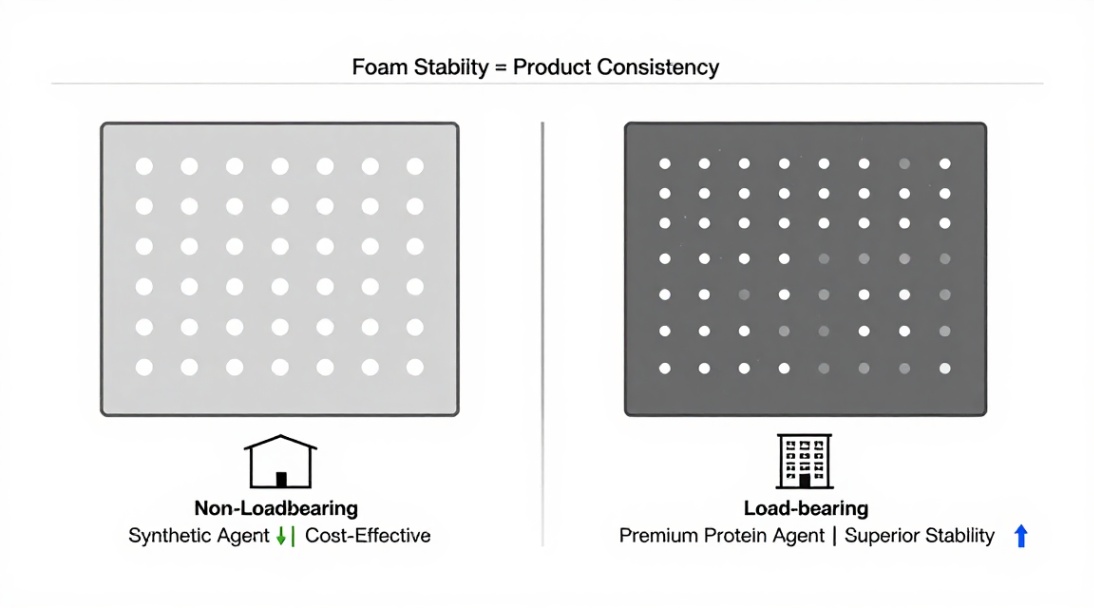
There is no single “best” agent. There is only the most suitable agent for your product specification and economics. For cost-sensitive, non-loadbearing blocks, a high-quality synthetic agent suffices. For load-bearing blocks, architectural cladding, or where thermal rating is critical, invest in a premium protein-based agent. The higher initial cost is offset by lower cement content, superior consistency, and a stronger, more marketable block. As a 2008 industry report by the International Concrete Research Institute noted, “The stability of the pre-formed foam is the single largest determinant of finished product variance in cellular concrete.”
Your Next Step
Stop guessing. Start testing. Procure 1-liter samples of two synthetic and two protein-based agents from reputable suppliers. Run the step-by-step process outlined above with your exact materials. Measure foam stability, wet density, and make test cubes. The data will make the decision for you. For producers seeking a proven, high-stability starting point, I consistently see optimal results with hydrolyzed protein-based agents for demanding applications. Contact your admixture supplier today and request samples for a controlled trial. The right foam builds more than blocks; it builds your reputation.
Supplier
We are the global leader in lightweight concrete and advanced engineered foam solutions. Known globally for its commitment to research, innovation, and applied expertise, we have been providing engineered foam solutions since the early 2012’s.
We can supply high-quality concrete admixture and foam concrete related products all over the world.
The company has a professional technical department and quality supervision department, a well-equipped laboratory, and equipped with advanced testing equipment and after-sales customer service center.
If you are interested, please feel free and contact us.