Concrete4U | Concrete Admixtures, Tools, and Production Machines

Fast-Setting Early Strength Agents for Precast: A 20-Year Expert’s Guide to Objective Comparison & Selection
Fast-Setting Early Strength Agents for Precast: The Essential Q&A
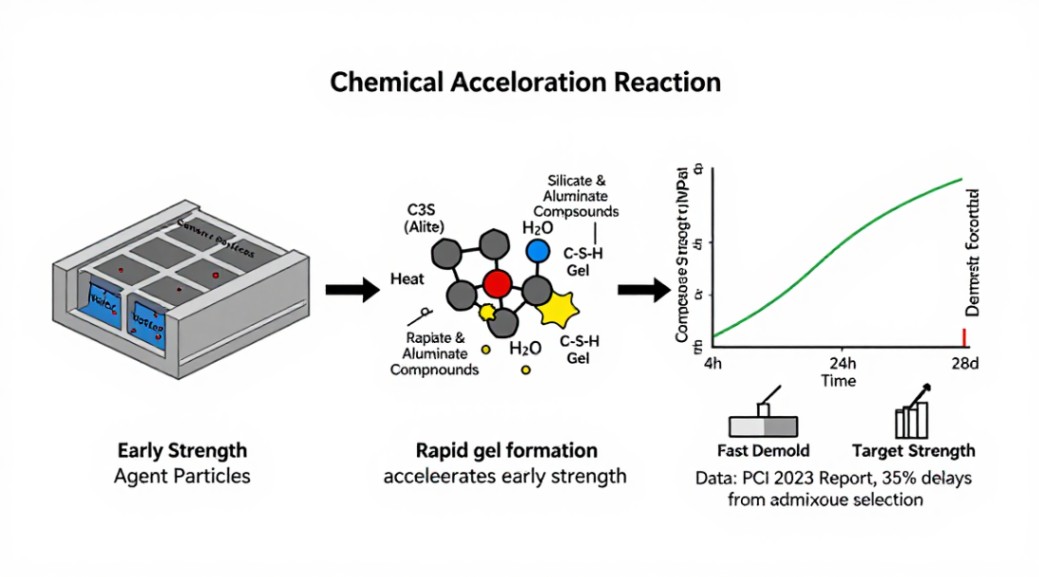
Manufacturers often struggle to balance demolding speed with long-term concrete performance. Data from a 2023 PCI Industry Report indicates that a surprising 35% of production cycle delays are linked directly to suboptimal admixture selection, not curing conditions alone. This article provides objective, data-driven comparisons to help you choose the right fast setting early strength agent for precast.
What is the primary purpose of a fast-setting early strength agent?
These chemical admixtures are engineered to accelerate cement hydration. Their core function in a precast setting is to achieve high early compressive strength much faster than standard concrete. This allows for rapid demolding of forms, significantly increasing production cycle turnover. The result is higher plant throughput and reduced inventory of forms.
How do these agents differ from traditional accelerators?
Traditional accelerators, like calcium chloride, provide a general speed increase. Modern fast setting early strength agents are formulated for targeted performance. They are often calcium chloride-free, focusing on achieving a specific strength threshold (e.g., 15-20 MPa) within 4 to 12 hours without compromising long-term durability. They offer better control over setting time and final strength.
What are the key performance metrics I should compare?
Focus on two concrete data points from standardized tests. Initial set time reduction (ASTM C403) measures how quickly the concrete becomes unworkable. More critically, evaluate compressive strength gain at 6, 12, and 24 hours (ASTM C39). A superior agent delivers a steep early strength curve while ensuring the 28-day strength meets or exceeds the design target.
What are the common chemical compositions, and what are their trade-offs?
- Triethanolamine (TEA) based: Effective at low dosages. Pros: Cost-effective, good early strength. Cons: Can retard setting at higher doses, may impact long-term strength.
- Aluminate-based (e.g., calcium aluminate): Very fast setting. Pros: Excellent for ultra-rapid demolding (2-4 hours). Cons: Can cause flash set if misdosed, requires precise water control, higher cost.
- Nitrate/Nitrite-based: Calcium chloride-free standard. Pros: Good corrosion protection for embedded steel, predictable performance. Cons: Moderate acceleration compared to aluminates, slightly higher cost than TEA.
- Silicate-based formulations: Emerging technology. Pros: Can enhance durability and reduce efflorescence. Cons: Performance is highly mix-design dependent, requires thorough testing.
How does the choice of cement type affect agent selection?
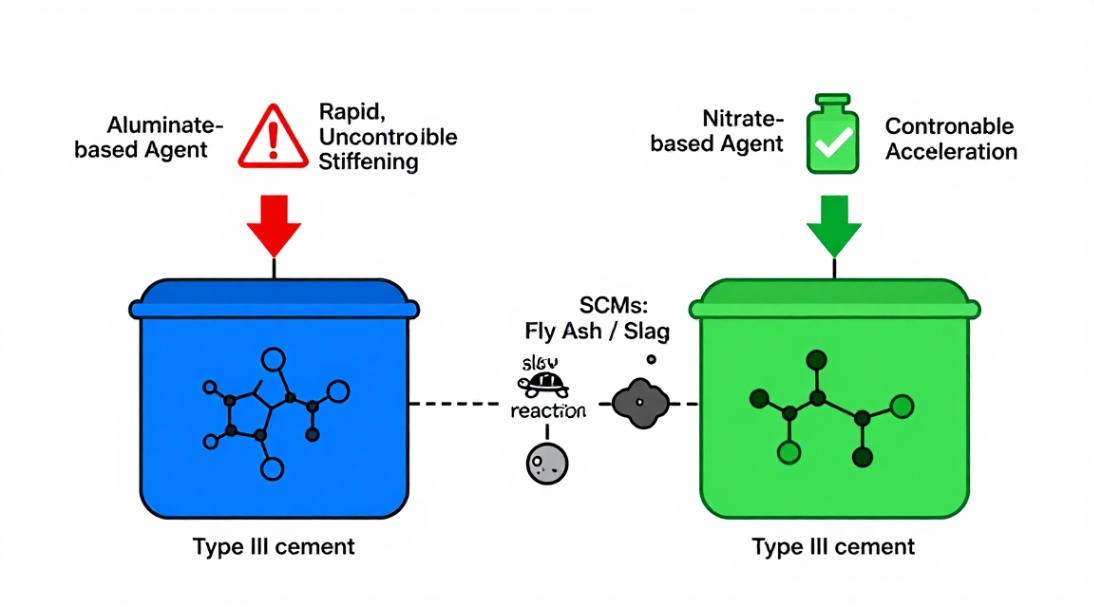
Compatibility is non-negotiable. Type III (high-early-strength) cement will react more vigorously with any accelerator. An aluminate-based agent may cause excessively rapid stiffening. For Type III cement, a nitrate-based agent often provides more controllable acceleration. Always conduct trial batches with your specific cement source and supplementary cementitious materials (SCMs) like fly ash or slag. SCMs typically slow early strength gain, potentially requiring a higher dosage or a more potent agent chemistry.
What is the correct way to integrate the agent into the batching sequence?
Proper integration is critical for uniform performance. Follow this procedure: introduce 75-90% of the total mix water, add aggregates, then add cement. Add the fast setting early strength agent diluted in the remaining mix water after the other solids have begun mixing. Never add the concentrated agent directly to dry cement. This sequence ensures even distribution and prevents localized flash set. In high-shear mixers, total mixing time after admixture addition may need to be reduced.
Do these agents negatively impact long-term durability or final strength?
Not if selected and dosed correctly. A common misconception is that high early strength sacrifices ultimate strength. Modern, well-formulated agents should not reduce 28-day or 56-day compressive strength. In fact, by enabling proper, early curing, they can improve durability. However, excessive dosage of any accelerator can increase drying shrinkage and the risk of microcracking. This is why dosage optimization through plant trials is a mandatory best practice.
What are the most common pitfalls in using these agents?
- Over-dosing: Chasing faster demolding by increasing dosage leads to rapid stiffening, poor finishability, and potential long-term defects.
- Inconsistent batching: Manual or imprecise addition causes batch-to-batch variability in set time and strength.
- Ignoring temperature: The acceleration effect is temperature-dependent. A dosage optimized for 20°C will act much faster at 30°C and slower at 10°C. Adjust dosage seasonally.
- Incompatibility with other admixtures: Combining with certain water-reducers or air-entraining agents can cause severe set retardation or acceleration. Test the full admixture system.
What are the critical selection criteria for my specific precast application?
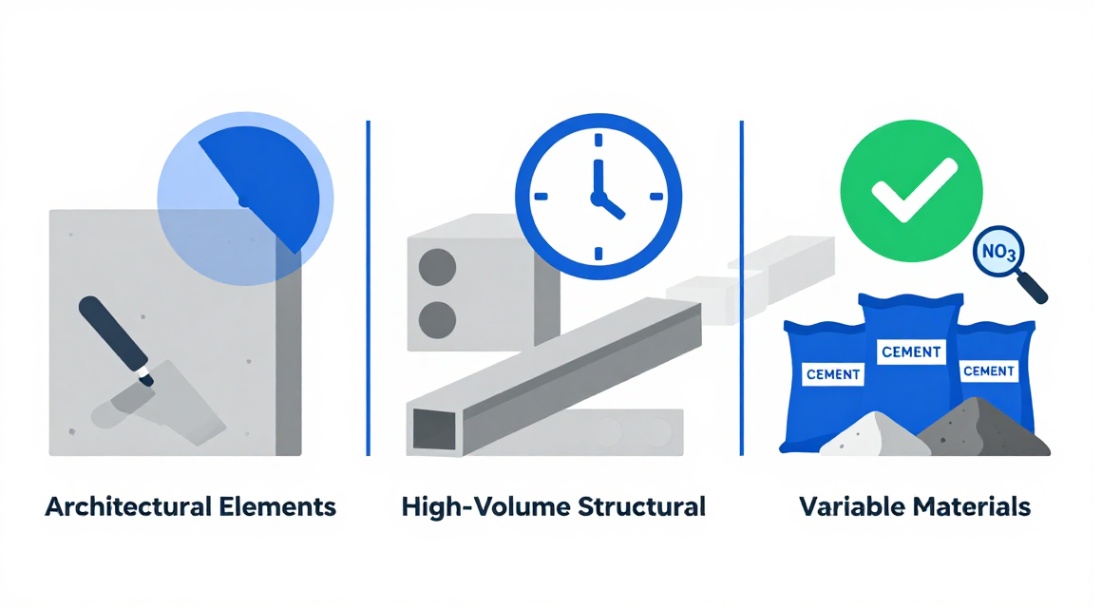
Choose based on your production constraint. For architectural elements requiring a flawless finish, prioritize an agent that provides a manageable window for finishing (e.g., a nitrate-based formula). For high-volume structural elements like hollow-core slabs or double tees, where demolding speed dictates the entire line, an aluminate-based agent might be necessary. For plants with variable cement or aggregate sources, choose an agent known for robust compatibility, even if its peak acceleration is slightly lower. A reliable agent like those based on nitrate chemistry often proves more economical in the long run by preventing production mishaps.
What is the next step after reading this comparison?
Analysis alone cannot guarantee success. Your specific materials and plant conditions are unique. The definitive step is to conduct controlled plant trials. Source small quantities of 2-3 top candidate agents based on this analysis. Run parallel batches with your standard mix, measuring workability, set time, and early strength hourly. This hands-on data is the only way to make a final, low-risk selection for your fast setting early strength agent for precast operation. Consult your admixture supplier’s technical team to design these trials; their expertise can help you avoid costly errors and pinpoint the optimal solution for your throughput and quality goals.
Supplier
We are the global leader in lightweight concrete and advanced engineered foam solutions. Known globally for its commitment to research, innovation, and applied expertise, we have been providing engineered foam solutions since the early 2012’s.
We can supply high-quality concrete admixture and foam concrete related products all over the world.
The company has a professional technical department and quality supervision department, a well-equipped laboratory, and equipped with advanced testing equipment and after-sales customer service center.
If you are interested, please feel free and contact us.