Concrete-mesa | Concrete Admixtures, Tools, and Production Machines

How to Dense Concrete with Sodium Silicate Solution: A Definitive, Step-by-Step Guide
The Counterintuitive Science of Concrete Hardening
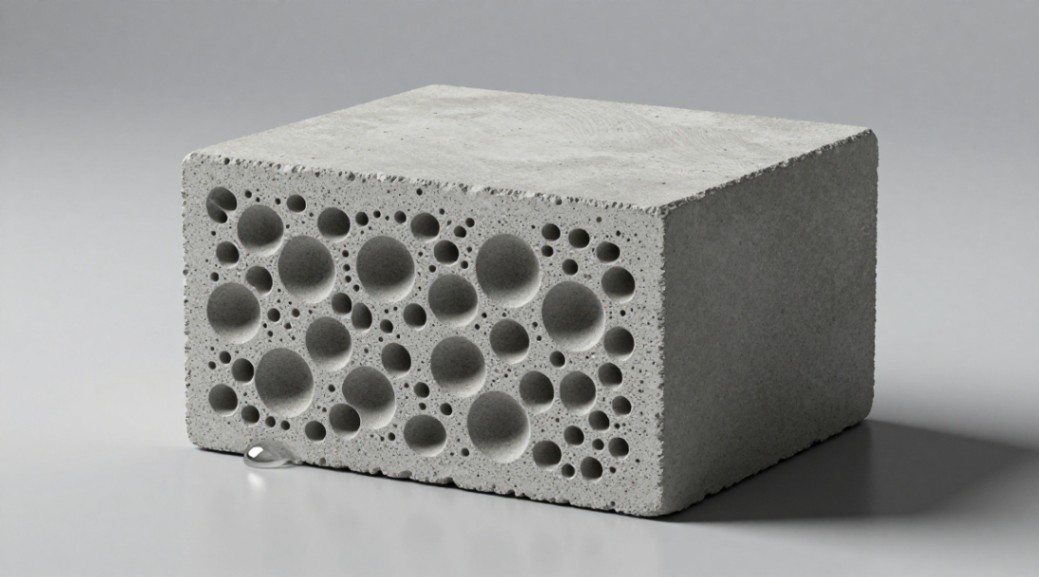
Concrete is not solid. It’s a porous matrix. This may sound strange, but microscopic air pockets and capillaries constitute up to 15-20% of a concrete slab’s volume. This inherent porosity is the root cause of dusting, surface degradation, and reduced chemical resistance. The goal of sodium silicate solution for concrete densification is not to coat the surface, but to exploit this very porosity to create a harder, more durable matrix from within.
Core Principles and Benefits of Sodium Silicate
Sodium silicate solution for concrete densification is a clear, viscous liquid colloquially known as waterglass. Its chemical formula is typically Na₂O·nSiO₂, where ‘n’ defines the silica modulus. The process works via a pozzolanic reaction. The solution penetrates the concrete’s capillaries and reacts with two key components:
- Free Calcium Hydroxide (CH): A weak byproduct of cement hydration.
- Available Calcium Ions (Ca²⁺): From other hydration products.
This reaction forms additional Calcium-Silicate-Hydrate (C-S-H) gel, the primary binder in concrete. You are effectively growing more of the glue that holds concrete together, filling pores and densifying the structure. The primary benefits are undeniable:
- Increased Surface Hardness: Measurably higher Mohs scale and pencil hardness values.
- Superior Abrasion Resistance: Critical for industrial floors and high-traffic areas.
- Effective Dust Proofing: Binds loose fines at the surface.
- Improved Chemical Resistance: A denser surface slows acid and solvent penetration.
Step 1: Pre-Application Assessment and Surface Preparation
Success is determined before a drop of solution is applied. Skipping this phase leads to inconsistent results and wasted material. Begin with a critical assessment.
1.1 Evaluate Concrete Suitability
Not all concrete is a candidate. Sodium silicate requires a reactive substrate. It performs optimally on standard Portland cement concrete. Avoid application on:
- Non-cementitious surfaces (epoxy, paint, sealers).
- Concrete with waterproofing or curing membranes.
- Extremely old, carbonated, or non-reactive surfaces.
- Concrete with a water-cement ratio above 0.5 (often too dense for deep penetration).
1.2 Execute Mandatory Surface Preparation
The surface must be clean, sound, and open. Follow this sequence:
- Mechanically Profile: Use a diamond grinder or shot blaster to open the surface. This removes laitance and contaminants. A CSP 2-3 (Concrete Surface Profile) is typically sufficient.
- Remove All Contaminants: Vacuum thoroughly. Any dust, oil, or grease will block penetration.
- Check Moisture Content: The concrete must be dry. Internal moisture should be below 4-5% for optimal penetration. Use a reliable moisture metre.
Many users on professional forums like Reddit’s r/Concrete report failure, citing “the product just pooled on the surface.” In 90% of cases, the culprit is insufficient mechanical profiling and residual contamination.
Step 2: Application Methodology
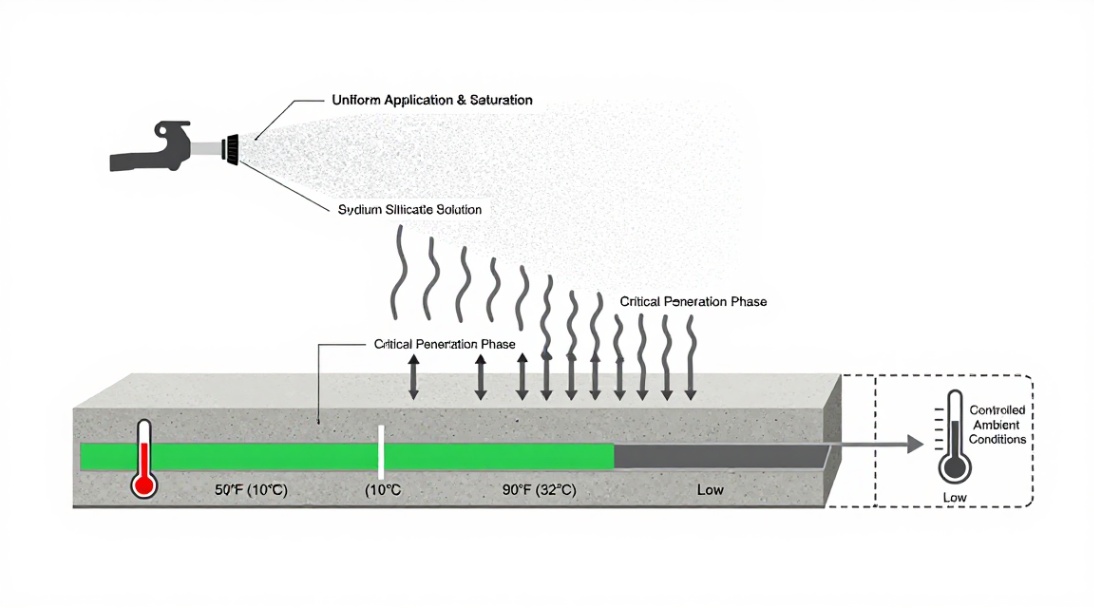
Uniformity and saturation are the objectives. Ambient conditions are critical: apply between 50°F (10°C) and 90°F (32°C) with low humidity to allow proper penetration before evaporation.
2.1 Mixing and Initial Application
Most commercial sodium silicate solutions for concrete densification are ready-to-use. Agitate the container. Do not dilute unless specified by the manufacturer. Apply the first coat using a low-pressure sprayer, microfiber mop, or soft-bristle squeegee. The goal is to flood the surface without puddling.
2.2 Managing Penetration and Re-application
Watch the concrete closely. It will darken as the solution penetrates. Maintain a wet edge. Areas that absorb the solution quickly are more porous. Apply a second or even third coat to these areas while the previous coat is still damp to ensure deep, uniform concrete densification. A common benchmark is applying 150-300 sq ft per gallon for the initial saturation, but let the concrete’s thirst guide you.
2.3 Curing and Final Steps
The chemical reaction requires time. Allow the treated surface to cure for a minimum of 1-2 hours. After this period, you must remove any unreacted silicate residue, which will appear as a white, crystalline powder or haze once dry.
- Lightly mist the surface with clean water.
- Scrub with a stiff-bristle broom or auto-scrubber.
- Remove the slurry with a wet vacuum.
Allow the floor to dry completely. Light foot traffic can resume in 4-6 hours, but postpone heavy equipment traffic for at least 24-48 hours to allow the internal pozzolanic reaction to mature.
Step 3: Understanding Limitations and Best Practices
Sodium silicate solution for concrete densification is a powerful tool with defined boundaries. Acknowledging them prevents misuse.
3.1 Key Limitations
- Not a Coating: It provides no glossy film or significant protection against stains.
- Limited Penetration Depth: Effective action is typically within the top 1-4 mm of the slab. It will not stabilize deeply compromised concrete.
- Potential for Whitening: Improper residue cleanup leads to a permanent white haze.
- Alkali-Silica Reaction (ASR) Risk: Avoid on concrete with known alkali-reactive aggregates.
3.2 Comparison to Lithium Silicate
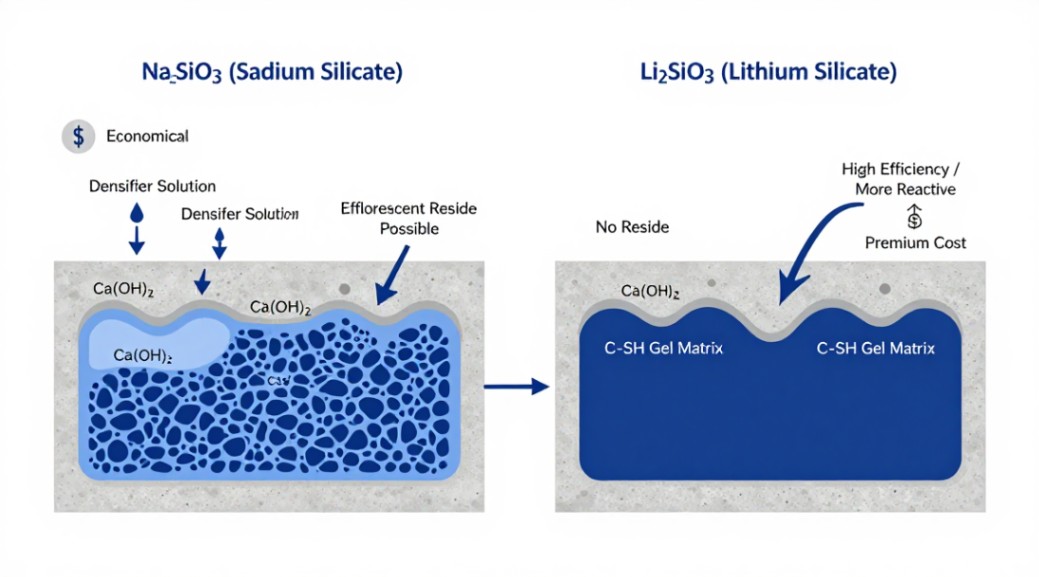
Professionals often ask about lithium-based densifiers. Lithium silicate is more reactive and efficient, especially on lower-quality concrete with high calcium hydroxide content. It forms a harder, more chemically stable gel and does not produce the same efflorescent residue. For mission-critical applications or problem slabs, lithium silicate is often the superior, albeit more expensive, choice. Sodium silicate remains a highly effective, economical solution for standard industrial hardening and dust-proofing.
3.3 Expert Best Practices for Uniformity
- Always conduct a test patch in an inconspicuous area to gauge absorption and final appearance.
- Use consistent, overlapping application patterns, similar to painting.
- Work in manageable sections to maintain a wet edge.
- Under-applied areas will remain softer. It’s better to apply multiple thin, controlled coats than one heavy, wasteful one.
Next Steps for the Professional
This guide provides the foundational framework. Mastery comes from application. Your next action is to source a high-quality, industry-grade sodium silicate solution for concrete densification from a reputable supplier. Obtain a technical data sheet and review the specific silica modulus and solids content. Then, execute a controlled test on your project substrate. Document the absorption rate, number of coats, and final surface hardness. This empirical data is your most valuable tool for predicting full-scale project success and achieving a truly densified, high-performance concrete surface.
Supplier
We are the global leader in lightweight concrete and advanced engineered foam solutions. Known globally for its commitment to research, innovation, and applied expertise, we have been providing engineered foam solutions since the early 2012’s.
We can supply high-quality concrete admixture and foam concrete related products all over the world.
The company has a professional technical department and quality supervision department, a well-equipped laboratory, and equipped with advanced testing equipment and after-sales customer service center.
If you are interested, please feel free and contact us.