Concrete-mesa | Concrete Admixtures, Tools, and Production Machines

Graphene Oxide vs. Traditional Concrete Modifiers: The Essential Guide for Engineers
Is This the End for Traditional Additives?
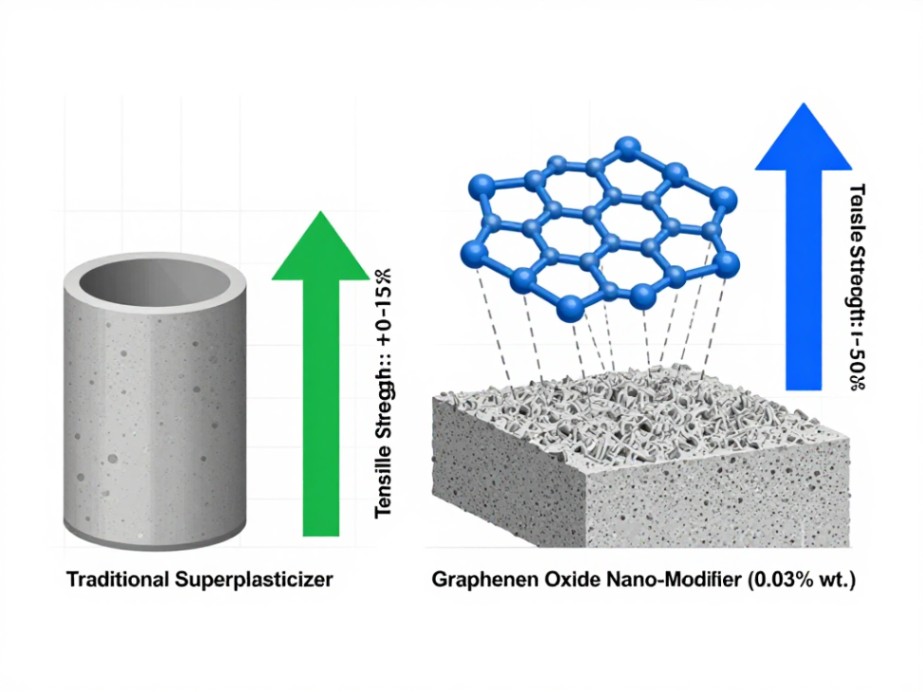
Concrete is strong in compression. That’s the old story. The new data is startling. Introducing a mere 0.03% by weight of cement of a graphene oxide nano-modifier for concrete can boost tensile strength by 30-50%. Compare that to the 10-15% you might get from a typical superplasticizer. This is not an incremental step. It’s a material-level transformation. Let’s break down how it stacks up against the additives you already know.
How Graphene Oxide Actually Works in Your Mix
Forget vague claims. The mechanism is physical and elegant. Graphene oxide sheets act as a nano-scale reinforcement mesh within the cement paste.
- Nucleation Sites: The sheets provide countless surfaces for cement hydrates to form, accelerating early strength.
- Crack Bridging: Their high aspect ratio and strength physically block micro-cracks from propagating.
- Pore Refinement: They fill nano-pores, making the matrix denser. This directly reduces water permeability.
The result? You aren’t just adding a chemical; you’re engineering the nanostructure.
The Head-to-Head Comparison: Graphene Oxide vs. The Field
You need clear, objective pros and cons to make a specification decision. Here is the direct analysis.
1. Strength & Durability Performance
Graphene Oxide Nano-Modifier:
- Pros: Unmatched tensile/flexural strength boost. Dramatically lowers permeability (often 50-70%). Excellent chloride ion resistance extends service life in corrosive environments. Reduces long-term creep and shrinkage.
- Cons: Compressive strength gains are significant but not its primary superpower. Performance is highly dependent on perfect dispersion.
Traditional Superplasticizers (PCE, SNF):
- Pros: Proven, reliable workability and water reduction. Good for achieving high early compressive strength. Cost-effective for standard applications.
- Cons: Minimal direct impact on tensile strength or intrinsic durability. Can sometimes cause excessive retardation or air entrainment issues.
2. Crack Resistance & Toughness
Graphene Oxide Nano-Modifier:
- Pros: Actively controls cracking at the micro-scale. Increases fracture energy. This is its killer feature for structures subject to dynamic loads or thermal cycling.
- Cons: Does not replace macro-fibers (steel/polypropylene) for controlling large cracks; it works synergistically with them.
Traditional Shrinkage-Reducing Admixtures (SRA):
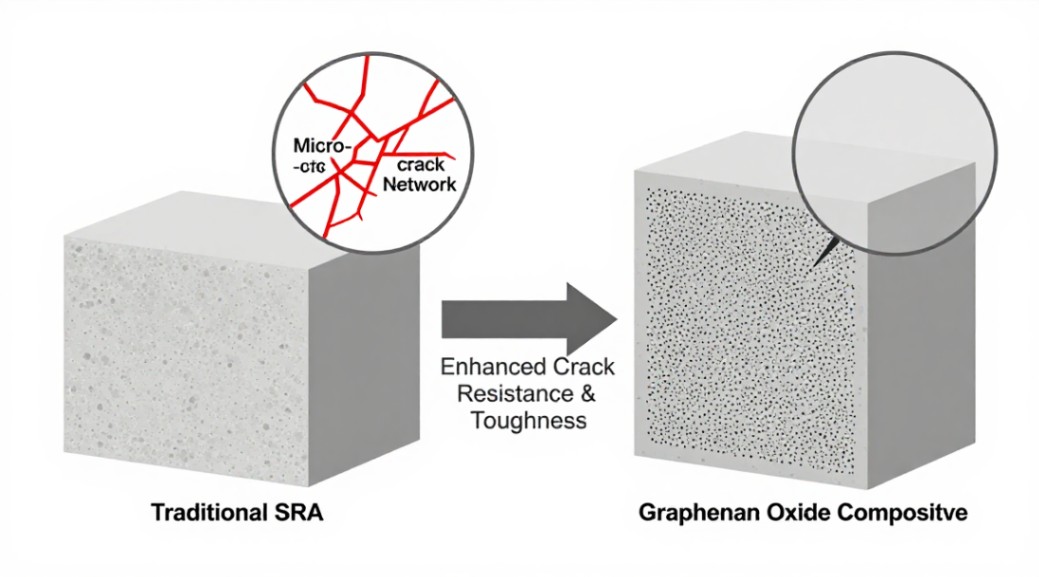
- Pros: Effective at reducing plastic and drying shrinkage, which indirectly reduces cracking risk.
- Cons: A chemical band-aid. Does not improve the fundamental mechanical properties or post-crack behavior of the concrete.
3. Cost, Handling & Scalability
Graphene Oxide Nano-Modifier:
- Pros: Extremely low dosage (0.01%-0.05%) means a little goes a long way. Potential for long-term lifecycle cost savings through reduced maintenance and longer service life.
- Cons: Higher upfront material cost per kg. Requires precise dosing equipment and trained batching personnel. Scalability depends on consistent quality of the graphene oxide dispersion.
Traditional Additives:
- Pros: Low cost, familiar technology. Every batch plant is set up to handle them. Massive, proven supply chains.
- Cons: Recurring material cost with diminishing returns on performance. May require combinations of multiple admixtures to approach the multi-property benefits of graphene oxide.
What Real Users and Researchers Are Saying
Let’s ground this in reality. Feedback from early adopters is telling.
On engineering forums, a common theme emerges. Users report that the greatest challenge is achieving consistent dispersion. “If you just chuck the powder in the truck mixer, you’ll waste your money,” one project manager noted. The successful projects pre-disperse the graphene oxide nano-modifier for concrete in a small amount of mixing water using a high-shear mixer before batching.
Case studies from pilot projects show compelling data. A marine terminal slab showed chloride ingress reduced by over 60% after 2 years compared to an SRA-modified control section. Researchers publishing in Cement and Concrete Composites consistently highlight the accelerated C3S hydration and the formation of a more cohesive, cross-linked C-S-H gel.
The Practical Path Forward: Your Next Steps
So, is graphene oxide right for your next project? Use this decision framework.
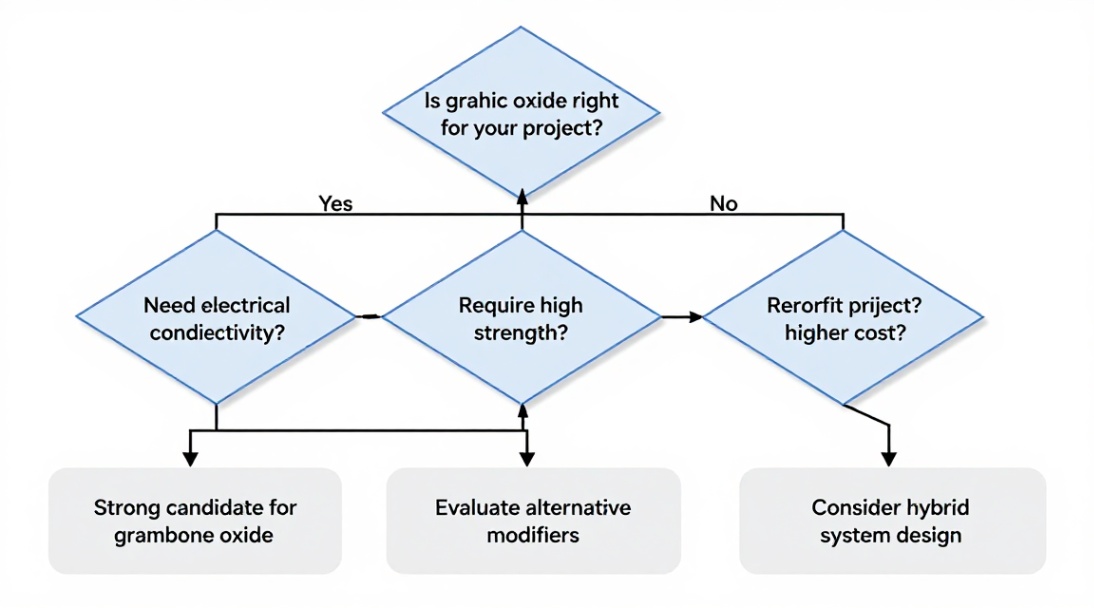
- Choose Graphene Oxide If: Your project demands extreme durability (marine, chemical plants, bridges), requires high tensile strength with thin sections, or aims for a 100+ year design life where lifecycle cost trumps initial cost.
- Stick with Traditional Additives If: You’re working on standard commercial slabs, foundations, or pavements where code-minimum performance is sufficient, and budget/timeline constraints are paramount.
The future is multifunctional. Imagine concrete with graphene oxide that also enables self-sensing or thermal regulation. That research is already underway. For now, the choice is clear. For specialty, high-performance applications where failure is not an option, the graphene oxide nano-modifier for concrete is no longer a lab curiosity. It’s a legitimate, performance-driven specification. Start with a small trial batch. Master the dispersion process. Measure the results yourself. The data will speak for itself.
Supplier
We are the global leader in lightweight concrete and advanced engineered foam solutions. Known globally for its commitment to research, innovation, and applied expertise, we have been providing engineered foam solutions since the early 2012’s.
We can supply high-quality concrete admixture and foam concrete related products all over the world.
The company has a professional technical department and quality supervision department, a well-equipped laboratory, and equipped with advanced testing equipment and after-sales customer service center.
If you are interested, please feel free and contact us.