Concrete-mesa | Concrete Admixtures, Tools, and Production Machines

Non-Chloride Early Strength Admixtures: What Every Contractor Must Avoid to Prevent Catastrophic Corrosion
The Hidden Cost of Speeding Up Concrete: A Critical Warning
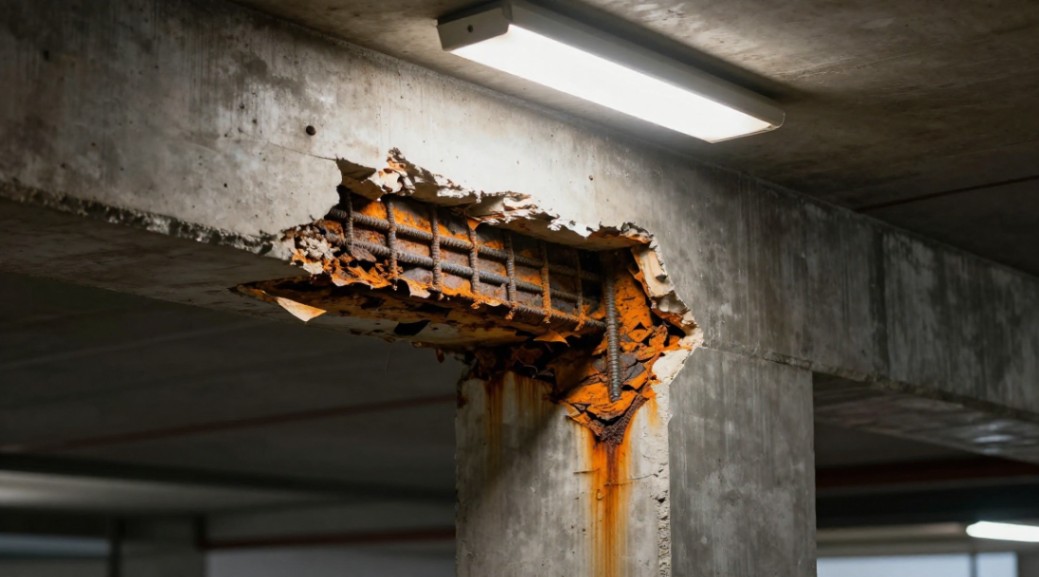
For decades, the industry has focused on speed and initial cost. Here’s a sobering truth: over 60% of premature deterioration in reinforced concrete, particularly in parking garages and bridge decks, originates from chloride-induced corrosion. This failure often begins with a single, seemingly minor specification error during cold weather pours. The logic is undeniable: using an early strength admixture containing chlorides to accelerate a pour is financially equivalent to installing a hidden, multi-million dollar demolition timer within your structure. The initial gain in speed is catastrophically offset by the long-term liability of corrosion. Let’s dissect the critical errors you must avoid.
Essential Q&A: Avoiding the Pitfalls of Non-Chloride Accelerators
1. What is the single biggest mistake when using any early strength admixture?
Assuming all accelerators are the same. The fundamental, non-negotiable rule is this: never use a chloride-based accelerator on reinforced concrete, pre-stressed concrete, or any structure where metal is embedded. Calcium chloride, while effective and cheap, delivers a potent dose of chloride ions directly into the concrete matrix. These ions actively attack and depassivate the protective oxide layer on steel rebar, initiating corrosion that expands, cracks the concrete, and leads to structural compromise. This is not a theory; it’s an electrochemical inevitability.
2. Why is “non-chloride” specifically mandated in modern codes for critical infrastructure?
Codes like ASTM C494 (Type C, Accelerating) and AASHTO M194 exist to prevent the systemic risk of chloride attack. A non-chloride early strength admixture provides the necessary early strength gain-often critical for cold weather concreting, formwork removal, or early load application-without introducing the primary agent of corrosion. The long-term durability and lifecycle cost of the structure supersede the marginal savings of a chloride-based product. Using chloride accelerators on bridges or parking decks today is professional negligence.
3. What are the primary chemical alternatives to calcium chloride, and what are their trade-offs?
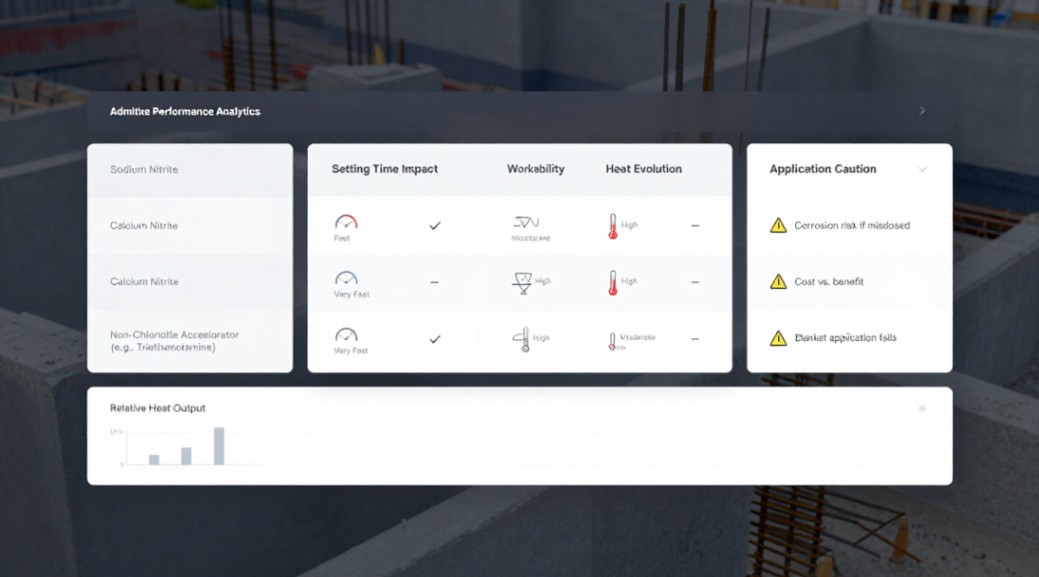
Understanding the chemistry is key to proper application. The main non-chloride accelerators function differently:
- Nitrates & Nitrites: These are common, effective accelerators. They can be mildly corrosive in very high concentrations in their raw form, but in the hardened concrete matrix at correct dosages, they are non-corrosive. Their primary function is to accelerate the silicate phase reactions in cement.
- Aluminates (e.g., Calcium Aluminate): These work by rapidly forming ettringite, which provides very early stiffening. They significantly reduce setting time. This demands precise timing for finishing operations. Be aware: over-dosage can cause flash set, ruining the placement.
- Triethanolamine (TEA) & others: Often used in small doses as a grinding aid or component in blended admixtures. In high doses, it can act as a retarder, highlighting the need for strict dosage control.
Each has a unique impact on setting time, workability, and heat evolution. A blanket application approach fails.
4. What are the top 3 errors in field application that compromise performance?
Even with the correct non-chloride admixture, execution errors can lead to failure.
- Improper Batching Sequence: Never add a concentrated liquid admixture directly to dry cement or into a nearly empty mixer. This causes severe localized acceleration and uneven set. The correct sequence is to add most mixing water first, then aggregates, then cement, with the admixture diluted in the remaining water.
- Ignoring Compatibility with Other Admixtures: Combining a non-chloride early strength admixture with a water-reducer or air-entraining agent without prior testing is a gamble. Chemical interactions can neutralize effects or cause unpredictable set behavior. Always conduct site trials with the full mix design.
- Over-Dosing to Compensate for Poor Practices: Using extra admixture to salvage a mix with too low a temperature or excessive water content is a critical error. It disrupts the chemical balance, can cause rapid stiffening or cracking from thermal stress, and is never a substitute for proper cold weather concreting protocols (heated materials, insulation).
5. How does the cost-benefit analysis truly weigh out?
Frame the question correctly. It’s not “admixture cost per cubic yard.” The real analysis is: Cost of a premium non-chloride admixture versus the Net Present Value of future repair costs due to corrosion. For a temporary construction slab, the risk may be low. For any permanent, reinforced structure, the economic and safety logic is overwhelming. The admixture cost is a fraction of a percent of the total project cost. The repair cost for corrosion-damaged concrete is routinely 5-10 times the original construction cost per square foot, not including liability and downtime.
6. What is the one step most contractors skip that guarantees suboptimal results?
They fail to conduct a simple, site-specific trial batch. Every mix design, cement source, and local aggregate is different. A trial batch under realistic temperature conditions is the only way to verify: final set time, early strength gain at 12-24 hours, workability window, and finishability. It reveals problems before the truck arrives on the critical pour. This step is not optional for success with any accelerating admixture.

Implementing a Fail-Safe Strategy
The path to durable, accelerated concrete is clear and logical. First, eliminate chloride-based products from your specification entirely. Second, select a non-chloride early strength admixture compatible with your full chemical system-this is where consulting with a qualified technical representative, who can provide a product like a nitrate or aluminate-based accelerator proven for your climate and application, becomes a strategic necessity. Third, enforce strict batching and placement protocols. Finally, validate everything with a field trial. Your structure’s century-long service life depends on the decisions you make during the first 24 hours.
Supplier
We are the global leader in lightweight concrete and advanced engineered foam solutions. Known globally for its commitment to research, innovation, and applied expertise, we have been providing engineered foam solutions since the early 2012’s.
We can supply high-quality concrete admixture and foam concrete related products all over the world.
The company has a professional technical department and quality supervision department, a well-equipped laboratory, and equipped with advanced testing equipment and after-sales customer service center.
If you are interested, please feel free and contact us.