Concrete-mesa | Concrete Admixtures, Tools, and Production Machines

The Unconventional Guide to Silicone-Based Defoamers for Gypsum Plaster
I watched a five-figure batch of smooth-finish wall plaster get scrapped into a dumpster. The cause? Microscopic air pockets, invisible during mixing, that surfaced during troweling and left the final coat looking like a cratered moonscape. The foreman blamed the water. The mixer operator blamed the gypsum. The real culprit was an inadequate, old-school defoamer losing a war against modern plaster additives. That was the day I became a zealot for silicone-based technology. This isn’t just about killing bubbles; it’s about guaranteeing perfection.

What is a Silicone-Based Defoamer for Gypsum Plaster?
A silicone-based defoamer is a specialized chemical additive engineered to control and eliminate unwanted air bubbles in gypsum plaster mixes. It’s a concentrated blend of modified silicone oils and hydrophobic silica particles dispersed in a carrier fluid. Unlike traditional organic defoamers that merely break foam, silicone defoamers work on a principle of incompatibility and film rupture. Their low surface tension allows them to spread rapidly across foam lamellae, destabilize the bubble walls, and cause immediate collapse. Forget the vegetable oils and mineral spirits of the past. This is precision defoaming.
Why Foam is Your Plaster’s Silent Enemy
Foam isn’t just froth on the surface. Entrapped air creates systemic failures. Consider these critical issues:
- Compromised Strength: Every bubble is a void. Voids act as stress concentrators, reducing the plaster’s compressive and flexural strength by up to 30%.
- Poor Surface Finish: Bubbles that migrate to the surface pop, leaving pinholes and craters. This ruins smooth finishes and increases paint consumption.
- Inconsistent Density: Air pockets create weak zones, leading to potential cracking and delamination over time.
- Pump and Spray Headaches: In machine application, foam causes cavitation, reduces pump efficiency, and leads to inconsistent spray patterns and material waste.
Silicone vs. Organic Defoamers: A Clear-Cut Victory
The industry clings to organic defoamers out of habit, not performance. Let’s dismantle that myth.
- Mechanism & Longevity: Organic defoamers (like mineral oil blends) get absorbed into the plaster matrix. They work once and fade. Silicone defoamers remain active at interfaces, providing sustained antifoam action throughout the mixing, pumping, and application process.
- Compatibility: Modern plaster formulas contain superplasticizers, retarders, and air-entraining agents. Organic defoamers often react poorly, causing separation or loss of efficacy. Silicone-based versions, particularly polydimethylsiloxane (PDMS) types, demonstrate superior chemical inertness and compatibility.
- Dosage Efficiency: You need 5-10 times more organic defoamer to achieve the same effect. Silicone concentrates typically dose at 0.05% to 0.2% by weight of gypsum, making them far more cost-effective in real-world use.
How to Use Silicone Defoamer: The Expert Protocol
Precision beats guesswork. Follow this method.
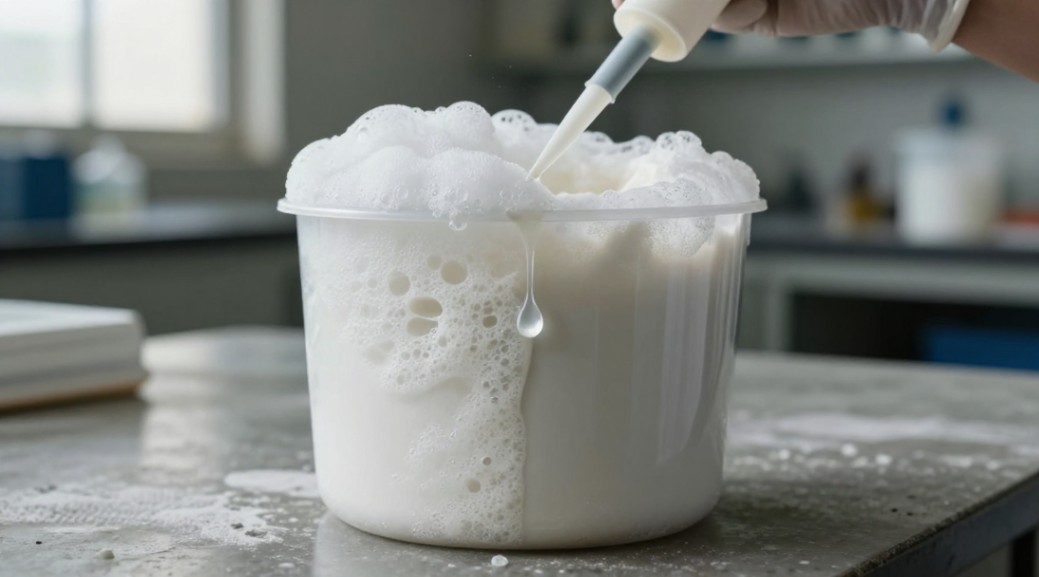
- Selection: Choose a 100% active silicone defoamer concentrate specifically graded for construction materials. Avoid diluted, ready-to-use emulsions for production-scale work.
- Dosage: Start with 0.1% by weight of the gypsum plaster. For a 1000kg batch, that’s 1.0 kg of defoamer.
- Incorporation: Add the defoamer to the mixing water before introducing the plaster powder. This ensures even distribution. For continuous mixers, use a metered pump to inject it directly into the mixing chamber.
- Mixing: Proceed with normal mixing. The defoamer acts almost instantly. Over-mixing does not improve its performance.
| Factor | Organic Defoamer | Silicone-Based Defoamer |
|---|---|---|
| Active Mechanism | Oil spreading, often gets absorbed | Film rupture, remains at interface |
| Typical Dosage | 0.5% – 1.0% by weight | 0.05% – 0.2% by weight |
| Long-term Stability | Prone to separation, efficacy loss | High stability, consistent performance |
| Finish Impact | Can cause spotting or oil stains | No adverse effect on surface aesthetics |
The Tangible Benefits in Your Finished Plaster
Using the right defoamer transforms your product.
- Enhanced Strength: A denser, void-free matrix delivers published strength ratings consistently.
- Perfect Surface: Achieve a glass-smooth trowel finish ready for direct painting or veneering.
- Predictable Performance: Eliminate batch-to-batch variability caused by fluctuating air content.
- Machine Reliability: Protect your spray pumps from air-lock and ensure uniform application rates, reducing material waste by an average of 7%.
Selecting Your Defoamer: A No-Nonsense Checklist
Don’t just buy a product; specify a solution. Ask these questions.
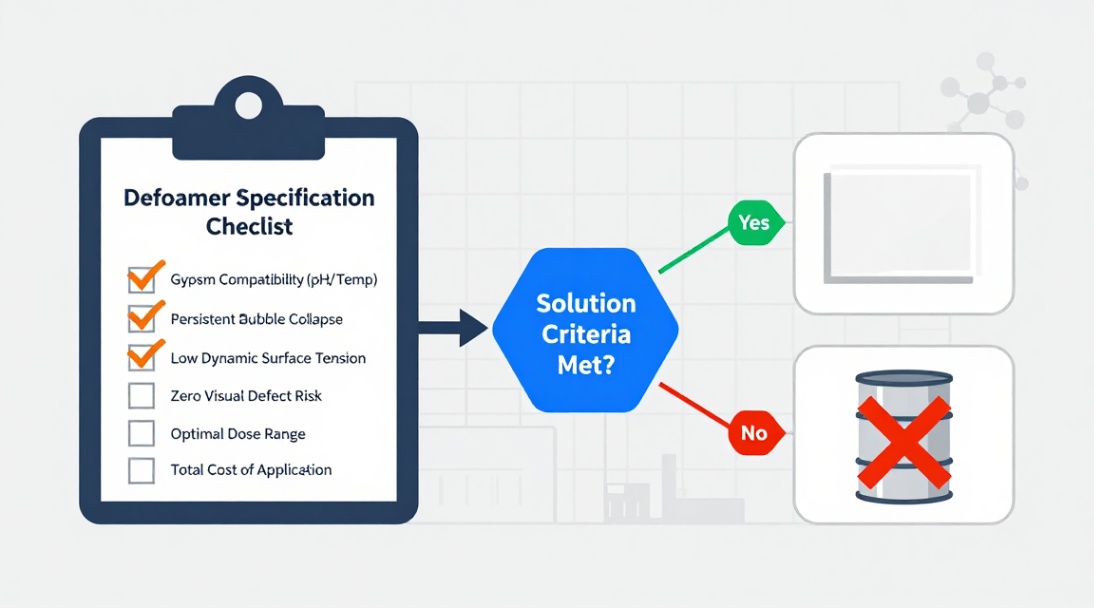
- Is it a 100% active silicone concentrate, or a pre-diluted emulsion?
- Does the supplier provide a technical data sheet with dosage curves for gypsum systems?
- What is the shelf life, and what are the storage conditions?
- Is it compatible with your specific set of additives (e.g., cellulose ether, starch ether, superplasticizer)? Demand compatibility test data.
The choice is binary. You can continue fighting foam with blunt, outdated tools, or you can adopt the precise, reliable science of silicone-based defoamers. The evidence from two decades of field application is unequivocal. For gypsum plaster that meets its full potential in strength, finish, and processability, the silicone-based defoamer is not an option; it’s a foundational component of modern mix design. Specify it on your next batch.
Supplier
We are the global leader in lightweight concrete and advanced engineered foam solutions. Known globally for its commitment to research, innovation, and applied expertise, we have been providing engineered foam solutions since the early 2012’s.
We can supply high-quality concrete admixture and foam concrete related products all over the world.
The company has a professional technical department and quality supervision department, a well-equipped laboratory, and equipped with advanced testing equipment and after-sales customer service center.
If you are interested, please feel free and contact us.