Concrete-mesa | Concrete Admixtures, Tools, and Production Machines

The Industrial Foam Generator for CLC Blocks: Your Single Most Critical Piece of Equipment. Don’t Buy Before Reading This.
Let me tell you about a project I saw fail. The goal was a standard load-bearing CLC block for an apartment complex. The mix design looked perfect on paper. The cement was high-grade, the sand was precisely graded, and the team followed the process to the letter. Yet, three weeks after casting, the blocks crumbled under hand pressure. The core was a weak, honeycombed mess. The culprit wasn’t the cement or the sand. The entire batch was sabotaged by unstable, inconsistent foam from an undersized, poorly maintained foam generator. That single piece of equipment, often treated as an afterthought, turned a significant investment into a pile of worthless slurry. This isn’t an isolated incident. On industry forums and in private conversations, the same story repeats: “Our blocks lack strength,” “The density is never consistent,” “The insulation value is a guess.” The root cause almost always traces back to the foam.
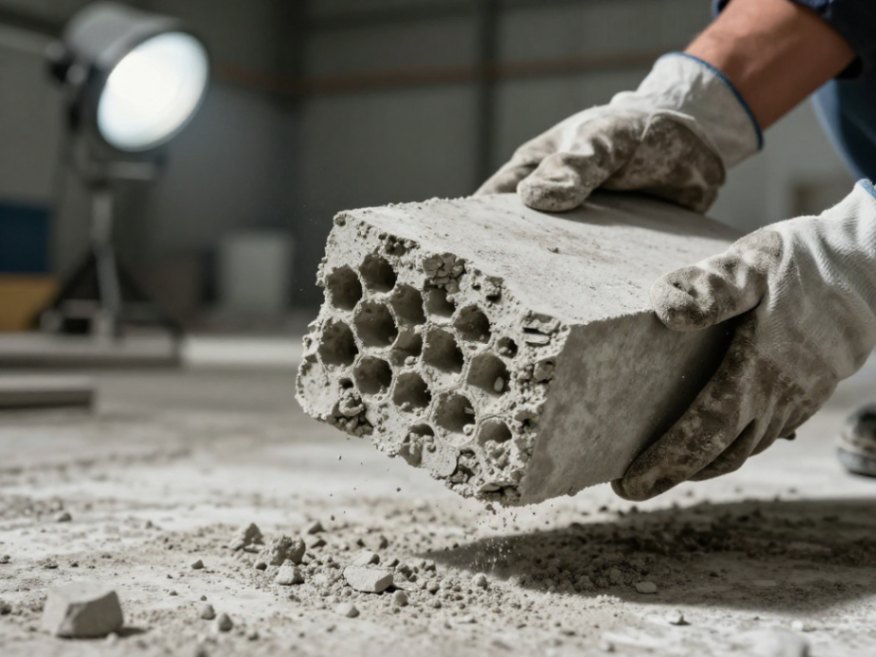
The Heart of the Matter: Why Your Foam Generator Isn’t Just a Bubbler
An industrial foam generator for CLC blocks is not a simple air compressor hooked to a soapy water tank. It is a precision metering and shearing system. Its sole purpose is to produce a stable, microscopic cellular structure-the foam-that will permanently replace solid aggregate in your concrete matrix. The quality of these air voids directly dictates every critical property of your final CLC block: compressive strength, dry density, thermal insulation, and water absorption. Get the foam wrong, and you compromise the entire product. Many newcomers fixate on the mixer or the block mold. Experienced manufacturers watch the foam generator like a hawk.
The Three Unforgivable Mistakes with CLC Foam Generation
1. Ignoring Foam Stability and ‘Half-Life’
This is the silent killer. You generate beautiful, stiff foam, but it starts collapsing the moment it leaves the nozzle. By the time it’s mixed into the slurry, its volume has dropped 30%. Your calculated density of 600 kg/m³ becomes 800 kg/m³. Your insulation spec is gone. Your strength is unpredictable. Stability is measured by the foam’s “half-life”-the time it takes for a set volume to drain 50% of its liquid. Industrial-grade foam generators using precise pressure and shear create foam with a half-life exceeding 2 hours. The warning is clear: if your foam collapses in the mixing drum, you will never achieve consistent, specification-grade CLC blocks.
2. Chasing Low Cost Over Consistent Bubble Size
Bubble size distribution is non-negotiable. Uniform, sub-millimeter bubbles (typically 0.3-0.8mm) create a strong, closed-cell matrix. Inconsistent, large bubbles create weak points. I’ve seen generators that produce a froth of large, unstable air pockets mixed with fine foam. This leads to differential shrinkage, cracking, and drastically reduced compressive strength. The common culprit is a low-shear generator or an unsuitable foaming agent. The feedback from production managers is unanimous: investing in a generator with a high-shear inline mixing head pays back tenfold in block quality and reduced rejection rates.
3. Neglecting the System Integration
A foam generator does not operate in a vacuum. Its output must synchronize perfectly with your mixing station’s batch cycle and water flow. A frequent error is using a generator rated for a continuous, low-output flow for a large, rapid-batch mixer. The result is under-foamed slurry or painfully long cycle times. The system must be engineered together. Key parameters are foam output rate (liters per minute), working pressure (typically 4-8 bar), and the integration of automated density controllers that adjust foam injection based on real-time slurry feedback.
A Technical Look at the Right Way: Core Components and Protocol
To avoid these pitfalls, understand what a proper industrial system entails. It’s a closed-loop pressure system. A precision dosing pump delivers a concentrated foaming agent solution (synthetic or protein-based) to a mixing chamber. Simultaneously, a regulated air supply injects air. The heart is the shear generator-often a series of fine mesh screens or a dynamic shear valve-that violently mixes the liquid and air under pressure, creating dense, uniform foam.
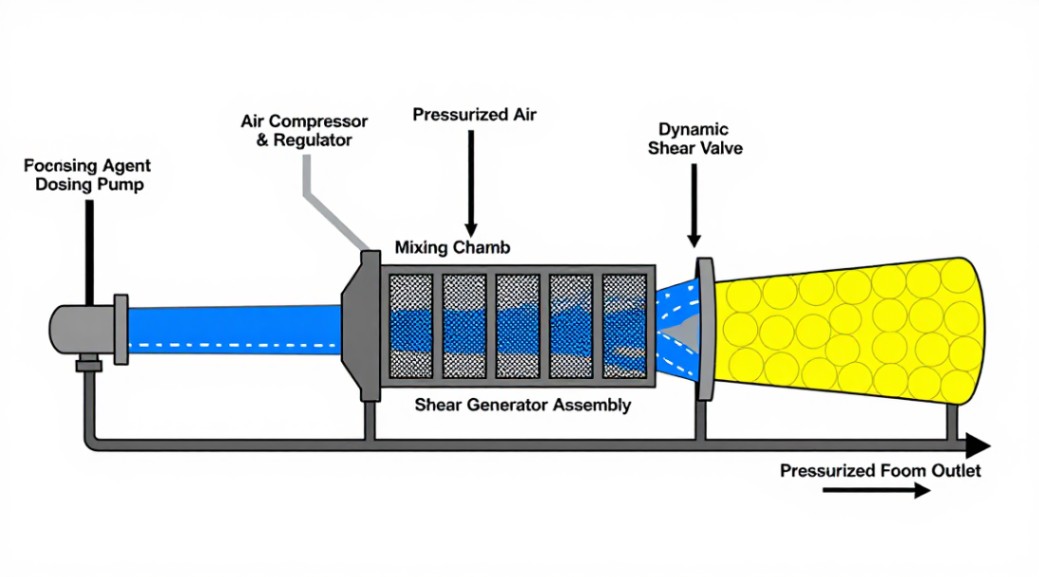
| Component | Critical Function | Common Failure Point |
|---|---|---|
| Proportioning Pump | Precisely meters foaming agent concentrate (e.g., 1-4% dilution). | Diaphragm wear causing ratio drift; always keep spares. |
| Air Regulation System | Provides constant pressure (e.g., 6 bar) regardless of flow demand. | Water in airline corroding valves, causing pressure spikes. |
| Shear Generation Chamber | Creates uniform bubble size via meshes or mechanical shear. | Clogging from impurities; requires daily inspection and weekly cleaning. |
| Foam Density Sensor | Measures mass per liter of foam (e.g., 40-80 g/L) for real-time control. | Calibration drift; calibrate against known weight/volume weekly. |
The Choice That Defines Your Product: Synthetic vs. Protein Foam
This decision impacts your block’s market. Synthetic foaming agents (sulfonated compounds) are common, cost-effective, and produce good, stable foam. They are the default for general-grade blocks. However, for blocks requiring the highest strength-to-density ratio or superior fire resistance, protein-based foams are superior. Derived from hydrolyzed animal or plant proteins, they create a tougher, more elastic bubble membrane. The result is a CLC block with approximately 15-25% higher compressive strength at the same density. The trade-off is cost and shorter shelf life. The warning here is straightforward: if you are producing structural-grade or premium insulation blocks, do not default to the cheapest synthetic agent. Test both. Your final product data will justify the investment.
The Non-Negotiable Maintenance Ritual
This equipment demands respect. A neglected generator will bankrupt you through wasted material and failed blocks. Your daily checklist must include: flushing the system with clean water for 10 minutes after the final batch, checking all hose connections for leaks, and verifying the foam density with a simple bucket test. Weekly, you must dismantle the shear elements (screens or valve) and clean them in a mild acid solution to dissolve cementitious buildup. Monthly, inspect pump diaphragms and air regulator filters. This isn’t optional overhead. This is the core discipline of profitable CLC manufacturing.
Beyond the Hype: A Clear-Eyed Cost-Benefit Analysis
Yes, a proper industrial foam generator represents a capital expenditure. Compare it to the true cost of failure: entire batches of substandard blocks, lost customer trust, and constant remedial work. A reliable generator is the foundation of your process control. It enables you to hit precise density targets consistently, which translates directly to predictable strength, predictable insulation values, and predictable material costs per block. It turns your production from an artisanal gamble into an industrial science.
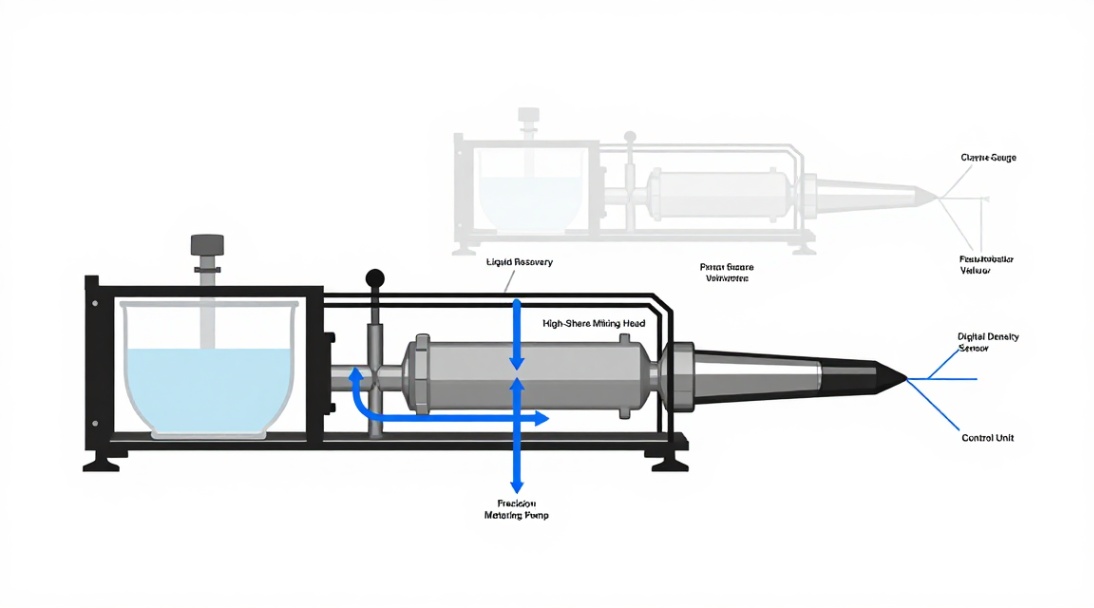
The path forward is not about buying the most expensive machine. It is about understanding the process deeply enough to ask the right questions. Demand a foam stability test. Insist on seeing the bubble structure under a microscope. Require that the supplier integrate the generator’s controls with your batching system. Your foam generator is the lungs of your CLC plant. Treat its selection and care with the gravity it deserves, and it will breathe life into a strong, consistent, and profitable product. Treat it as a commodity, and it will suffocate your business.
Supplier
We are the global leader in lightweight concrete and advanced engineered foam solutions. Known globally for its commitment to research, innovation, and applied expertise, we have been providing engineered foam solutions since the early 2012’s.
We can supply high-quality concrete admixture and foam concrete related products all over the world.
The company has a professional technical department and quality supervision department, a well-equipped laboratory, and equipped with advanced testing equipment and after-sales customer service center.
If you are interested, please feel free and contact us.