Concrete4U | Concrete Admixtures, Tools, and Production Machines

Bury Your Concrete In Chlorides? Here’s Why Non-Chloride Superplasticizer Admixture Is Your Only Safe Bet
You’ve Been Handed a Recipe for Disaster
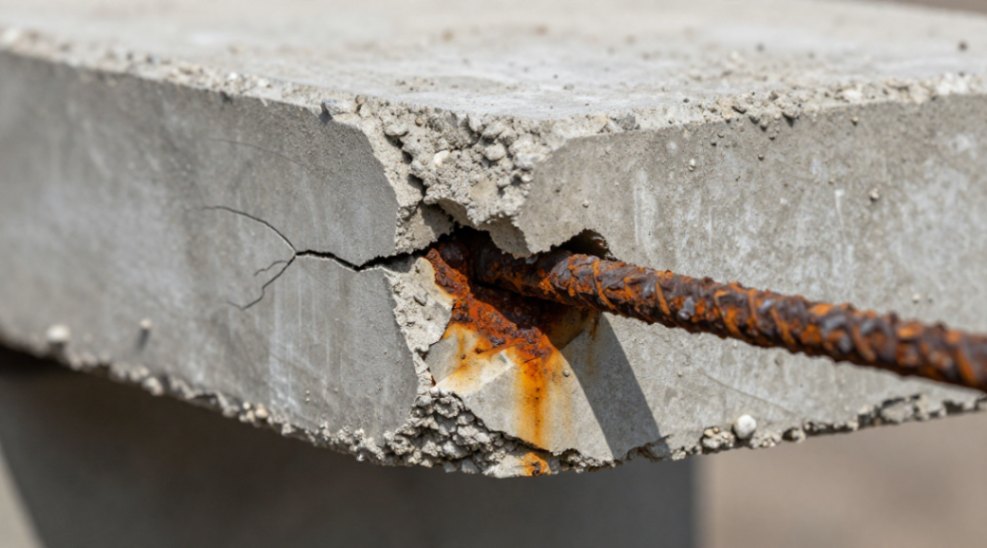
Have you ever watched a perfectly good pour turn into a patchwork of rust stains and spalling cracks two years later? You blamed the aggregate. You blamed the cover depth. But deep down, you knew the real culprit was hiding in your chemical admixture. Let me make this brutally clear: if your superplasticizer contains chlorides, you are destroying your reinforcement from the inside out. The industry has spent decades glossing over this fact, pushing cheap solutions that look great on a slump cone and fail catastrophically on a load-bearing beam. It stops today. This article is a warning. You need a non-chloride superplasticizer admixture, and you need to understand why the alternative is not just substandard—it’s negligent.
What a Non-Chloride Superplasticizer Admixture Actually Does
Let’s strip away the marketing nonsense. A superplasticizer is a high-range water reducer. That’s its job. It frees up water trapped in cement flocs, giving you a fluid mix without adding a drop of extra water. The non-chloride superplasticizer admixture performs this function without introducing any chloride ions into the system. Chloride ions are the enemy of passive film on steel. They break it down, initiate pitting corrosion, and once that starts, no epoxy coating or cathodic protection can fully reverse the damage. A non-chloride product keeps the chemistry clean. It maintains the alkalinity of the pore solution, allowing the steel to stay passive. This is not debatable. It is electrochemistry 101. If you are pouring reinforced or prestressed concrete, using a chloride-based superplasticizer is like injecting salt water directly into your rebar cage. You don’t do that. You use a non-chloride superplasticizer admixture.
The Three Chemical Families and Their Real Performance
Not all non-chloride superplasticizers are created equal, and if your supplier cannot tell you the exact base chemistry, walk away. Three families dominate the market: polycarboxylate ether (PCE), sulfonated naphthalene formaldehyde (SNF), and sulfonated melamine formaldehyde (SMF). PCE is the current king. It provides exceptional water reduction, up to 40% in some formulations, with excellent slump retention. It works by steric hindrance—long polymer chains physically push cement particles apart. SNF and SMF work by electrostatic repulsion. They are cheaper, but their water reduction tops out around 20-25%, and they suffer from rapid slump loss, especially in hot weather. Both SNF and SMF are non-chloride, but they are not equal to PCE in high-performance applications. If you are specifying a non-chloride superplasticizer admixture for a high-rise core or a bridge segment, demand a PCE-based product. Do not let a supplier substitute a naphthalene-based product without testing. The rheology difference is night and day.
How to Kill Your Concrete with a Single Bad Decision
Here is a list of mistakes I have seen on job sites that ended in demolition. Read this and do not repeat them.
- Do not assume that a cheap superplasticizer is non-chloride. Some manufacturers cut corners. They hide chlorides in the formulation as accelerators. You must request a chloride-ion content certificate. If they cannot provide it, the product is suspect.
- Do not overdose a non-chloride superplasticizer admixture expecting faster strength. Overdosing leads to severe retardation. Your concrete might not set for 48 hours. Segregation and bleeding become unmanageable. The water reduction benefit disappears.
- Do not store the admixture in direct sunlight. PCE-based admixtures are sensitive to temperature. Heating degrades the polymer chain. Performance drops by half in some cases.
- Do not ignore cement compatibility. A non-chloride superplasticizer admixture that works beautifully with Type I cement can turn Type III or a blend with high slag into a sticky mess. Always do a paste flow test before the actual pour.
These warnings are not academic. They come from twenty years of watching contractors bleed money because they skipped the basics.
Setting Time, Early Strength, and the Long Game
A common myth is that non-chloride superplasticizers always retard the set. False. Chlorides accelerate hydration. When you remove them, you lose that acceleration. But a well-formulated PCE-based non-chloride superplasticizer admixture can actually promote early strength gain by reducing the water-cement ratio so drastically that the hydration products form a denser, more connected structure. You get higher early compressive strength than a chloride-based product that simply forced hydration with chemical heat. The long-term durability is superior because the pore network is refined. Chlorides create a more porous microstructure over time due to the formation of Friedel’s salt, which expands and causes microcracking. A non-chloride system stays stable. Your structure lasts decades longer.
Ready-Mix, Precast, and High-Performance Concrete
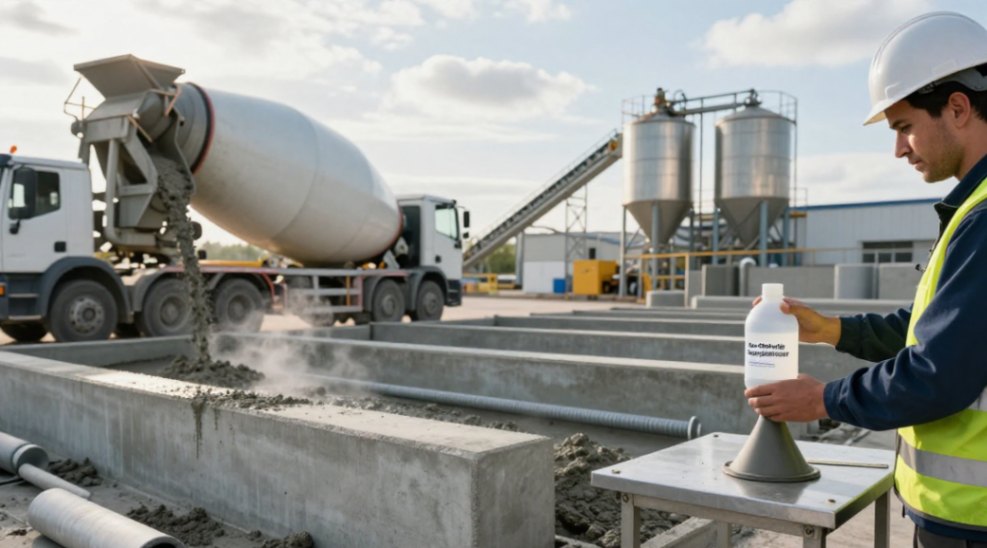
Each sector has its own tolerance for risk. In ready-mix, the biggest challenge is slump retention. The truck drives an hour to site. The concrete must be workable upon arrival. A non-chloride superplasticizer admixture with a retarding component can give you 90 minutes of slump life without compromising strength. In precast, speed is the priority. You want high early strength for form stripping. Use a high-dose non-chloride superplasticizer with a low water-cement ratio. Steam curing works synergistically with PCE chemistry. For high-performance concrete, there is no alternative. Self-consolidating concrete, high-strength mixes, and ultra-high-performance concrete rely entirely on the dispersion efficiency of a non-chloride superplasticizer. Trying to use a chloride-based product in SCC is insanity. The chloride ions will interfere with the viscosity modifiers and cause segregation.
Standards Are Your Safety Net, Not Your Excuse
ASTM C494 Type F (high-range water reducer) and Type G (high-range water reducer with retarding) both explicitly require non-chloride formulations for use in reinforced concrete. EN 934-2 has similar requirements. Compliance is mandatory, not optional. Yet I still see spec sheets that claim compliance while listing chloride content above 0.1% by weight of admixture. That is not compliant. That is deceptive. When you buy a non-chloride superplasticizer admixture, you must verify that the chloride content is less than 0.01% of the admixture weight or as low as the manufacturer can achieve. Do not accept 0.1%. The standard allows that, but you do not need to accept risk. Demand the lower limit.
Dosage: The Fine Line Between Perfection and Ruin
Typical dosage rates for PCE-based non-chloride superplasticizers range from 0.2% to 1.0% by weight of cementitious material. Start low. Increase incrementally. Watch the rheology. The goal is to achieve the required water reduction without creating a mix that bleeds water or segregates aggregates. Overdosage is the most common error on site. A concrete producer pushes the dose to hit a target slump, hoping the water reduction will compensate. It backfires. The excessive polymer chains coat the cement particles so completely that hydration slows to a crawl. The concrete stays plastic for two days. When it finally sets, the strength is lower, not higher. Charts and tables are guidelines. Your job is to optimize for your specific materials. Every cement, every fly ash, every sand is different.
Cost vs. Value: Stop Buying Cheap Insurance Against Failure
A non-chloride superplasticizer admixture costs more per gallon than a chloride-based product. That is a fact. But the cost per cubic yard of concrete is marginal—usually less than 2% of the total material cost. The risk you eliminate is the cost of a single structural failure. A bridge deck rehabilitation runs into the millions. A parking garage repair can shut down a business for months. Are you really going to save twenty dollars on a truckload of concrete and gamble with structural integrity? That is not economy. That is folly. Traditional superplasticizers save you money today. A non-chloride superplasticizer saves your building tomorrow.
Your Next Move is Critical
You have read the evidence. You have seen the logic. Chlorides in superplasticizers are a liability you cannot afford. The only rational choice for any reinforced concrete application is a non-chloride superplasticizer admixture. Not just any product—a high-quality, PCE-based formulation with verified low chloride content. Stop trusting verbal assurances. Demand test reports. Run your own compatibility tests. And when you find a product that works, standardize on it. Do not switch suppliers for a discount. Your reputation, your license, and the safety of the public depend on this single decision. Do not get it wrong. If you are currently using a chloride-based superplasticizer, stop immediately. Replace it. Test the new mix design. Then and only then, pour with confidence.
The Solution is Here
I have seen too many failures caused by cheap chemistry. Do not be the next case study. My recommendation is specific: move to a non-chloride superplasticizer admixture immediately. Contact your current supplier and demand a non-chloride alternative. If they cannot deliver one within 48 hours, find a supplier who can. Your next project might depend on it. Take action now.
Supplier
We are the global leader in lightweight concrete and advanced engineered foam solutions. Known globally for its commitment to research, innovation, and applied expertise, we have been providing engineered foam solutions since the early 2012’s.
We can supply high-quality concrete admixture and foam concrete related products all over the world.
The company has a professional technical department and quality supervision department, a well-equipped laboratory, and equipped with advanced testing equipment and after-sales customer service center.
If you are interested, please feel free and contact us.