Concrete-mesa | Concrete Admixtures, Tools, and Production Machines

7 Hard Truths About Liquid Concrete Water Reducing Admixture Nobody Tells You
The 40% Water Myth: Why Your Mix Design Is Lying to You
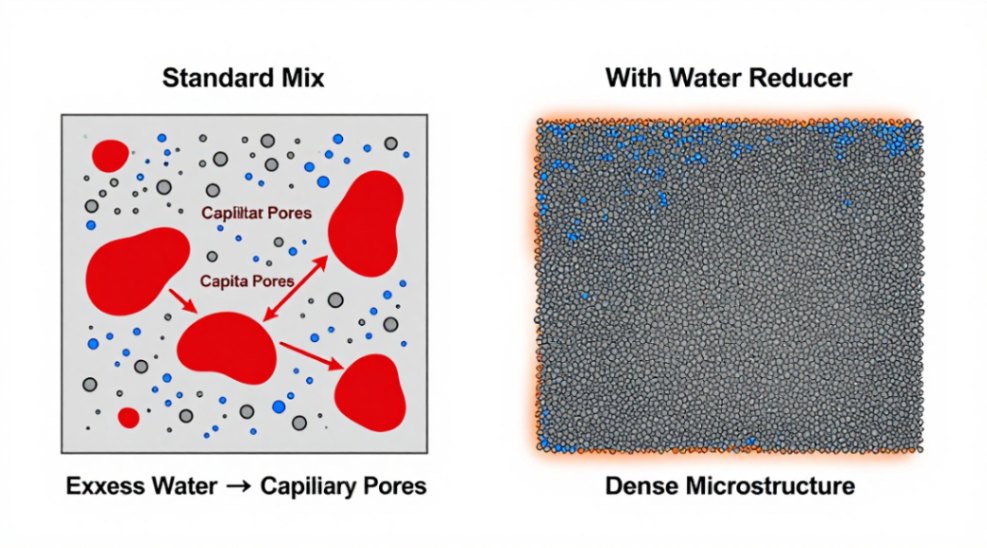
Standard concrete requires approximately 20% more water for workability than needed for complete cement hydration. That extra water creates capillary pores. Those pores steal strength. A liquid concrete water reducing admixture eliminates that excess. The result: denser microstructure, higher early strength, and lower permeability. Industry data consistently shows a 15-25% reduction in water demand without losing slump. That is not a claim. That is a chemical fact enforced by surface physics.
1. The Dispersion Mechanism: Beyond Simple Wetting
Water reducers do not ‘lubricate’ the mix. They alter the zeta potential of cement particles. Cement particles naturally flocculate—they clump together, trapping water inside the flocs. A liquid concrete water reducing admixture adsorbs onto particle surfaces, creating electrostatic repulsion (anionic charges) or steric hindrance (long polymer chains). Particles disperse. Trapped water releases. Workability increases without adding water.
- Electrostatic repulsion: Common with lignosulfonates and naphthalene sulfonates. Short-range effect. Sensitive to sulfate ion concentration.
- Steric hindrance: Dominant in polycarboxylate ethers (PCE). Long polymer side chains physically block re-agglomeration. Excellent slump retention.
Understand this distinction before selecting a product. The mechanism dictates dosage sensitivity and compatibility with your cement.
2. Normal-Range vs. High-Range: The 15% Threshold
The industry separates liquid concrete water reducing admixture into two categories based on water reduction capacity.
- Normal-range (plasticizers): 5-15% water reduction. Typically lignosulfonate or hydroxycarboxylic acid based. Suitable for standard ready-mix with w/c ratios above 0.50. Cost-effective. Moderate slump gain.
- High-range (superplasticizers): 15-40% water reduction. Naphthalene sulfonate formaldehyde (SNF) or polycarboxylate ether (PCE). Essential for high-performance concrete (HPC), self-consolidating concrete (SCC), and precast elements requiring high early strength.
Do not use a normal-range admixture where high-range is required. The dosage required to achieve 20% reduction will cause severe retardation and air entrainment issues.
3. Liquid vs. Powder: The Operational Cost Factor
Liquid formulations dominate the market for a reason. Powder water reducers (typically naphthalene or melamine based) require specialized mixing equipment and longer dissolution times. Liquids are pre-dissolved, ready for instantaneous dosing at the batch plant.
- Liquid dosing accuracy: ±1% by weight with flow meters. Powder dosing requires volumetric or weigh feeders with ±3% tolerance at best.
- Storage: Liquids in tanks (ambient temperature). Powders need dry, humidity-controlled silos—capital intensive.
- Mixing energy: Liquid disperses in seconds. Powder often requires 30-60 seconds extra mixing time to avoid undissolved lumps.
For operations producing more than 50 m³ per day, liquid is the logical choice. The cost per liter is higher than powder per kg, but the total installed cost of handling equipment is significantly lower.
4. Dosage Windows: Where Performance Drops Off
Every liquid concrete water reducing admixture has a defined saturation point. Beyond that point, adding more admixture yields no further water reduction. Worse, it causes segregation, excessive retardation, or sticky rheology.
Typical optimal dosage ranges based on cement weight (bwoc):
| Admixture Type | Optimal Dosage (% bwoc) | Saturation Point |
|---|---|---|
| Lignosulfonate | 0.15 – 0.30% | ~0.35% |
| Naphthalene sulfonate (SNF) | 0.30 – 0.80% | ~1.00% |
| Polycarboxylate ether (PCE) | 0.10 – 0.40% | ~0.50% |
These ranges shift with cement type (C3A content), ambient temperature, and slump target. Always conduct a Marsh cone or mini-slump test to identify the saturation point for your specific materials.
5. Setting Time: The Retardation Trade-Off
All water reducers cause some degree of set retardation. Lignosulfonates contain sugar residues (up to 8%) that strongly delay hydration. PCE formulations can be engineered for minimal retardation.
- Lignosulfonate: Expect 1-3 hours delay in initial set at standard dosage. Useful in hot weather concreting. Problematic in cold weather below 10°C.
- Naphthalene sulfonate: Minimal retardation (30-60 minutes) at normal dosage. Preferred for precast where early form stripping is critical.
- PCE: Tunable retardation. Standard products show 30-90 minute delay. Accelerated PCE variants exist for cold weather.
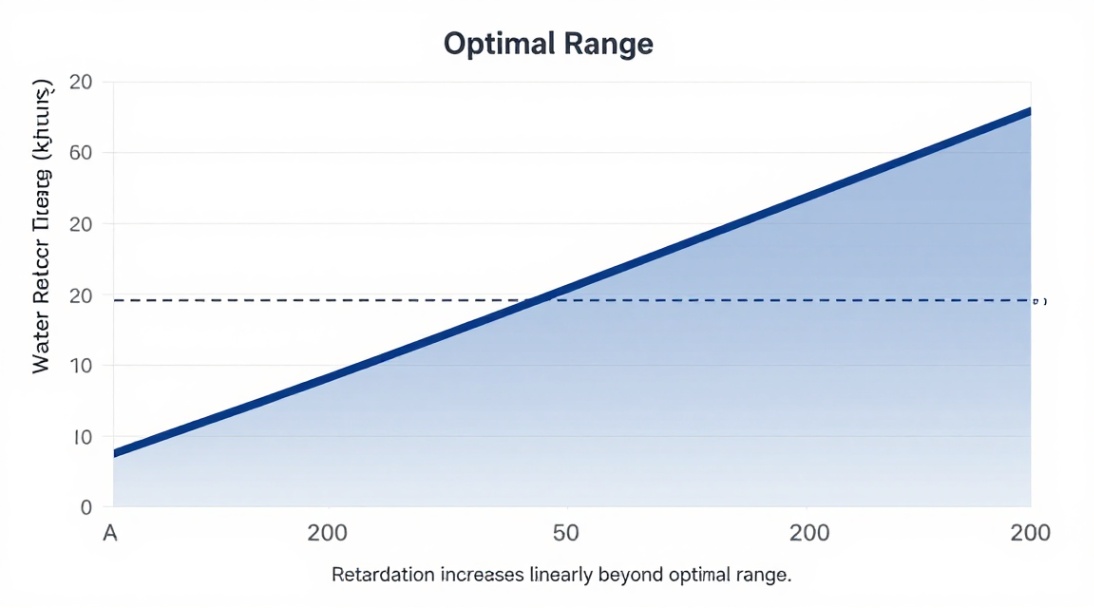
Do not assume ‘water reducer’ is neutral to setting. Always verify with your cement paste hydration calorimetry or Vicat needle testing. Retardation increases linearly with dosage beyond the optimal range.
6. Compatibility: When Admixtures Fight Each Other
Mixing admixtures without compatibility testing is the fastest path to a rejected load. The liquid concrete water reducing admixture interacts with other chemical admixtures in the system.
- Air-entraining agents (AEA): Water reducers, especially lignosulfonates, can destabilize air voids. The foam index changes. You may need 30-50% more AEA to maintain target air content.
- Accelerators: Calcium-based accelerators react with sulfonated naphthalene, causing precipitation. Dose sequentially—add water reducer first, accelerator last.
- Retarders: Synergistic effect. Mixing a lignosulfonate water reducer with a citric acid retarder can over-delay setting by 8+ hours.
Sequence of addition matters. Introduce the liquid concrete water reducing admixture after 70% of mix water, allow 20 seconds of mixing, then add remaining water and admixtures. This ensures proper dispersion before other chemicals adsorb onto cement.
7. Quality Control: The Slump Flow Correlation
Field QC for liquid admixture effectiveness relies on slump and flow measurements. But slump alone is deceptive. A high slump with high w/c ratio yields no strength gain.
Use these two metrics together:
- Slump retention: Measure slump at 0, 30, and 60 minutes. A good liquid water reducer should retain 80% of initial slump for 45 minutes at 25°C. Loss exceeding 50% indicates poor compatibility or cement-admixture mismatch.
- Flow table test (for SCC): Target spread of 650-750 mm with no segregation. Bleeding water on the edge indicates overdosage.
Keep a log of ambient temperature, cement source, and admixture batch number. Temperature variations of ±10°C can shift optimal dosage by 0.05% bwoc. Your control chart is your best tool.
Cost and Carbon: The Double Dividend
A liquid concrete water reducing admixture directly reduces cement content. For every 10% reduction in water, you can reduce cement by 7-10% while maintaining the same w/c ratio. That translates to:
- Cost savings: Cement is the most expensive component. A 10% reduction cuts material cost by 3-5% per cubic meter.
- Carbon footprint: Cement production generates 0.87 kg CO₂ per kg. Reducing cement by 30 kg/m³ saves 26 kg CO₂ per cubic meter. For a plant producing 50,000 m³/year, that is 1,300 metric tons CO₂ avoided.
Sustainability is not a marketing angle. It is a direct operational saving. The same admixture that improves your slump pays for itself through reduced cement use.
Final Recommendation: Standardize Before You Optimize
Stop switching admixtures every time a salesperson visits. Pick one reliable liquid concrete water reducing admixture for your base mix design. Run a full compatibility matrix with your three most common cements. Document the saturation dosage, slump retention curve, and strength gain at 1, 7, and 28 days.
We have developed a high-performance liquid polycarboxylate ether-based water reducer that delivers 25% water reduction at 0.20% bwoc, with less than 60-minute set retardation at 20°C. It is compatible with fly ash, slag, and silica fume blends. We offer free 20-liter samples for field testing.
Click here to request your free sample pack and dosage calculator — include your average cement type and ambient temperature range. We will recommend the exact formulation and starting dosage. No generic advice. No sales calls without your consent.
Supplier
We are the global leader in lightweight concrete and advanced engineered foam solutions. Known globally for its commitment to research, innovation, and applied expertise, we have been providing engineered foam solutions since the early 2012’s.
We can supply high-quality concrete admixture and foam concrete related products all over the world.
The company has a professional technical department and quality supervision department, a well-equipped laboratory, and equipped with advanced testing equipment and after-sales customer service center.
If you are interested, please feel free and contact us.