Concrete4U | Concrete Admixtures, Tools, and Production Machines

Polycarboxylate Water Reducer Mistakes That Will Sink Your Concrete Project
Stop Treating Polycarboxylate Water Reducers Like Ancient Technology
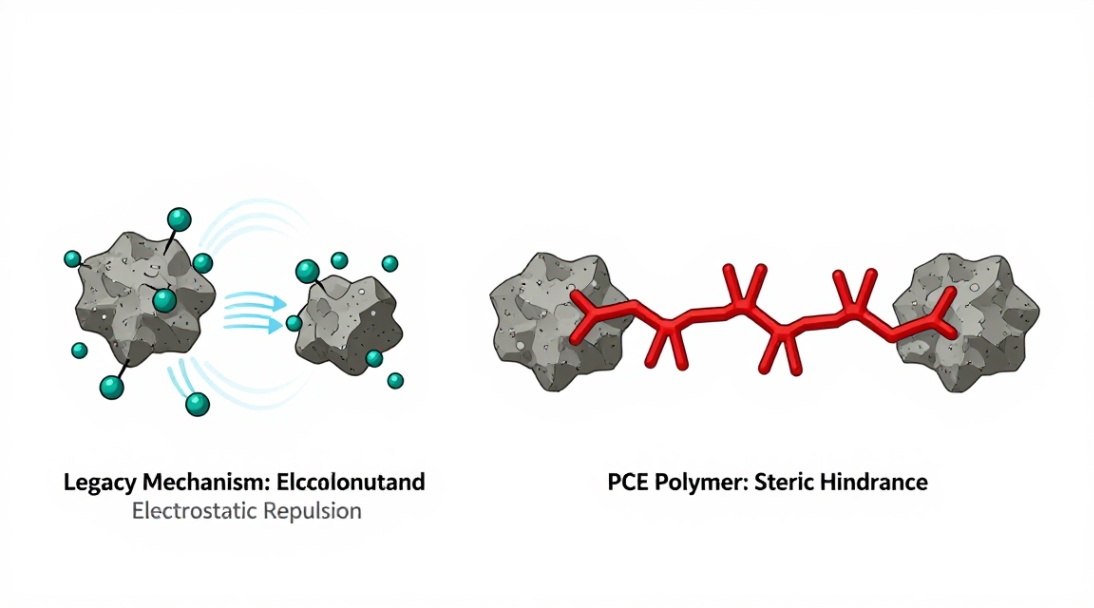
The single biggest mistake you can make is assuming a polycarboxylate based concrete water reducer behaves like a lignosulfonate or naphthalene sulfonate product. It doesn’t. The chemical action is fundamentally different. Using legacy mix design logic with this advanced polymer guarantees failure. Older water reducers relied on electrostatic repulsion, a primitive and easily disrupted mechanism. PCEs operate through steric hindrance. Their long, comb-like polymer chains physically separate cement particles. This is a robust effect, but it introduces new rules. Ignore them at your peril.
The Overdose Trap: More Is Catastrophically Worse
With older admixtures, a slight overdose often just meant more water reduction. With PCEs, it’s a recipe for disaster. Their dosage curve is not linear. Exceed the optimal point by a small margin, and you trigger severe side effects. Severe retardation becomes a certainty. The concrete may never set properly. You risk excessive air entrainment and crippling segregation where paste separates from aggregate. The mix becomes a sticky, unworkable mess or a bleeding, weak soup. There is no safe “ballpark” estimate. You must dose with precision.
Why PCEs Are So Sensitive
The steric hindrance mechanism is incredibly efficient. A tiny amount of polymer covers a massive surface area of cement. Adding just a little more saturates the system. The excess polymer molecules have nowhere to adsorb. They remain in the pore solution, acting as a powerful retarder and disrupting the mix’s rheology. This sensitivity is the trade-off for superior performance.
The Compatibility Minefield (It’s Not Just About Cement)
You cannot assume compatibility. Assuming your polycarboxylate based concrete water reducer will play nicely with other chemicals is a critical error. The most dangerous conflicts arise with sulfates. Calcium chloride accelerators? They will clash. Some fly ashes or slag cements with high residual carbon? They can adsorb the PCE polymer before it ever reaches the cement, nullifying its effect. Always conduct job-site compatibility tests with your exact materials. Lab reports mean nothing if your local sand has clay impurities or your mix water has unusual ions.
The Water Quality Blunder
Never use uncharted mix water. This is non-negotiable. The performance of a PCE polymer is exquisitely sensitive to the ionic content of the water. Hard water with high calcium or magnesium ions can drastically reduce its effectiveness. Chlorides, sulfates, and other dissolved solids interfere with the polymer’s adsorption. You think you’re adding a high-range water reducer, but you’re just adding an expensive, ineffective retarder. Test your water source. Know its chemistry. Adjust your dosage or product selection accordingly.
Slump Retention Is Not Magic
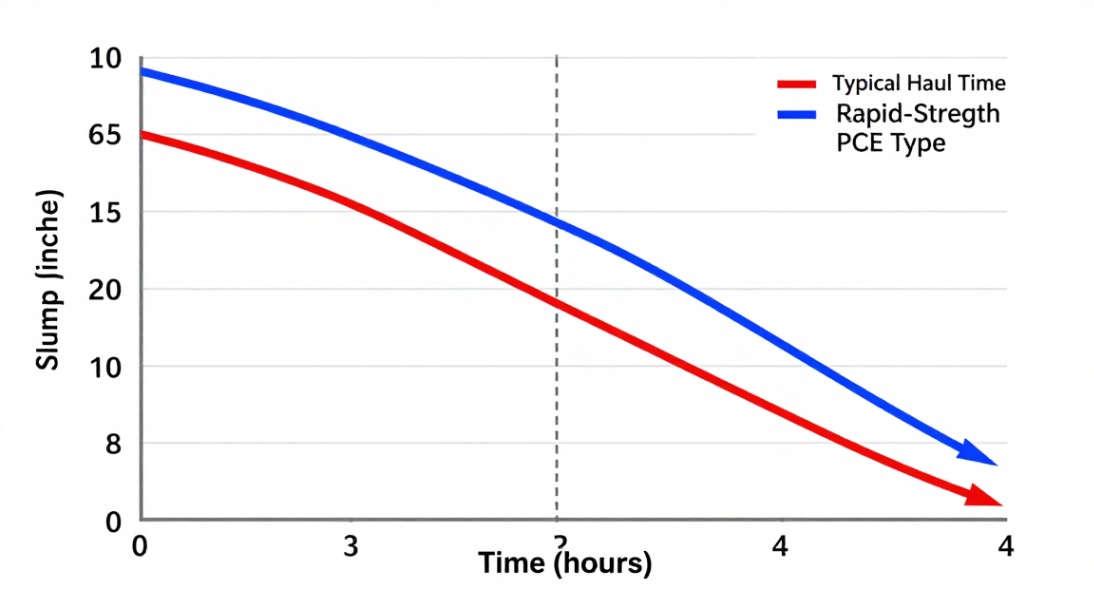
Do not mistake excellent initial slump for infinite workability. A common trap is batching concrete with a PCE, achieving a perfect 8-inch slump, and assuming it will hold for a three-hour haul. PCEs offer superior slump retention, but it is engineered, not inherent. The rate of slump loss depends on the specific polymer architecture, cement chemistry, and ambient temperature. Some PCEs are designed for rapid early strength with moderate retention. Others are built for long haul times. Using the wrong type leads to concrete that stiffens in the truck or, conversely, remains too soft for timely finishing.
Sustainability Gains vs. Performance Risks
The major benefit of a polycarboxylate based concrete water reducer is the ability to drastically cut water and cement content. This is also its greatest operational risk. When you reduce cement by 20% or more, the margin for error in your mix design shrinks to zero. The paste volume is lower. The aggregate grading must be perfect. Any deficiency in cohesion or sand fineness modulus becomes magnified. You are crafting a high-performance, lean system. It demands respect. Do not pursue cement reduction blindly without verifying the stability and finishability of the resulting concrete.
The Future Is Already Here (And It’s More Complex)
Next-generation PCEs are not just “stronger.” They are smarter. New polymers offer clay tolerance, rheology modification, and targeted setting profiles. The mistake is thinking this technology simplifies your job. It doesn’t. It gives you more powerful tools, which require more precise understanding. You are now a concrete chemist, not just a mixer. The brute-force era is over. Precision is mandatory.
Stop Gambling With Your Concrete
Guessing with PCEs costs you time, money, and structural integrity. The warnings above are not hypothetical. They are compiled from two decades of field failures. You need more than a generic product datasheet. You need a system engineered for your specific materials and goals. You need precise dosing technology and expert formulation support. This is not a commodity. It is a performance-defining component. Stop treating it like an afterthought.
Stop risking your project. The logical next step is to eliminate these variables. Consult with a specialist who provides not just a chemical, but a validated process for your plant and mix. Demand site-specific trials. Insist on technical support that understands steric hindrance, not just sales talk. Your concrete’s performance is the foundation of everything you build. Do not compromise it with amateur-hour admixture use. Contact a true technical partner today and specify your exact challenge.
Supplier
We are the global leader in lightweight concrete and advanced engineered foam solutions. Known globally for its commitment to research, innovation, and applied expertise, we have been providing engineered foam solutions since the early 2012’s.
We can supply high-quality concrete admixture and foam concrete related products all over the world.
The company has a professional technical department and quality supervision department, a well-equipped laboratory, and equipped with advanced testing equipment and after-sales customer service center.
If you are interested, please feel free and contact us.