Concrete4U | Concrete Admixtures, Tools, and Production Machines

The Superplasticizer Dosage Guide: How to Get Workability Right Every Time
Why Superplasticizer Dosage is Your Make-or-Break Variable
Are your concrete batches inconsistent? Does slump vanish before the pour finishes? Do you face a heartbreaking choice between a stiff, unworkable mess or a segregated, bleeding nightmare? The culprit is often one thing: superplasticizer dosage.

Getting this wrong wastes money, compromises strength, and destroys schedules. This is not a theoretical discussion. It’s a practical guide. We will show you the logic, step by step.
The Core Logic of Dosage
Think of a superplasticizer as a chemical traffic director. Its molecules attach to cement particles, creating a negative charge. Like charges repel. This force pushes the cement grains apart, releasing trapped water and creating flow. The dosage determines the strength of this repulsive force. Too little, and the traffic jam persists. Too much, and you lose all control.
Step-by-Step: How to Find Your Dosage
Step 1: Define Your Starting Point
Never start from zero. Begin with the manufacturer’s recommended dosage range. This is your baseline, not your final answer. Common superplasticizer types have typical starting points.
| Superplasticizer Type | Typical Starting Dosage (% by weight of cement) | Primary Action |
|---|---|---|
| Polycarboxylate Ether (PCE) | 0.15% – 0.25% | High water reduction, slump retention |
| Sulfonated Naphthalene (SNF) | 0.5% – 1.0% | Good water reduction, lower cost |
| Sulfonated Melamine (SMF) | 0.5% – 1.5% | Similar to SNF, better with some cements |
Step 2: Adjust for Your Mix Components
Your baseline needs correction. Three factors directly alter the required superplasticizer dosage.
- Cement Chemistry: High C3A (tricalcium aluminate) content in cement can “eat” the admixture. You will need more. Low-alkali cements often require less.
- Aggregate Properties: Fine, angular aggregates increase surface area and water demand. You may need a slightly higher dosage to achieve the same workability compared to rounded gravel.
- Target Slump/Flow: A standard 100mm slump needs less than a 200mm+ self-consolidating concrete (SCC) mix. This is the most obvious but most ignored variable.
Step 3: The Water Reduction Equation
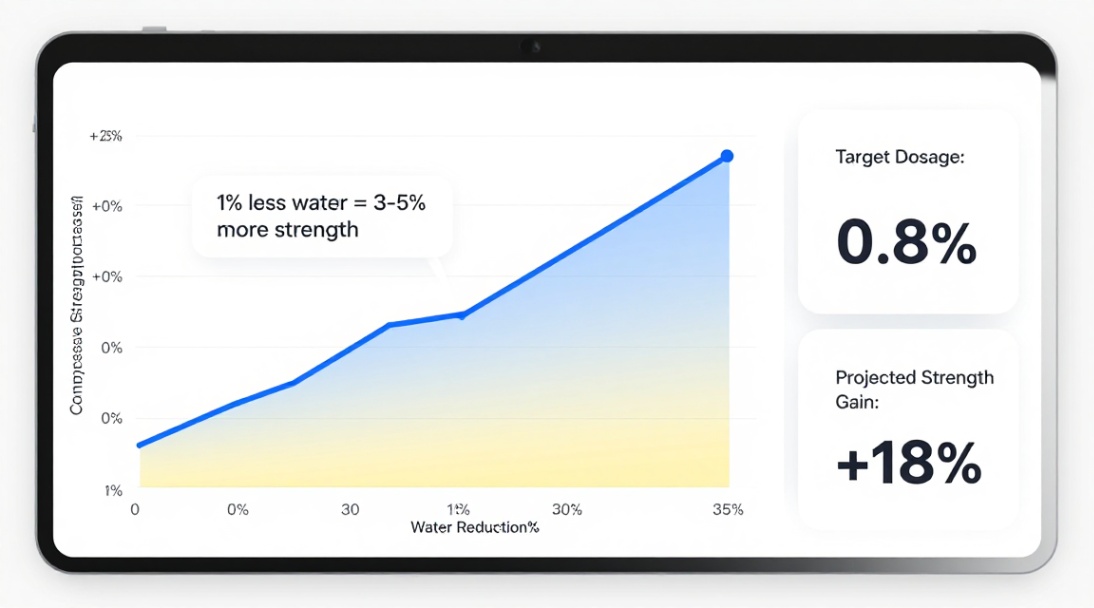
This is the whole point. Adding superplasticizer is not just about flow. It’s about reducing water. For every 1% reduction in water content, you can expect a 3-5% increase in compressive strength. Your dosage must target a specific water reduction percentage, typically 15-30%. This relationship is non-negotiable.
Step 4: The Critical Mixing Sequence
Timing is everything. Adding superplasticizer to dry cement wastes it. Adding it too late causes inhomogeneous mixing. Follow this rigid order.
- Add 80-90% of your mixing water to the drum.
- Add all aggregates and cement. Mix for 30 seconds.
- Add the full, pre-determined dosage of superplasticizer directly into the remaining 10-20% of mixing water. Stir it.
- Add this admixture-water solution to the mix. Mix for a minimum of 2-3 minutes.
The Consequences of Getting it Wrong
Over-Dosage: The Silent Killer
More is not better. Exceeding the saturation point causes severe problems. The concrete may over-flow initially, then rapidly segregate. Stone sinks, paste rises. Excessive bleeding creates a weak surface layer. The chemical structure can delay final set by hours, wrecking finishing schedules and early strength gain.
Under-Dosage: The Obvious Failure
Insufficient dosage fails its primary job. You do not achieve target workability. Workers add water on-site, destroying your designed water-cement ratio and crushing the potential strength and durability of the structure. This single error nullifies all your mix design efforts.
Advanced Scenarios: Pushing the Limits
For high-performance concrete (HPC) and SCC, dosage logic intensifies. You operate at the upper edge of the effective range. Precision is mandatory. Small variations in material moisture or temperature require immediate on-site adjustment. The only reliable tool for this is the slump flow test. Be prepared to add incremental “kicker” doses of superplasticizer, mixed thoroughly, to maintain flow without segregation. This is where a consistent, high-quality admixture like FloTech Pro proves its value, offering predictable response and robust slump retention, giving you the control needed for these critical mixes.
Final Command: Test and Verify
Your theoretical dosage is a hypothesis. The slump test is your experiment. Before any full-scale pour, conduct trial batches. Adjust the superplasticizer dosage in increments of 0.05% by weight of cement. Record the results. Find the minimum dosage that gives you the required slump and flow without bleeding or segregation. This number is your golden rule for that specific combination of materials. Stick to it. Control it. Your concrete’s integrity depends on it.
Supplier
We are the global leader in lightweight concrete and advanced engineered foam solutions. Known globally for its commitment to research, innovation, and applied expertise, we have been providing engineered foam solutions since the early 2012’s.
We can supply high-quality concrete admixture and foam concrete related products all over the world.
The company has a professional technical department and quality supervision department, a well-equipped laboratory, and equipped with advanced testing equipment and after-sales customer service center.
If you are interested, please feel free and contact us.