Concrete4U | Concrete Admixtures, Tools, and Production Machines

How to Choose a Concrete Foaming Agent: Avoid These 5 Costly Mistakes
A Story of a Collapsed Slab
I watched a contractor’s face go pale. We were standing over a section of lightweight topping slab for a renovation. It was supposed to be 1100 kg/m³. It crumbled underfoot like wet sand, testing below 500 kg/m³. The cause? A “bargain” synthetic foaming agent that destabilized the moment it met the cement. The re-pour cost more than the entire initial budget. It’s a mistake I’ve seen too often. Let’s ensure it doesn’t happen to you.

What You’re Really Choosing: The Core of Cellular Concrete
A concrete foaming agent isn’t just an additive. It’s the engine of lightweight cellular concrete (LCC). By generating millions of stable, microscopic air bubbles, it replaces aggregate, creating a controllable, low-density material. Your choice dictates everything: strength, weight, insulation, and durability. Get it wrong, and the project fails.
Mistake #1: Ignoring the Synthetic vs. Protein Battle
This is your first, most critical fork in the road. Picking the wrong base chemistry is the root of most failures.
- Synthetic Foaming Agents: These are detergent-based. They’re typically lower cost and generate high foam volumes quickly. Sounds great? Here’s the catch. The bubbles are often weaker, less uniform, and more prone to coalescing and collapsing in the mix. They can be sensitive to mix water chemistry and cement alkalinity. As Dr. Michael Berry, a materials researcher noted in a 2021 report for the National Precast Concrete Association, “Synthetic foams can introduce instability in mixes with high fines content or chemical admixtures, leading to unpredictable density and strength.”
- Protein-Based Foaming Agents: Derived from hydrolyzed animal proteins or plant sources. These create smaller, tougher, and far more stable bubbles. The foam integrates into the cement paste like a reinforced structure. You pay more per liter, but you get predictable density, superior strength-to-density ratios, and much better long-term durability. For any structural or semi-structural application, this is the only professional choice.
The Quick Decision Rule:
- Use synthetic only for strict, non-structural fill applications (e.g., old pipe trench backfill) where extreme cost sensitivity overrides all performance needs.
- Choose protein-based for everything else: roofing screeds, floor toppings, lightweight blocks, precast panels, and insulating sub-screeds.
Mistake #2: Focusing Only on Price Per Drum
This mindset will bankrupt you. The real cost is in the in-situ cubic meter of finished, compliant concrete.
Let’s break it down. A cheap, unstable agent requires a 20% higher dosage to hit your target wet density. Then, 30% of those bubbles collapse before setting. Now you’re over-dosing again, scrambling on site, and your yield is completely off. Your material cost just doubled, and you have a weak product.
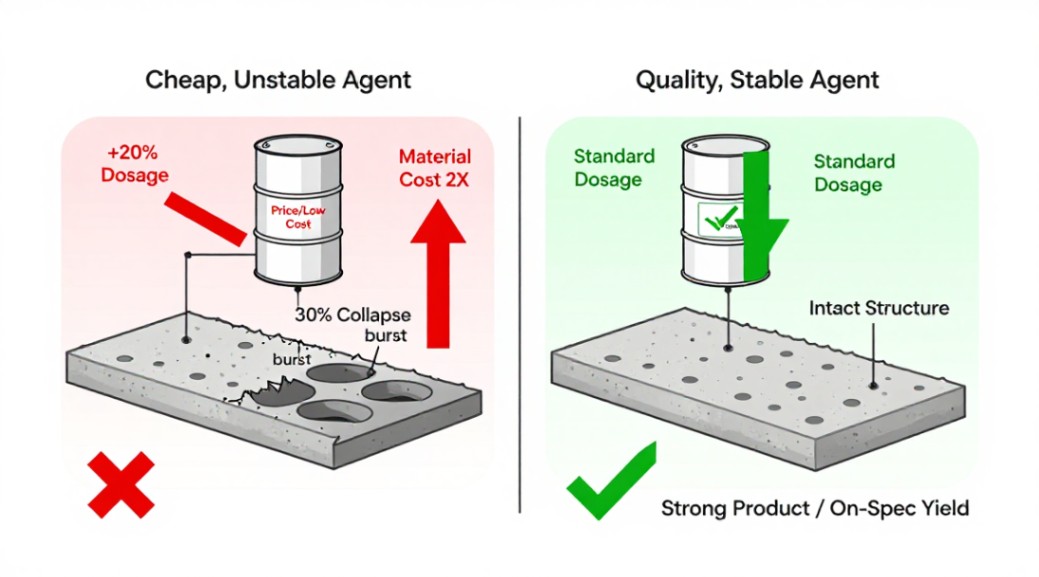
A premium, stable protein agent uses less volume, gives you a perfect yield, and delivers the specified strength with zero headaches. You budget accurately. You pour with confidence.
Mistake #3: Skipping the Trial Batch (The “It’ll Be Fine” Fallacy)
Never, ever introduce a new foaming agent to a project without a full-scale trial batch. This is non-negotiable. Here is your protocol.
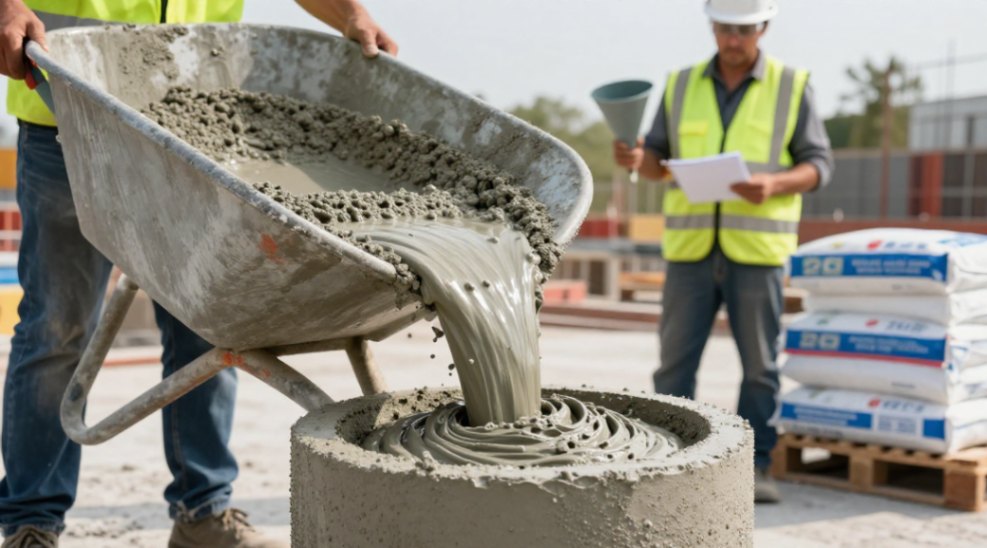
- Simulate Exact Conditions: Use the same materials (cement, sand, water, admixtures) from the project batch plant. Use the same water temperature.
- Use Your Field Equipment: Test with the actual foaming generator and pump you’ll use on site. Dial in the pressure and airflow settings.
- Measure Everything: Record foam density (kg/m³) straight from the generator. Record wet density of the mixed concrete immediately after placement. Cast test cylinders.
- Monitor Stability: Check for foam bubble collapse or bleeding at 15, 30, and 60-minute intervals.
- Test the Hardened Product: Crush cylinders at 7 and 28 days. Verify compressive strength.
This trial reveals incompatibilities with your mix design before they become a catastrophe.
Mistake #4: Overlooking the Supplier’s Role
You’re not just buying a chemical. You’re buying expertise and consistency.
- Technical Support: Can they provide mix design guidance? Will they visit your site?
- Batch-to-Batch Consistency: Demand certificates of analysis. A reputable supplier, like ProFoam Inc. or Sika, has tight manufacturing controls.
- Compliance: For structural work, the agent must be part of a system proven to meet standards like ASTM C869 or EN 934-10. Ask for the test reports.
Mistake #5: Mismatching Agent to Application Method
How you introduce foam matters. The agent must be suited to your system.
| Application Method | How It Works | Agent Consideration |
|---|---|---|
| Pre-foaming | Foam is generated separately in a unit, then blended into the mortar slurry in a mixer. | Requires foam with excellent stand-alone stability. Protein agents excel here. |
| Inline / Direct Injection | Concentrated agent is metered, diluted, and aerated directly into the slurry stream during pumping. | Agent must be highly soluble, fast-acting, and compatible with pump pressure. Some synthetics are formulated for this. |
Confirm your agent is designed for your chosen method.
Your Step-by-Step Selection Checklist
Print this. Use it.
- Define the ‘Why’: Target dry density (kg/m³)? Required 28-day compressive strength (MPa or psi)? Is it for insulation, fill, or structure?
- Choose Your Chemistry: Protein-based for performance. Synthetic only for basic fill.
- Source Wisely: Vet suppliers. Demand data sheets, compliance certificates, and references.
- Test Relentlessly: Conduct a full trial batch with your materials and equipment. Verify fresh and hardened properties.
- Calculate Real Cost: Factor in dosage rate, yield, and performance-not just drum price.
- Plan the Process: Match the agent to your foaming and placement system. Train your crew on dosing accuracy.
Stop Guessing. Start with a Proven Performer.
After decades in the field, I don’t gamble with project success. For the vast majority of professional applications, a high-quality protein-based foaming agent is the only sensible choice. It removes risk.
If you’re ready to lock in density, strength, and peace of mind, I strongly recommend you request a technical datasheet and sample of a proven protein foaming agent from a leading manufacturer today. Test it against your current product. The difference in stability and finished quality isn’t subtle. It’s the difference between a project you’re proud of and one that keeps you up at night. Make the call to your supplier, or contact us directly for vetted recommendations. Don’t let the wrong choice sink your next pour.
Supplier
We are the global leader in lightweight concrete and advanced engineered foam solutions. Known globally for its commitment to research, innovation, and applied expertise, we have been providing engineered foam solutions since the early 2012’s.
We can supply high-quality concrete admixture and foam concrete related products all over the world.
The company has a professional technical department and quality supervision department, a well-equipped laboratory, and equipped with advanced testing equipment and after-sales customer service center.
If you are interested, please feel free and contact us.