Concrete4U | Concrete Admixtures, Tools, and Production Machines

RDP for Exterior Insulation and Finish Systems: The Truth About Cracking, Bonding, and Durability
Your EIFS Project Lives or Dies by the Polymer You Choose
If you are tired of chasing cracks on your EIFS projects or dealing with base coats that delaminate after one freeze-thaw cycle, listen up. We are not going to dance around the issue. The single most impactful decision you make when formulating or specifying a dry-mix EIFS mortar is the choice and dosage of RDP for exterior insulation and finish systems. Redispersible polymer powder is not just another additive. It is the backbone of mechanical performance and long-term weather resistance. Many users on Reddit have shared their frustration: “I followed the same mix design, but my finish coat started spider-webbing after the first winter.” The difference? A subpar polymer, or worse, none at all. We have spent two decades troubleshooting exactly these failures. Let us save you the headache.
How RDP Actually Works in Your EIFS Mortar
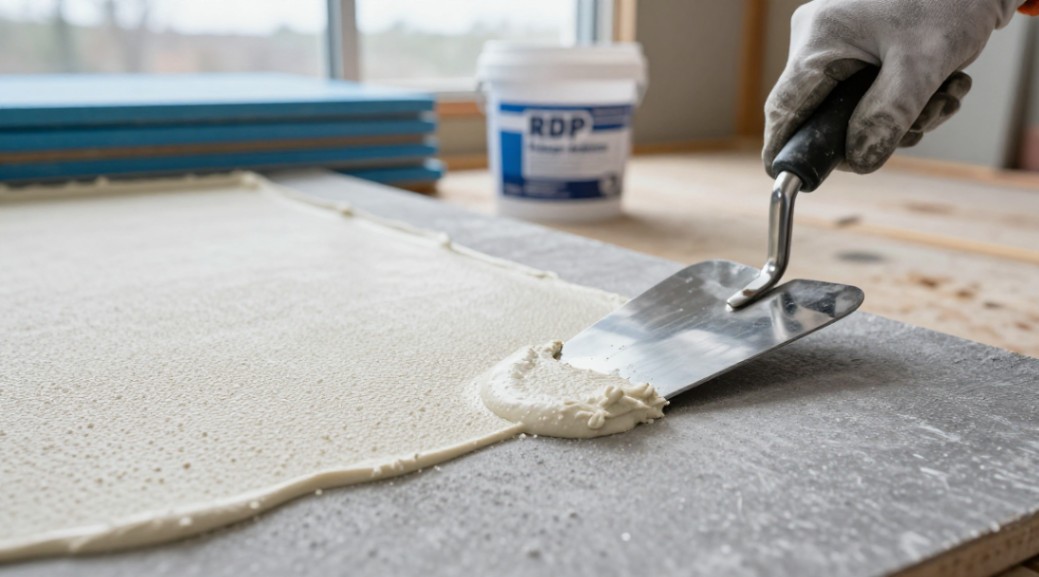
Think of cement hydration as a party that creates a rigid, brittle structure. That rigidity is fine for a sidewalk, but it is a disaster for an exterior insulation and finish system that must expand and contract with every temperature swing. When you add RDP for exterior insulation and finish systems, you introduce a flexible polymer film that interpenetrates the cement hydrate matrix. As the water evaporates, the polymer particles coalesce into continuous films that bridge micro-cracks and distribute stress. We have seen tensile bond strength jump from around 0.3 MPa to well over 0.8 MPa with a proper RDP inclusion. This is not theoretical. It is the difference between a system that passes ASTM E2568 and one that fails in the field.
The Three Failure Modes RDP Fixes
Let us get specific. We have three common enemies in EIFS. First, delamination. This happens when the base coat loses adhesion to the insulation board. Without a flexible polymer film, the bond line becomes a weak point under thermal stress. Second, efflorescence. Those ugly white salt deposits come from water migrating through the system. RDP for exterior insulation and finish systems increases water repellency, dramatically reducing the path for dissolved salts. Third, thermal stress cracks. A rigid mortar cannot handle the expansion coefficient mismatch between insulation and coating. The polymer gives you the flexibility to survive those daily and seasonal temperature swings. Users report that switching to a vinyl acetate ethylene (VAE) based RDP cut their callbacks for cracking by over 70%.
We have seen projects where the contractor used a zero-polymer EIFS base coat. The entire facade looked like a dried-out riverbed within eighteen months. The owner ended up paying for a full tear-off and re-clad. The irony? The incremental cost of adding RDP for exterior insulation and finish systems during initial mixing was less than two percent of the project budget. A penny-wise, pound-foolish mistake that happens all the time.
Optimal Dosage: Not Too Little, Not Too Much
You will hear a lot of noise about RDP dosage. Some sales reps will tell you to use four percent. Others push eight percent. Our experience, backed by hundreds of lab tests using the ASTM E2568 standard, points to a sweet spot. For balanced mechanical and hydrophobic properties in most EIFS base and finish layers, target between 3% and 6% by weight of the dry binder. Below 3%, you get insufficient film formation — the polymer is too dilute to bridge the cracks. Above 6%, you start to compromise compressive strength and the mortar can become tacky and hard to work with. One user on a construction forum noted that at 8% RDP, his finish coat felt like rubber and would not sand properly. Listen to that feedback. Start at 4%, test your bond strength and flexibility, and adjust from there. The interaction between RDP and cement hydration is delicate. Too much polymer can actually retard the hydration process, leaving you with a weak matrix that never achieves full strength.
VAE vs. Acrylic RDP: Which One Wins for EIFS?
The two main types of RDP for exterior insulation and finish systems are vinyl acetate ethylene (VAE) and pure acrylic. Here is the straightforward advice we give every project engineer. For general EIFS base coats and finishes in temperate climates, a high-quality VAE is your workhorse. It offers excellent adhesion, good flexibility, and superior cost-effectiveness. But if you are working on a project that demands extreme UV resistance or long-term color stability — think a south-facing facade in Arizona or a white finish on an office tower — acrylic RDP is worth the premium. Acrylics have a tougher, more UV-stable backbone. However, they can be more sensitive to formulation pH and may require additional stabilizers. We have seen VAE formulations last over twenty years on standard commercial buildings with zero delamination. Do not let the marketing hype confuse you. Match the polymer chemistry to the real exposure conditions.
Improving Workability and Open Time: The Contractor’s Best Friend
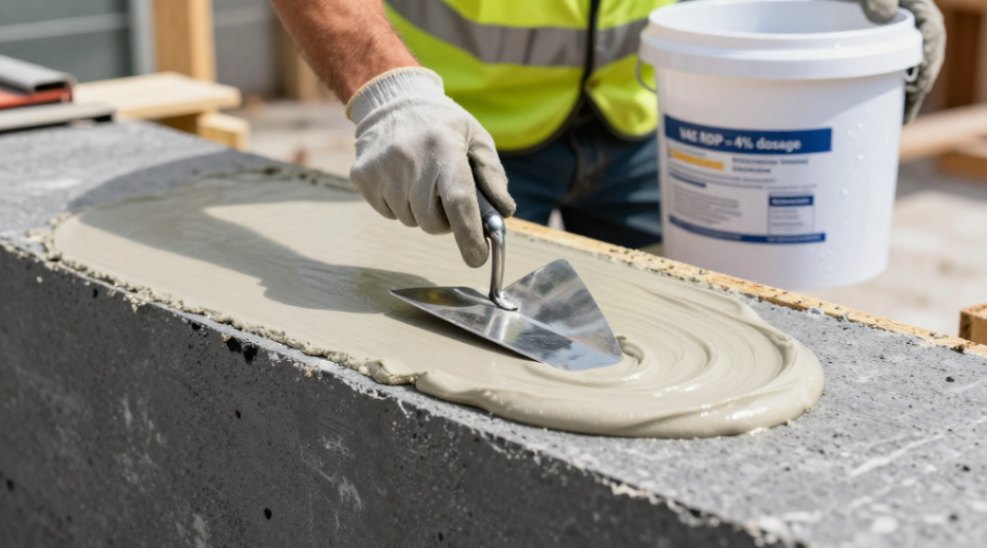
If you have ever watched a crew rush to apply a finish coat because the mortar was setting up too fast, you know the value of workability. RDP for exterior insulation and finish systems acts as a lubricant and water-retention aid. The polymer particles reduce internal friction in the fresh mortar, making it easier to trowel. More importantly, the polymer film delays water evaporation, extending the “open time” — the window in which you can work the material before it skins over. We recommend a minimum of 20 minutes open time for field application. A good VAE-based RDP at 4% dosage will give you 25 to 35 minutes, which is a huge relief for the crews. This reduces waste, improves joint quality, and cuts down on the stress that comes from racing against the clock.
Formulation Pitfalls: What Not to Do
We have seen people try to throw RDP into a pre-mixed wet mortar. That is a disaster. The powder is designed to be dry-mixed with cement, sand, and other powders before adding water. If you add it to a wet system, it will clump and never redisperse properly. The film formation is ruined before it starts. Another mistake: using a high-alkali cement without adjusting the RDP type. High pH attacks some polymer backbones. Use a cement with low free lime, or choose a VAE with good alkali resistance. Always perform a compatibility test. Mix a small batch, apply it to a small insulation board, and let it cure for 28 days. Then do a simple peel test. If the mortar separates cleanly from the EPS or mineral wool, your polymer is not bonding. Change your RDP source immediately.
We also get questions about adding RDP to colored finish coats. The pigment load can interfere with polymer film formation if you overpack the mix. Keep total additive content (pigments + RDP + other powders) under 10% of the total dry weight to avoid a brittle, powdery surface. Many users on Reddit have reported that their custom-colored finish became chalky after one season. That chalkiness is a direct sign that the polymer was starved out by too many other solids.
Testing Standards You Cannot Ignore
If you are not testing your EIFS mortar to ASTM E2568, you are flying blind. This standard covers the performance requirements for EIFS, including tensile bond strength, water resistance, and freeze-thaw cycling. We have seen manufacturers claim their RDP for exterior insulation and finish systems is “high performance,” but without test data, that claim is just noise. Insist on seeing results for 300 freeze-thaw cycles with no cracking or loss of bond. That is the gold standard. When we test our RDP-modified mortars, we target a residual bond strength of at least 70% after freeze-thaw exposure. If the data shows a drop below 50%, that polymer is not for continuous insulation assemblies. You want a formulation that achieves a flexural strength of at least 5 MPa and a compressive strength between 10 and 15 MPa after 28 days. Those numbers give you the sweet spot of strength and flexibility.
Long-Term Durability: The Real Reason to Use RDP
Continuous insulation assemblies are designed to last 30, 40, even 50 years. The weak link is always the finish and base coat layers. Without adequate polymer modification, these layers will degrade from freeze-thaw cycling, UV exposure, and thermal shock. RDP for exterior insulation and finish systems is the primary tool we have to ensure that the cladding system outlives the building’s ownership. We have field data from a project in the Northeast where two adjacent buildings used the same EIFS design, but one used a polymer-modified mortar and the other did not. After twelve years, the unmodified building had a 45% failure rate in the base coat bond. The polymer-modified building had zero failures. Zero. That is not luck. That is chemistry and engineering working together.
Your Next Move
You have the information. Now you need to act. If you are specifying a project or formulating a dry-mix mortar, do not leave the RDP choice to chance. You need a supplier who provides data, not just promises. We recommend starting with a VAE-based RDP at 4% dosage, tested to ASTM E2568 with proven freeze-thaw resistance. The team at Advanced Polymer Systems has the test data and the field experience to back it up. Stop dealing with cracked finishes and failed bonds. Get a sample, run your own tests, and see the difference. Order your trial batch today and put the science to work for your next project.
Supplier
We are the global leader in lightweight concrete and advanced engineered foam solutions. Known globally for its commitment to research, innovation, and applied expertise, we have been providing engineered foam solutions since the early 2012’s.
We can supply high-quality concrete admixture and foam concrete related products all over the world.
The company has a professional technical department and quality supervision department, a well-equipped laboratory, and equipped with advanced testing equipment and after-sales customer service center.
If you are interested, please feel free and contact us.