Concrete4U | Concrete Admixtures, Tools, and Production Machines

The Foam Generator Machine Trap: How 70% of Production Failures Start Here
70% of Foam Concrete Failures Aren’t in the Mix. They’re in the Machine.
Look at a collapsed CLC block or a screed with inconsistent density. The problem didn’t start in the mixer. It began the moment the foam generator machine for concrete production created a weak, unstable bubble. Most failures originate here, before a single bubble touches cement. This article isn’t a sales pitch. It’s a warning label. We’ll dissect the working principle, not to sell you, but to show you where your process is likely breaking.
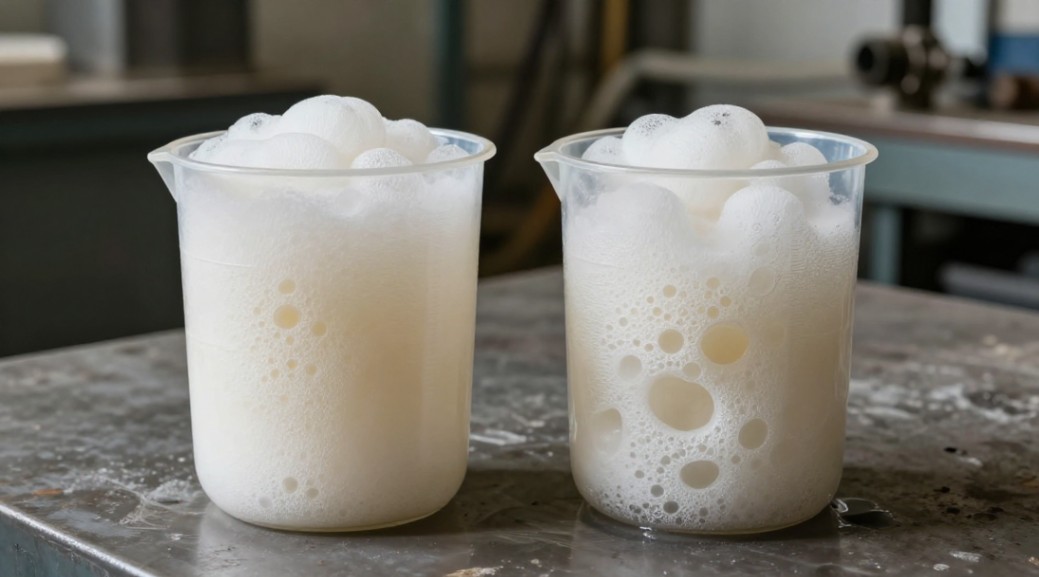
1. The Foam Generation Lie: It’s Not Just Air and Soap
Operators think a foam generator machine is just mixing air, water, and concentrate. That’s a catastrophic oversimplification. The real process is about kinetic energy and surface tension control. You inject compressed air and a pre-diluted foam solution into a high-shear mixing chamber. The machine’s core job is to transform liquid film into a spherical bubble with a specific, resilient membrane. Fail to control the energy input, and you produce wet, large, or immediately collapsing foam. The foam concentrate isn’t “soap”; it’s a engineered surfactant designed to lower water’s surface tension and stabilize the air-liquid interface under the alkaline attack of cement.
1.1. The Two System Types and Their Built-In Pitfalls
You have two main designs: batch systems and inline (continuous) systems. The industry often picks the wrong one.
- Batch Foam Generators: These produce a fixed volume of foam in a pressurized tank. The pitfall? Foam density can drift during discharge as pressure drops. If you don’t calibrate for the entire batch cycle, your first and last cubic meters of concrete have different weights.
- Inline Foam Generators: These produce foam on-demand in a continuous stream. The pitfall? They are hypersensitive to fluctuations in water pressure and air supply. A slight drop in water pressure starves the mixing chamber, instantly creating denser, wetter foam that wrecks your entire batch.
2. The Three Specifications That Actually Matter (Ignore the Brochure)
Forget maximum output capacity. Focus on these three:
- Foam Density Control Precision: Can the machine maintain a foam density of, for example, 45 g/L ± 2 g/L for hours? This isn’t about a dial; it’s about the consistency of the pump motors and the precision of the proportional dosing system.
- Foam Stability Over Time: The foam must survive from generator to mixer, through piping, and into the cement slurry without more than 5-10% drainage or bubble coalescence in the first 15 minutes. Test this. Poor foam collapses in the hopper.
- Integration Simplicity: Does it have a simple 4-20mA signal input to sync with your batching plant controller? If integration requires a PhD, you’ll have synchronization errors, leading to over-sanding or a slurry that’s too stiff.
3. The Water Ratio Catastrophe Waiting to Happen
This is the most common, silent killer. You do not dilute the foam concentrate with arbitrary water. You must use the dilution ratio specified by the concentrate manufacturer—typically between 1:20 and 1:40 (concentrate:water). Use hard water with high mineral content, and you neutralize the surfactants. Use water that’s too cold, and you increase viscosity, breaking the foam generation cycle. The water must be clean, potable, and at a stable temperature. Mix the diluted solution in a separate tank before it enters the foam generator machine. Feeding concentrate and water separately into the machine is asking for inconsistent foam.
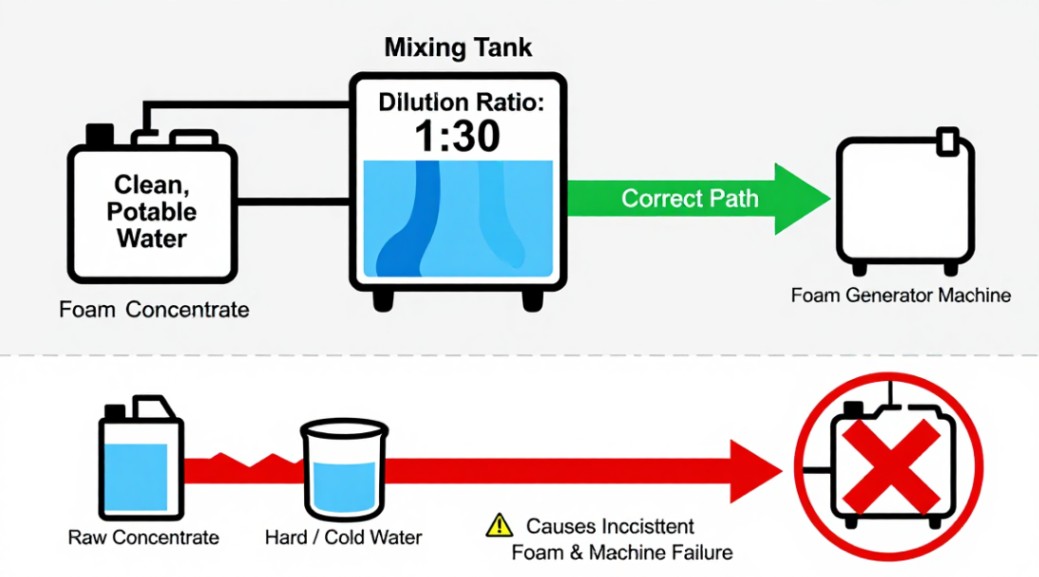
4. Operational Steps That Prevent Disaster
Here is the non-negotiable sequence. Skip a step, accept the risk.
| Step | Action | Critical Check |
|---|---|---|
| 1. Pre-Batch | Ensure compressed air is dry, oil-free, and at stable pressure (5.5-6.5 bar). Prepare diluted foam solution. | Drain the air line filter. Verify dilution ratio with a refractometer. |
| 2. Calibration | Run the foam generator into a calibrated 1-liter container for 60 seconds. Weigh the foam. | Adjust water/air/concentrate flow until foam density matches your design (e.g., 45 g/L). Do this daily. |
| 3. Integration | Signal the generator to start 5-10 seconds before the slurry is ready in the mixer. Pipe foam delivery line directly into the mixing vortex. | Foam must blend into slurry, not sit on top. Use a flexible hose to optimize entry point. |
| 4. Post-Batch | Immediately flush the foam generator with clean water for 3-5 minutes. Run a cleaning cycle with mild acid solution weekly to dissolve cement dust and concentrate residue. | Any dried concentrate inside the chamber will act as a nucleation site, creating giant, useless bubbles next time. |
5. Maintenance: Your Insurance Policy Against 30% Cost Overnight
Neglect turns a foam generator into a paperweight in months. The cost isn’t just repair. It’s every cubic meter of out-of-spec concrete you pour. Your weekly ritual must include inspecting and cleaning the foam nozzle or mixing chamber. Check all hose clamps and fittings for air leaks—a tiny leak destroys pressure balance. Every 500 operating hours, replace the diaphragm or piston seals in the dosing pumps. They wear. Worn pumps deliver the wrong ratio, and you won’t know until your blocks fail compression tests.
6. The ROI Mirage and the Real Calculation
Don’t compare machine cost to lightweight aggregates. That’s the wrong math. The real comparison is the cost of a failed pour, a rejected load, or thermal bridging in a building facade. The ROI of a properly specified and maintained foam generator machine for concrete production comes from predictable density, consistent thermal performance, and zero waste. If your machine isn’t delivering that, you bought the wrong model, the wrong concentrate, or you’re operating it wrong.
What You Do Next Defines Your Product
Stop treating foam generation as a peripheral task. It is the central control point for the entire physical and economic performance of your lightweight concrete. Audit your current process against the failure points listed here. Test your foam’s stability with a simple drainage test. Calibrate your machine every single day. The machine doesn’t make foam concrete. It makes the bubbles that either carry your profit or sink it. Your next batch depends on which one you choose.
Supplier
We are the global leader in lightweight concrete and advanced engineered foam solutions. Known globally for its commitment to research, innovation, and applied expertise, we have been providing engineered foam solutions since the early 2012’s.
We can supply high-quality concrete admixture and foam concrete related products all over the world.
The company has a professional technical department and quality supervision department, a well-equipped laboratory, and equipped with advanced testing equipment and after-sales customer service center.
If you are interested, please feel free and contact us.