Concrete4U | Concrete Admixtures, Tools, and Production Machines

Foamed Concrete Density for Fill: The Decisive Metric You’re Probably Getting Wrong
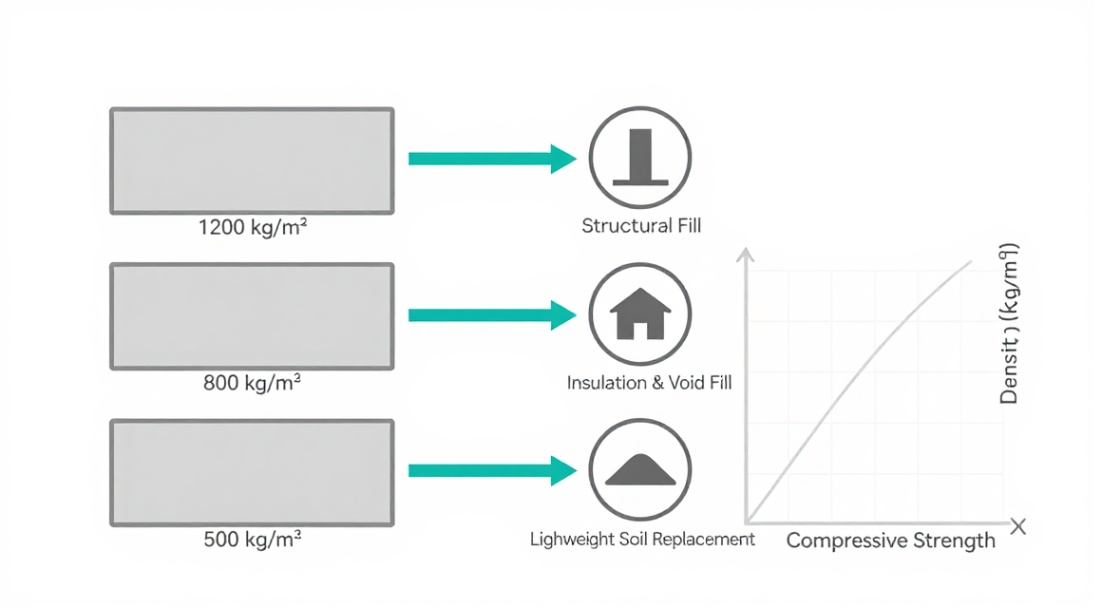
The optimal foamed concrete density for fill applications isn’t a single number; it’s a precise engineering range, typically between 500 kg/m³ and 1200 kg/m³, selected to deliver the exact strength and weight needed to replace soil or aggregate.
1. What is Foamed Concrete for Fill?
Don’t call it “lightweight concrete.” That’s too vague. Foamed concrete for fill is a controlled, engineered material. It’s a slurry of cement, water, and a pre-formed foam. The foam creates millions of microscopic, non-interconnected air voids. This cellular structure is the key. It replaces the heavy aggregate in standard concrete. The result is a fluid, self-compacting, lightweight mass.
Its core job? To occupy void spaces efficiently and predictably.
2. Density is the Primary Control Knob
Everything hinges on density. Adjust the foam volume, you adjust the density. Adjust the density, you control the performance.
- Ultra-Lightweight Fill (500-800 kg/m³): For reducing load on weak soils, filling abandoned tanks, or creating thermal insulation layers. Minimal strength, maximum weight savings.
- Standard Structural Fill (800-1200 kg/m³): The workhorse range. Provides sufficient compressive strength (0.5 MPa to 5 MPa+) for most backfill, trench reinstatement, and foundation support. This is where you balance economy and performance.
- High-Density Fill (1200-1500 kg/m³): Used where higher load-bearing is critical, but flowability and self-compaction are still required over compacted aggregate.
3. The Sharp Advantages Over Traditional Fill
Forget compacted granular fill. Here’s why foamed concrete wins.
3.1. Settlement? What Settlement?
- No Compaction Required. It’s cast in place. You eliminate the risk of inadequate compaction, the #1 cause of differential settlement.
- Consistency is Guaranteed. A density-controlled pour is uniform. No pockets of loose material. This predictability drives engineers to specify it for critical voids.
3.2. Speed and Access Trump Cost (Often)
Material cost per cubic metre is higher than dirt. Total project cost is frequently lower.
- One-pour placement. No layering, no compaction equipment, no testing between lifts.
- Flows anywhere. Can be pumped over 500+ meters horizontally or vertically into inaccessible trenches, culverts, or old basements. Manual labor in dangerous spaces? Eliminated.
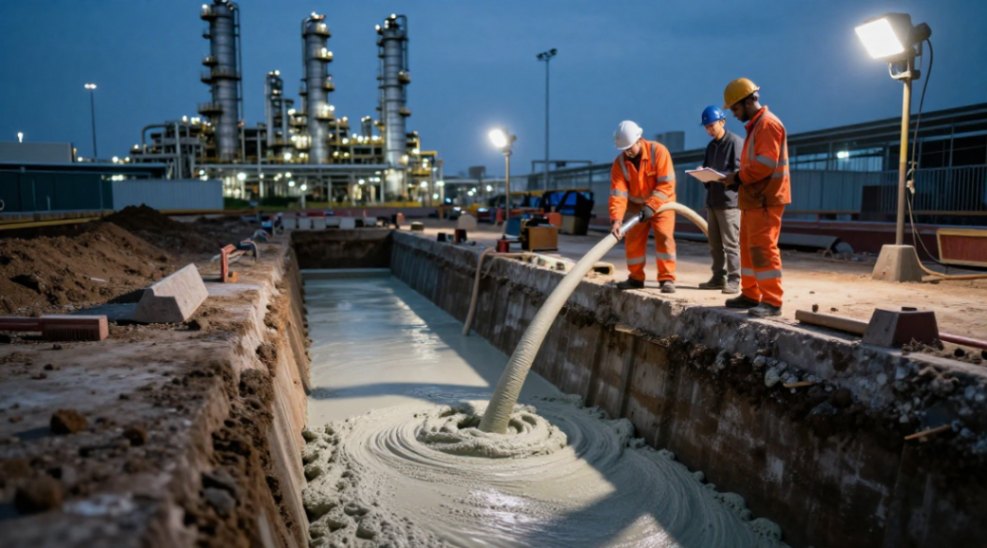
On Reddit’s civil engineering forums, users note: “We used 950 kg/m³ foamcrete to backfill an 8m deep service trench in a live refinery. Saved three weeks. The safety guys loved it.” That’s real-world proof.
4. The Production & Quality Control Process
This isn’t a DIY job. Proper execution is non-negotiable.
- Batching: Cement slurry is mixed on-site or delivered ready-mixed.
- Foam Generation: A dedicated foam generator blends foaming agent, water, and air to produce stable, pre-formed foam.
- In-Line Mixing: The foam is injected into the slurry stream within a mixing chamber. This is the critical step where density is set.
- Placement: The fluid mix is pumped directly into the void. It self-levels.
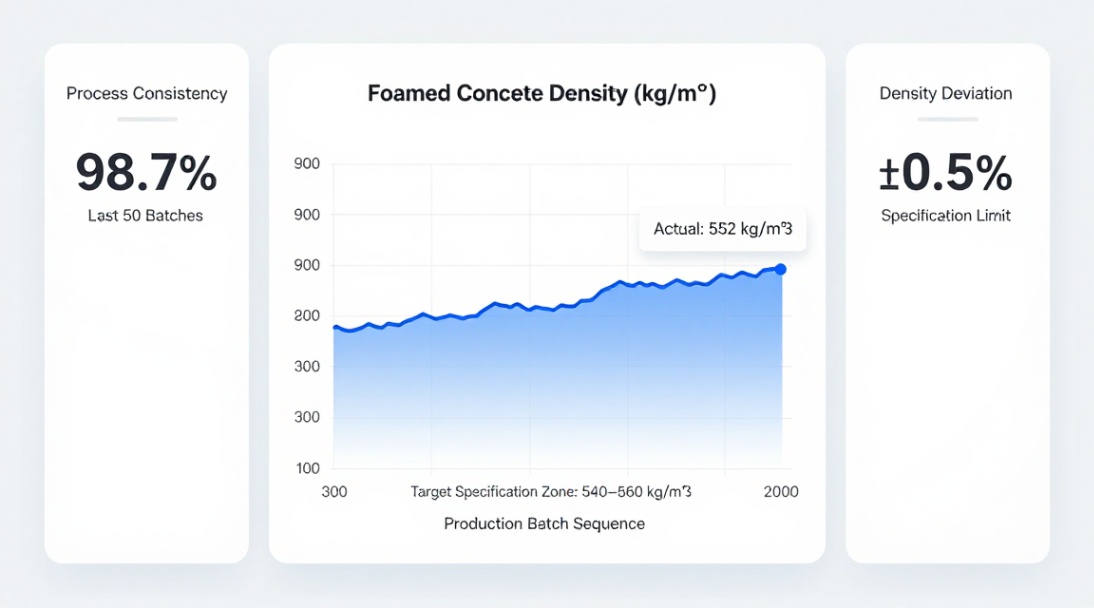
Quality control is continuous. The crew checks density every 15-30 minutes using a pressurized air metre or simple weight/volume checks. No guesswork allowed.
5. Where It Shines: Real Applications
- Abandoned Pipeline & Utility Trench Backfill: Prevents future collapse and surface settlement. The industry standard for reinstating high-value pavements.
- Bridge Abutment & Culvert Fill: Reduces lateral earth pressure on structures. This is a major, underutilized benefit.
- Slab-On-Grade Foundation Support: Replaces poor, expansive, or collapsible soils under floor slabs. Provides a uniform, stable platform.
- Mining & Solution Cavity Stabilization: Fills unstable underground voids with a permanent, rigid material.
6. Stop Debating, Start Testing
The biggest mistake is treating foamed concrete like a commodity. It’s a precision-engineered solution. Specifying “lightweight fill” is useless. You must specify:
- Target Plastic Density Range: e.g., 1000 kg/m³ ± 50 kg/m³
- Required 28-Day Compressive Strength: Derived from the density. e.g., >1.0 MPa
- Flowability & Placement Method: Pump distance, head pressure.
Your success depends on partnering with a producer who understands this is a process, not just a product. Their expertise in achieving consistent density is everything.
Ready to move beyond compacted fill and its hidden risks? Consult with a specialist foamed concrete producer today. Demand a project-specific mix design based on your required density and strength. Send them your geotechnical report. The right foamed concrete density for fill applications will save you time, eliminate callbacks, and give you a permanent, stable result. Stop guessing. Engineer it.
Supplier
We are the global leader in lightweight concrete and advanced engineered foam solutions. Known globally for its commitment to research, innovation, and applied expertise, we have been providing engineered foam solutions since the early 2012’s.
We can supply high-quality concrete admixture and foam concrete related products all over the world.
The company has a professional technical department and quality supervision department, a well-equipped laboratory, and equipped with advanced testing equipment and after-sales customer service center.
If you are interested, please feel free and contact us.