Concrete4U | Concrete Admixtures, Tools, and Production Machines

Non-Chloride Early Strength Admixtures: The Contractor’s Guide to Faster Strength Without Corrosion Risk
A Bridge That Didn’t Wait
The repair window was 8 hours. We had to open the bridge deck to traffic by morning. The project manager looked at the sub-freezing temperature readings, then at me. ‘We need it to set fast, but the spec says no chlorides.’ His engineers were scared of accelerated corrosion. I told him what we were going to use. Eight hours later, the concrete was hard enough to take a beating. It wasn’t magic. It was a deliberate choice.

What Is a Non-Chloride Early Strength Admixture?
A non-chloride early strength admixture is a chemical added to concrete. It speeds up the hydration of cement particles. You get faster setting and higher early strength. The key differentiator? It contains no chloride ions. Zero. This eliminates the primary catalyst for corrosion in steel reinforcement. It’s a tool for speed that doesn’t mortgage the structure’s future.
Chloride vs. Non-Chloride: The Ultimate Showdown
Making the wrong choice here costs millions. Let’s compare.
Calcium Chloride Admixtures (The Old Guard)
Pros:
- Cost: Inexpensive. The lowest upfront price per cubic yard.
- Effectiveness: Exceptionally powerful at accelerating set and early strength, especially in cold weather.
- History: Decades of use; contractors are familiar with it.
Cons:
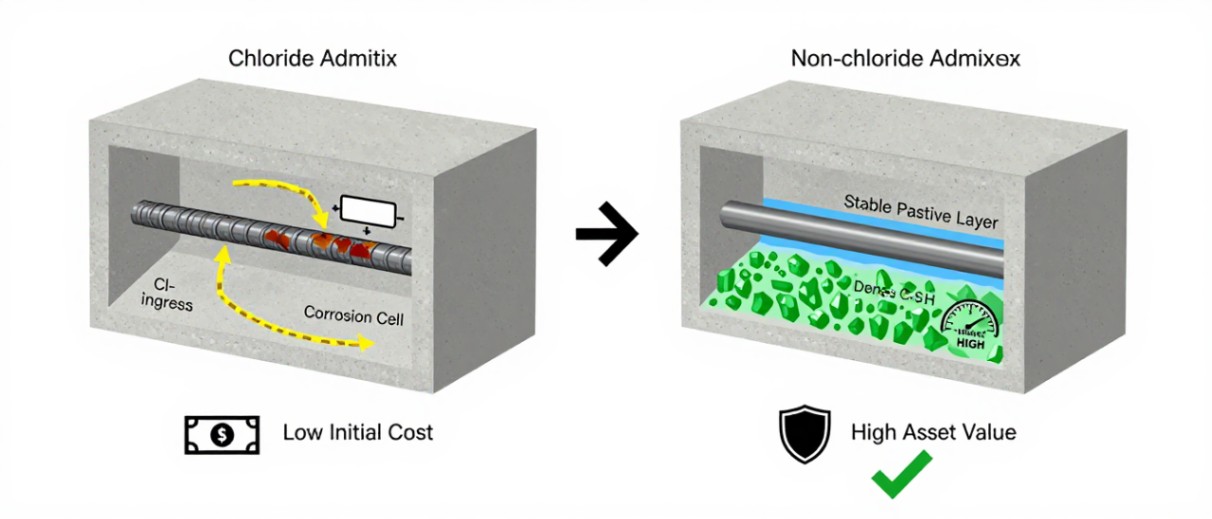
- Corrosion: Chloride ions attack the passive layer on reinforcing steel, initiating rust. This is a guaranteed, time-delayed failure mechanism.
- Code Restrictions: Prohibited in prestressed concrete and most reinforced concrete by modern building codes (ACI 318, CSA A23.1).
- Durability Impact: Compromises long-term structural integrity. It’s a short-term gain for a long-term catastrophe.
Non-Chloride Admixtures (The Modern Standard)
Pros:
- Corrosion Safety: Zero chloride content. This is the single biggest reason to use them. You protect the steel.
- Code Compliance: Meets the requirements for use in reinforced, prestressed, and post-tensioned concrete.
- Durability: No chemical attack on the reinforcement. The concrete’s lifespan remains intact.
- Versatility: Can be used with a wider range of cement types and supplementary cementitious materials.
Cons:
- Cost: Higher initial cost per unit compared to calcium chloride.
- Peak Performance: In extremely cold conditions (below 20°F / -7°C), some non-chloride types may not accelerate as aggressively as pure calcium chloride. They often require better cold weather concreting practices (insulation, heated materials).
- Variability: Performance depends heavily on the specific formulation (nitrate, nitrite, thiocyanate, alkanolamine-based). You must test the specific product with your mix design.
Key Questions, Direct Answers
How does a non-chloride admixture work?
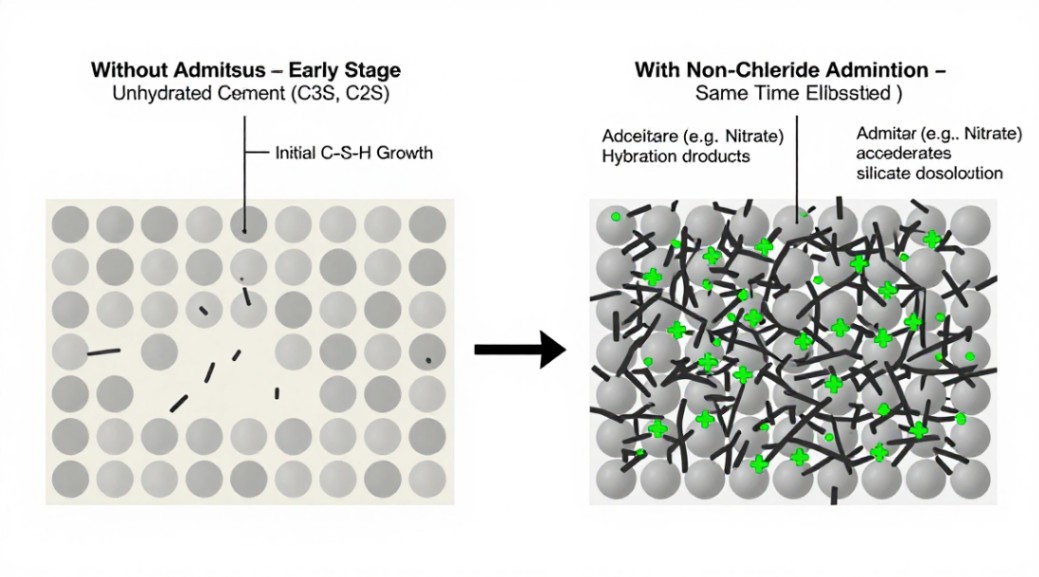
It alters the chemistry of the cement paste. It doesn’t rely on chlorides. Instead, it uses compounds like nitrates or specific organic agents. These compounds accelerate the dissolution of silicate and aluminate phases in the cement. This creates more nucleation sites for hydration products to form. More products form faster. The result is a rapid stiffening and strength gain.
When must I use a non-chloride admixture?
Use it always in reinforced concrete. This is not a suggestion. Modern codes treat calcium chloride as a contaminant in structural concrete. For repairs, precast panels, slabs, columns, and beams with any embedded steel, non-chloride is the only responsible choice.
Can I use it with other admixtures?
Yes, but you must test. Non-chloride accelerators are generally compatible with water reducers and superplasticizers. However, the sequence of addition matters. Always add the non-chloride early strength admixture to the mix water first, before other admixtures. Trial batches are non-negotiable to confirm performance and set time.
Does it affect final strength?
Properly dosed, it should not reduce the 28-day design strength. In fact, by creating a denser early microstructure, it can sometimes enhance it. The danger is overdose. Too much can lead to rapid stiffening, poor finishing, and even micro-cracking that can impact long-term durability. Follow the manufacturer’s dosage based on cement content, not just cubic yards.
The Logic of Your Decision
The choice is binary and clear. Look at the total cost.
Calcium chloride offers a cheap ticket to fast strength. The real cost? Potential structural failure, liability lawsuits, and catastrophic repair bills in 10-15 years. You are trading immediate schedule convenience for a guaranteed, expensive problem.
A non-chloride early strength admixture has a higher ticket price. The real value? It delivers the schedule performance you need while preserving the asset. It protects the multi-million dollar structure you are building. The logic is irrefutable. The only reason to ever consider chlorides is for non-structural mass concrete where no metal is present. For everything else, the decision was made for you by the laws of electrochemistry and modern engineering standards.
Your Next Step
Do not guess. Your mix is unique. Contact a reputable admixture supplier. Request technical data sheets for their non-chloride early strength products. Then, run trial batches. Test set time, early strength (at 12 and 24 hours), and final compressive strength. The few hundred dollars spent on testing will validate your schedule and protect your project from a hidden, corrosive failure. This is how you build things that last.
Supplier
We are the global leader in lightweight concrete and advanced engineered foam solutions. Known globally for its commitment to research, innovation, and applied expertise, we have been providing engineered foam solutions since the early 2012’s.
We can supply high-quality concrete admixture and foam concrete related products all over the world.
The company has a professional technical department and quality supervision department, a well-equipped laboratory, and equipped with advanced testing equipment and after-sales customer service center.
If you are interested, please feel free and contact us.