Concrete4U | Concrete Admixtures, Tools, and Production Machines

Early Strength Agents for Cold Weather Concrete: Your Guide to Avoiding Winter Disaster
Your Concrete Is Setting Up to Fail in the Cold
You’ve seen it. You pour a slab in 35°F weather. You protect it, you think. Yet, days later, the surface looks weak. It powders under your boot. Maybe hairline cracks appear. That’s the cold winning. Without sufficient early strength, fresh concrete is vulnerable. Ice crystals form, expanding and permanently damaging the paste matrix. The result? Reduced durability, compromised strength, and a failed project. The old methods-just straw and tarps-aren’t enough for modern schedules. We need a smarter defense. That’s where early strength agents become non-negotiable.

How Cold Weather Sabotages Concrete Hydration
Concrete cures through a chemical reaction called hydration. Cold temperatures slow this reaction dramatically. Think of it like trying to cook a meal with a weak flame. For every 18°F (10°C) drop in temperature below 73°F (23°C), the rate of strength gain can halve. In freezing conditions, hydration nearly stops. Water turns to ice, expands, and creates internal pressure. If the concrete hasn’t reached a critical strength-typically about 500 psi-this expansion causes permanent, microscopic damage. Your concrete never reaches its potential. An early strength agent accelerates the initial flame, getting the reaction hot and fast enough to outrun the freeze.
What Exactly Is an Early Strength Agent?
An early strength agent is a chemical admixture designed to accelerate the hydration of Portland cement. It jump-starts the reaction, allowing concrete to develop its initial compressive strength much faster than it would under normal cold-weather conditions. This is not a magical cure-all. It is a critical tool within a system of cold-weather concreting best practices, including heated materials, insulated blankets, and enclosures. Its primary job is to get the concrete past that vulnerable stage before freeze damage can occur.
The Main Types of Accelerators: Chloride vs. Non-Chloride
Choosing the right agent is crucial. The wrong one can cause more problems than it solves.
Calcium Chloride-Based Accelerators
Calcium chloride (CaCl2) is the classic, most cost-effective accelerator. It works exceptionally well. But it has a major caveat: it introduces chloride ions, which can corrode embedded steel reinforcement. Its use is strictly prohibited in reinforced concrete, prestressed concrete, or any application where metal is present. Its domain is strictly limited to plain concrete (e.g., sidewalks, foundations without rebar).
Non-Chloride Accelerators
These are the modern workhorses for most commercial and structural projects. They contain compounds like calcium nitrite, nitrate, or thiocyanate. They provide excellent acceleration without the corrosion risk. They are more expensive than calcium chloride, but for any job with rebar, post-tensioning cables, or galvanized embeds, they are the only safe choice. Always verify the specific chemistry and its compatibility with your other materials.
Key Benefits Beyond Just “Faster”
Yes, you get faster initial set. But the strategic advantages are broader.
- Earlier Finishing: The concrete reaches its final set sooner, allowing finishers to begin and complete their work faster. This reduces labor time on-site in harsh conditions.
- Earlier Formwork Removal: Forms and shoring can be struck sooner, freeing up this equipment for reuse on the next phase of the project. This is a major schedule driver.
- Reduced Protective Period: Because the concrete achieves its critical, freeze-resistant strength faster, you may reduce the duration of costly heating and insulation measures.
- Mitigated Plastic Shrinkage: Faster stiffening reduces the time window for surface water evaporation, helping prevent early-age plastic shrinkage cracks.
Critical Application & Dosing Guidelines
More is not better. Improper use can lead to flash set, cracking, or reduced long-term strength.

Rule #1: Follow the Manufacturer’s Specs. Dosage is typically a percentage of cementitious materials by weight, often between 1-2%. Exceeding this can be detrimental.
Rule #2: Integrate it into the Mixing Sequence. The agent should be added to the mix water or with the initial mixing water. Ensure thorough, uniform dispersion. Adding it late to a partially mixed batch can cause uneven setting.
Rule #3: Conduct Compatibility Tests. Never assume your early strength agent plays nicely with your water reducer, air-entraining agent, or other admixtures. Order trial batches with your exact mix design and all planned admixtures to cheque for compatibility and performance.
The Non-Negotiable Companion Practices
An accelerator is not a substitute for cold weather protocols. It is part of the team.
- Pre-Heat Materials: Use heated mix water and aggregates to deliver concrete at a placement temperature above 55°F (13°C).
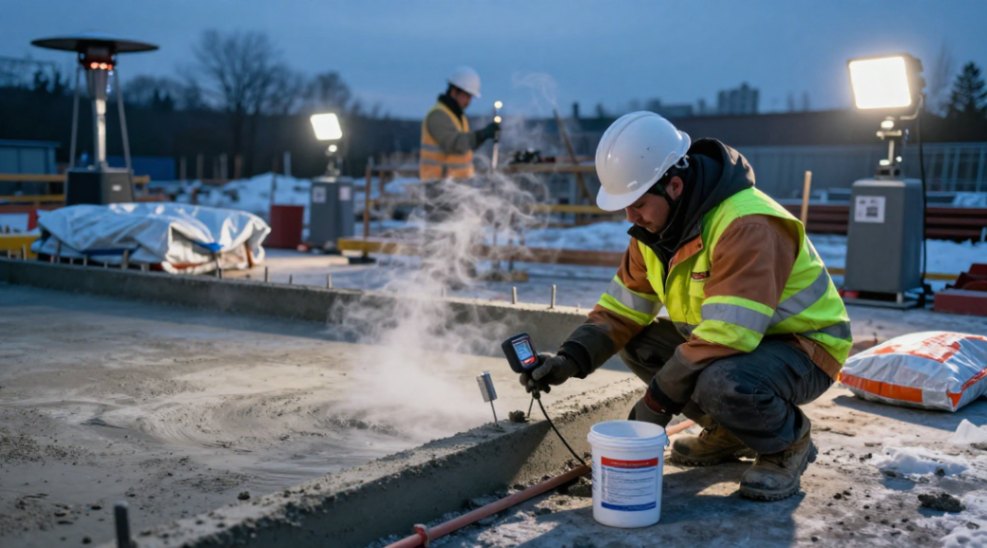
- Protect the Placed Concrete: Immediately after placement and finishing, cover the slab with insulated blankets or use heated enclosures to retain the heat of hydration.
- Monitor Temperature: Use maturity meters or temperature probes to verify the concrete is maintaining adequate temperature and gaining strength as predicted.
- Extend Curing: Even with an accelerator, maintain moist curing for the full recommended period. The agent speeds early reactions but doesn’t eliminate the need for proper hydration over time.
The Final Word: A Strategic Necessity
In cold weather, an early strength agent shifts from an optional additive to a core component of risk management. It buys you the most valuable commodity on a winter job: time. Time to achieve strength before a freeze. Time to move to the next task. Time to ensure the structural integrity you were hired to deliver. Don’t gamble with the weather. Specify and use the right accelerator as part of a disciplined, multi-faceted cold weather plan. Your concrete’s long-term performance depends on the decisions you make in those first critical hours.
Ready to specify with confidence? Consult your concrete supplier and admixture technical representative today. Provide them with your specific mix design, ambient temperature forecasts, and project requirements. Order a compatibility test batch. This small upfront step is the cheapest insurance you can buy against winter construction failure.
Supplier
We are the global leader in lightweight concrete and advanced engineered foam solutions. Known globally for its commitment to research, innovation, and applied expertise, we have been providing engineered foam solutions since the early 2012’s.
We can supply high-quality concrete admixture and foam concrete related products all over the world.
The company has a professional technical department and quality supervision department, a well-equipped laboratory, and equipped with advanced testing equipment and after-sales customer service center.
If you are interested, please feel free and contact us.