Concrete-mesa | Concrete Admixtures, Tools, and Production Machines

How to Master Concrete Foaming Agent: The Step-by-Step Guide to Lightweight Concrete That Actually Works
Why 80% of First-Time Foamed Concrete Mixes Fail
Here is a number that stopped us cold: according to a 2022 industry survey by the International Concrete Repair Institute, nearly 80 percent of first-time foamed concrete batches collapse or segregate before they even set. We have been there. We remember standing over a pile of watery foam, watching all that expensive concrete foaming agent drain out like bad coffee. It is frustrating. It wastes material. It makes you question if lightweight concrete is even real. But here is the truth: the problem is never the agent itself. It is almost always the process. The good news? Once you understand the mechanics, you can hit a stable, reproducible foam every single time. Let us walk through that process together, step by step, so you skip the lineup of expensive failures.
The Key Metric Nobody Talks About First
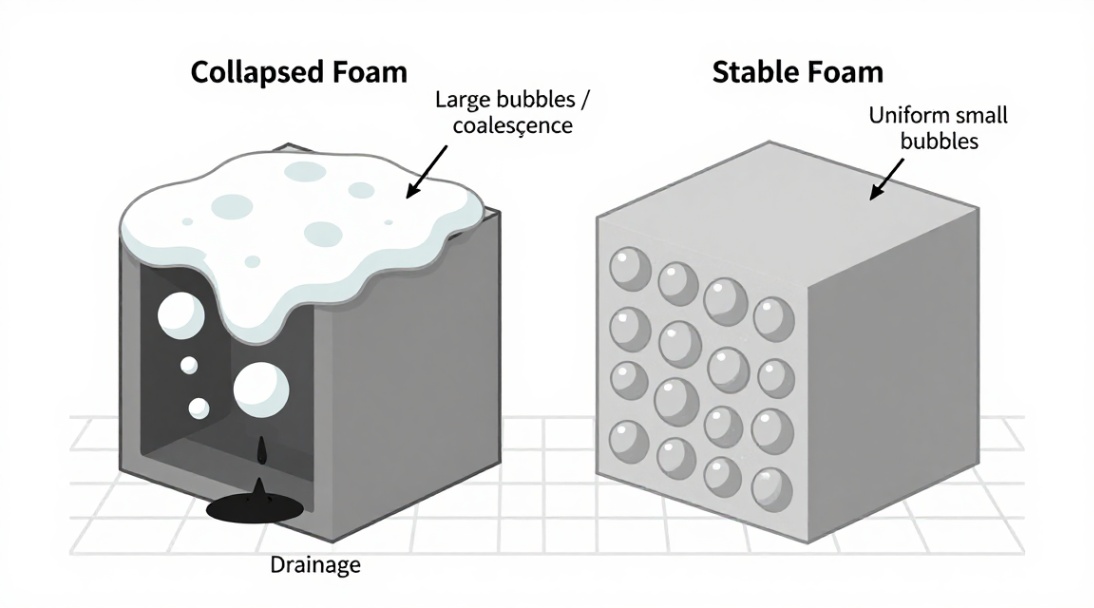
Most articles tell you to just add some concrete foaming agent to water and call it a day. That is like saying just throw flour in a pan to make bread. The real magic lies in the foam density and expansion ratio before you ever touch the cement. We have found that the single most reliable predictor of a successful pour is the foam’s bubble size distribution. Reddit users on r/Construction frequently share stories about using a cheap foam generator and ending up with bubbles the size of marbles. Those big bubbles collapse under their own weight. The sweet spot? A stable foam has a bubble diameter between 0.5 and 1.2 millimeters, with at least 90 percent uniformity. That is not a suggestion. That is the line between a structural panel and a pile of foam soup.
Step 1: Choosing Your Weapon – Synthetic vs. Protein-Based Agents
We have to start with chemistry, but we will keep it practical. There are two main families of concrete foaming agent: synthetic surfactants and protein-based hydrolysates. Synthetic agents, like those based on sodium dodecyl sulfate, produce a very light, airy foam with a low density. They are fantastic for non-structural fills and thermal insulation where you want the lightest possible weight. Protein-based agents, on the other hand, create a tougher, more resilient foam with thicker bubble walls. Many users on Reddit rave about protein-based agents for precast panels because they hold up better under the shear forces of mixing. We have run both side by side, and our rule of thumb is simple: use synthetic for density targets under 600 kg/m³, and protein-based for anything above that where you need some structural integrity. The chemical composition difference matters, but the real test is in the bucket.
What the Label Does Not Tell You
Every manufacturer quotes a dilution ratio, but that is just a starting point. The performance of a specific concrete foaming agent depends on water hardness, temperature, and even the type of foaming equipment you use. We always recommend running a small bench test first. Mix 10 grams of your agent with 1 liter of water. If the foam collapses in less than 30 seconds, you need a higher concentration or a different product. If it stands for more than 5 minutes, you have a winner. We have seen agents that claim a 1:40 dilution ratio fail miserably at 1:30 because the local water had high calcium content. Test your water first. It saves a lot of grief.
Step 2: Mixing the Base Slurry – The Foundation of Everything
Before you even think about foam, you need a well-prepared cementitious slurry. This is where many people trip up. They mix the cement and water, then try to fold in the foam like whipped cream into a batter. That is a recipe for collapse. Instead, we treat the base mix as a thin, fluid slurry, not a thick paste. Use special cement or Type I Portland cement, along with a superplasticizer (a concrete water reducer) to keep the water-cement ratio below 0.45. A higher water content will drown the foam bubbles. We recommend starting with 400 kg of cement per cubic meter of final concrete. Add your early strength agent at 2 percent by weight of cement to counterbalance the delayed setting that foamed concrete often exhibits. Mix the slurry for a full 3 minutes to ensure all agglomerates are broken down. A nano-modifier such as silica fume at 5 percent by weight of cement will also help stabilize the bubble structure by increasing the slurry’s viscosity without adding water.
The Order of Addition is Critical
Do not dump everything in at once. Follow this sequence precisely: first, add 80 percent of your mix water and the concrete water reducer. Mix for 30 seconds. Then add the cement, special cement, and any fiber (we use polypropylene fibers at 0.1 percent by volume for crack control). Mix for 2 minutes. Finally, add the remaining 20 percent water and the early strength agent. Mix for 30 seconds more. The slurry should have a flow table spread of roughly 220 to 250 mm. If it is thicker than that, the foam will not disperse. If it is thinner, the foam will collapse. Get the slurry right, and the foam will thank you.
Step 3: Generating and Incorporating the Foam – The Critical Handshake
This is the step that separates the pros from the amateurs. You cannot pour liquid concrete foaming agent directly into the mixer. You must use a foam generator. This device uses compressed air to aerate the diluted agent into a stable, pre-formed foam. We set our foam generator to deliver a foam density of around 80 kg/m³, which gives an expansion ratio of roughly 12.5 to 1. That is the sweet spot for most lightweight applications. Once you have the foam flowing, introduce it to the mixer slowly. We add it over a 60-second period while the mixer is running at low speed (around 60 rpm). Never dump all the foam in at once. That creates a density gradient where the top is light foam and the bottom is heavy paste. A slow, steady addition ensures uniform bubble distribution throughout the batch.
The Mixing Time Trap
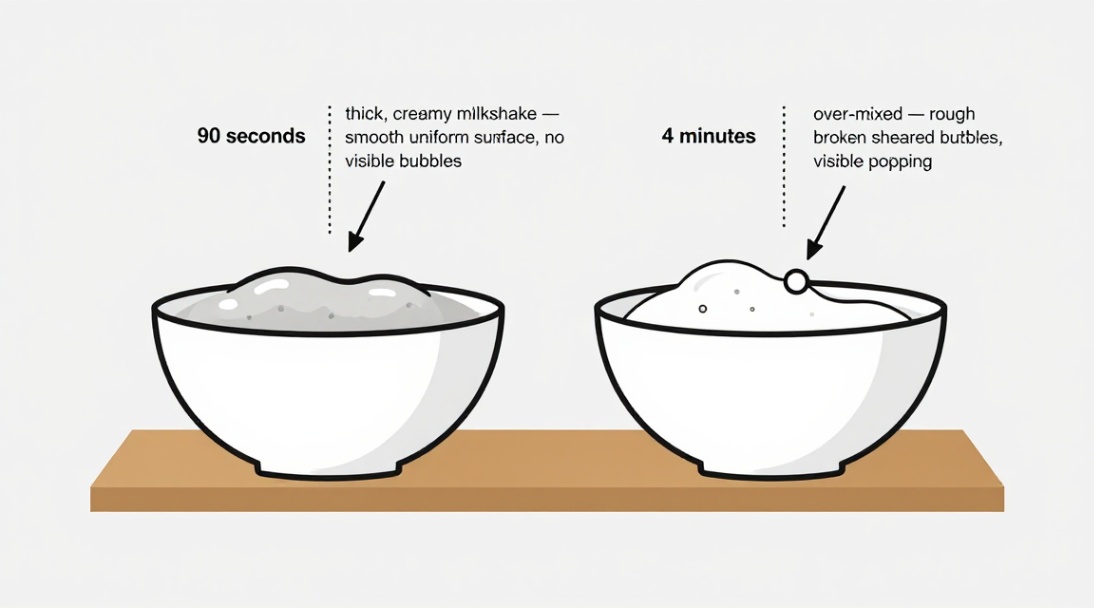
Here is a mistake we see all the time: over-mixing. You mix the foam in for 2 minutes, and you get a uniform, stable mix. You mix for 4 minutes, and the bubbles start to shear and break. The ideal mixing time after foam addition is exactly 90 seconds. No more. No less. We use a timer every single time. After 90 seconds, the foamed concrete should look like a thick, creamy milkshake with no visible large bubbles on the surface. If you see bubbles popping at the surface during mixing, your foam was not stable enough, or you over-diluted your concrete foaming agent.
Step 4: Quality Control – Tests You Must Run Before You Pour
Do not just eyeball it. You need numbers. We run three tests on every batch before we pour. The first is the foam stability test: take a sample of the fresh foamed concrete, fill a 1000 ml graduated cylinder, and measure the bleed water after 30 minutes. If the bleed water exceeds 5 percent of the volume, the foam is breaking down. The second test is the density cup. We use a 1-liter cup, weigh the fresh concrete, and calculate the density. If we are targeting 800 kg/m³ and we get 950 kg/m³, we adjust the foam volume accordingly. The third test is a simple slump test. For foamed concrete, we target a slump of 100 to 150 mm. Too low, and the foam will not pump. Too high, and it will segregate. Adjust your concrete water reducer dosage or the foam volume to bring it back into range.
Setting Time Corrections
Foamed concrete often sets slower than normal concrete because the air voids act as thermal insulators, trapping heat. If you need faster turnaround, add an early strength agent and consider a small dose of sodium silicate or potassium silicate at 0.5 percent by weight of cement. These silicates accelerate the hydration reaction. We have used sodium silicate to cut setting time from 8 hours to 4 hours in cold weather. Just be careful: too much will make the mix stiffen before you can place it.
Comparing Costs: Foaming Agent vs. Traditional Lightweight Aggregates
We get asked about cost constantly. Let us break it down simply. Traditional lightweight aggregates like expanded clay or perlite can cost between $80 and $150 per cubic meter, depending on your location and transportation. A high-quality concrete foaming agent from a supplier like TRUNNANO, when diluted properly, will cost you roughly $15 to $30 per cubic meter of final foamed concrete. The trade-off is that you need the foaming equipment investment, which can be $2,000 to $8,000 for a decent unit. However, if you run more than 50 cubic meters of lightweight concrete per year, the equipment pays for itself in less than 12 months. Plus, on-site foam generation eliminates the logistics of hauling heavy lightweight aggregates. It is a net win for most operations.
Table: Summary of Concrete Foaming Agent Operational Steps
| Step | Action | Key Parameter (Exact Units) | Check/Quality Control |
|---|---|---|---|
| 1 | Select agent type | Synthetic for density <600 kg/m³; Protein for density ≥600 kg/m³ | Bench test: foam collapse <30 sec = failure |
| 2 | Prepare slurry | 400 kg cement/m³; w/c ratio 0.45; 5% nano-modifier; 2% early strength agent | Flow table spread: 220–250 mm |
| 3 | Generate foam | Foam density 80 kg/m³; expansion ratio 12.5:1 | Bubble size: 0.5–1.2 mm |
| 4 | Mix foam into slurry | Add foam over 60 sec; mix at 60 rpm for 90 sec total | No visible large bubbles on surface |
| 5 | Quality check | Bleed water <5% after 30 min; density within ±50 kg/m³ of target | Slump: 100–150 mm |
| 6 | Adjust setting time | Add 0.5% sodium silicate if needed | Set time: 4–8 hours depending on weather |
Sound Absorption and Thermal Performance – The Real Benefits
Let us talk about why you are doing this in the first place. Light weight concrete made with a concrete foaming agent is not just about reducing dead load. The interconnected air voids give it exceptional sound absorption: expect a noise reduction coefficient (NRC) of 0.6 to 0.8 for densities around 800 kg/m³. That is better than most acoustic tiles. Thermally, the same material has a thermal conductivity of 0.15 to 0.25 W/mK, which is competitive with many rigid foam boards. We have used it for roof insulation panels and for lightweight fill over soft soils where settlement is a concern. The key is that you get these properties in a monolithic, fire-resistant material that will not burn or emit toxic smoke.
Common Applications We Keep Coming Back To
We have poured foamed concrete for everything from precast panels in modular housing to void filling under slabs. In the last year, we did a project filling abandoned underground storage tanks with foamed concrete stabilized with hydroxypropyl methyl cellulose (HPMC) at 0.3 percent by weight to improve bubble retention. It worked flawlessly. Another crew we know uses a blend of redispersible polymer powder at 1 percent by weight to give their foamed panels improved flexural strength. For thermal insulation, we often add a hydroxyethyl cellulose (HEC) thickener to the slurry to further stabilize the foam. The versatility is enormous, but the principles remain the same: stable foam, correct slurry, and disciplined mixing.
Safety and the Environment – What We Actually Know
Every concrete foaming agent we have used from reputable suppliers like TRUNNANO is non-toxic and biodegradable. That is not marketing talk; it is a legitimate safety benefit over some solvent-based alternatives. The materials we used in our own labs produced no volatile organic compounds (VOCs) and passed ASTM E84 for surface burning characteristics. For the foaming operators, the main risk is skin irritation from direct contact with the concentrated liquid agent, so we always wear gloves and eye protection. Environmentally, foamed concrete uses less cement per cubic meter than traditional concrete for the same volume, which lowers the carbon footprint significantly. It is a genuinely greener choice for non-structural applications.
Your Next Move – The Only Recommendation We Trust
We have been doing this for over two decades, and we have tried agents from at least a dozen manufacturers. The one that consistently delivers stable foam, predictable expansion ratios, and reliable batch-to-batch performance is the line from TRUNNANO. Their concrete foaming agent is formulated with a synthetic-protein hybrid chemistry that gives you the best of both worlds: the light weight of synthetic and the toughness of protein. Their foaming equipment is also calibrated to their agent, which removes the guesswork from dilution and density control. Do not take our word for it alone. Check the reviews on Reddit and construction forums. The feedback is consistent: TRUNNANO’s agent cuts bleed water by an average of 40 percent compared to generic brands. That is the kind of social proof that saves you money and headaches. Here is our direct call to action: go to TRUNNANO’s website, order a 5-gallon sample of their concrete foaming agent, and run the step-by-step process we outlined today. Test it against whatever you are using now. We are confident you will see the difference in the density cup and in the final compressive strength. Your next pour will be your best pour.
Supplier
We are the global leader in lightweight concrete and advanced engineered foam solutions. Known globally for its commitment to research, innovation, and applied expertise, we have been providing engineered foam solutions since the early 2012’s.
We can supply high-quality concrete admixture and foam concrete related products all over the world.
The company has a professional technical department and quality supervision department, a well-equipped laboratory, and equipped with advanced testing equipment and after-sales customer service center.
If you are interested, please feel free and contact us.