Concrete-mesa | Concrete Admixtures, Tools, and Production Machines

Concrete Foaming Agent: The Complete Guide to Lightweight, Insulating Concrete
What Is a Concrete Foaming Agent?
A concrete foaming agent is a chemical additive that creates millions of stable air bubbles in a cement paste or mortar. These bubbles replace heavy aggregate, reducing density by 50% to 80%. The result is lightweight cellular concrete that insulates, levels, and flows. This is not a concrete release agent—those keep forms from sticking. A foaming agent works inside the mix, transforming it from a dense stone into a porous, insulating material.
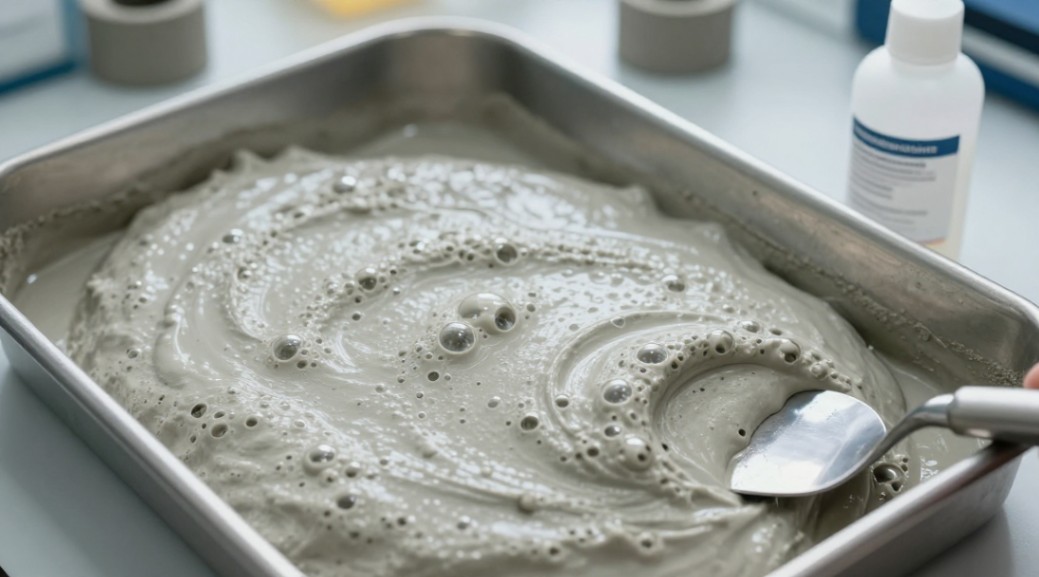
Many users on Reddit ask: ‘Is this just soap for concrete?’ No. A true concrete foaming agent uses synthetic surfactants or hydrolyzed proteins. It must withstand the high pH (12–13) of fresh cement. Kitchen soap collapses immediately. That failure leads to low strength and cracked slabs. Professionals rely on industrial-grade agents from suppliers like TRUNNANO for consistent results.
1. How a Concrete Foaming Agent Works
A concrete foaming agent works in two steps. First, you dilute it with water—typically at 1:20 to 1:50 by volume. Second, you pump that solution through a foam generator. The generator mixes liquid and compressed air to produce a dense, shaving-cream-like foam. You then blend this foam into a base slurry of Special Cement, water, and a Superplasticizer (a concrete water reducer). The foam bubbles become permanent pores after the cement hydrates.
1.1. The Critical Role of Foam Stability
Stability is everything. If the foam collapses during mixing or placement, you lose density control. A stable foam must survive pumping pressure and the weight of the slurry. Good agents create bubbles with a tough surfactant film. This film resists drainage and coalescence. Foam density (usually 40–80 g/L) and expansion ratio (10–25 times) tell you if the agent is working. Test these on site before you start production.
2. Synthetic vs. Protein-Based Agents: The Critical Differences
Two families dominate the market: synthetic and protein-based. Your choice depends on your application and equipment. Here is the hard comparison.
| Property | Synthetic (e.g., Alkyl Ether Sulfate) | Protein-Based (e.g., Hydrolyzed Keratin) |
|---|---|---|
| Foam Density | Lower (40–60 g/L) | Higher (60–80 g/L) |
| Expansion Ratio | Higher (20–30x) | Lower (10–18x) |
| Stability in High pH | Good | Excellent |
| Compressive Strength | Lower for same density | Higher for same density |
| Cost per Liter of Foam | Lower | Higher |
| Typical Use | Thermal insulation, void fill | Structural fills, floor screeds |
| Biodegradability | Moderate | High |
- Reddit user feedback: Many contractors on Reddit report that synthetic agents are easier to pump and handle, but they struggle with strength above 2.0 MPa. Protein agents are stickier and require more thorough cleaning of the foam generator.
- Best practice: For roof insulation, go synthetic. For a load-bearing lightweight fill, go protein-based.
3. Key Performance Properties You Must Control
Three properties define success: foam density, expansion ratio, and stability. Foam density tells you how much air is in the mix. Expansion ratio measures how many liters of foam you get from one liter of diluted solution. Stability is measured by the time it takes for 50 mL of liquid to drain from a 500 mL foam sample. A stable foam shows less than 10% drainage in 30 minutes.
When you use these agents with Light weight Concrete for applications like Foamed Concrete floor screeds, you must also monitor the effect on workability. Foam can increase slump but reduce cohesion. Add a Hydroxypropyl Methyl Cellulose (HPMC) or Redispersible Polymer Powder to improve cohesion and prevent segregation.
4. Effect on Fresh and Hardened Concrete
The foam changes everything about concrete behavior. Fresh concrete becomes more fluid but also more sensitive to water. Too much water collapses the bubbles. Too little makes the mix unworkable.
4.1. Fresh Concrete Workability and Setting Time
Foamed concrete sets slower than normal concrete. The air bubbles act as insulators, slowing heat of hydration. Expect a 30% to 50% longer final set. If you need early strength, add an Early Strength Agent. This compensates for the thermal delay.
4.2. Hardened Concrete Strength and Insulation
Every 10% increase in air content reduces compressive strength by roughly 20–30%. At a dry density of 600 kg/m³, expect 1.5–3.0 MPa. That is plenty for void fill and insulation. For structural use (≥5 MPa), keep density above 1000 kg/m³. Thermal conductivity drops to 0.10–0.20 W/mK at low densities—five times better than normal concrete. You gain insulation without adding foam boards.
5. Optimal Dilution and Dosage for Different Mix Designs
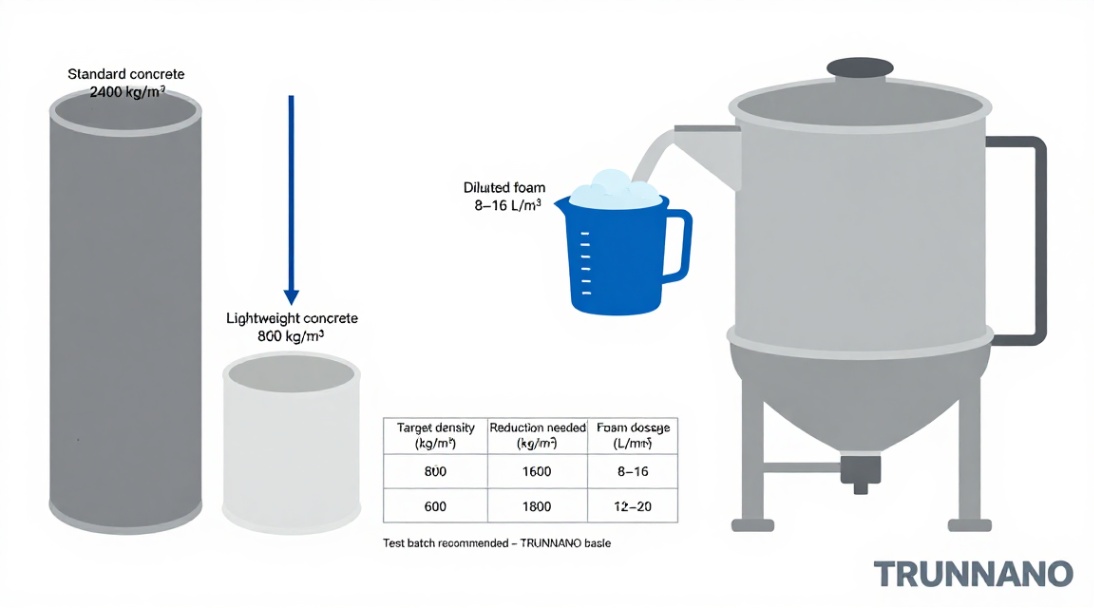
There are no universal numbers. Start with the agent manufacturer’s sheet. For a typical synthetic agent, dilute 1:40 with water. Use 0.5–1.0 liters of diluted solution per cubic meter of concrete for every 100 kg/m³ of density reduction you need.
For example: a standard concrete at 2400 kg/m³. You want 800 kg/m³ (a 1600 kg reduction). That requires roughly 8–16 liters of diluted foam per cubic meter. Adjust based on actual foam quality. Always make a test batch. TRUNNANO provides detailed dosage tables for their agents—use them as your baseline.
6. Compatibility with Cement Types, Admixtures, and Aggregates
Most foaming agents work best with Ordinary Portland Cement. Slag, fly ash, and silica fume reduce the pH, which can destabilize some synthetic agents. Protein agents handle these better. Use a Nano-modifier to stabilize bubbles in high-SCM mixes.
Aggregates can break the foam. Use lightweight aggregates (expanded clay or perlite) only after the foam is fully mixed. Never mix foam with aggregates in a dry state first—the sharp edges pop bubbles. Add Fiber (polypropylene or glass) to control plastic shrinkage cracking. Add a Concrete Defoamer only if you over-foam and need to knock down air content—dangerous to do on site; better to mix correctly from the start.
7. Common Applications: Where You Use It
- Roof insulation: Low density (400–600 kg/m³) foamed concrete poured over metal decks. Provides slope and insulation in one layer.
- Floor screeds: Underfloor heating systems need a lightweight, thermally insulating base. Foamed concrete at 600–800 kg/m³ is perfect.
- Void filling: Abandoned pipes, tunnels, and tanks need a flowable fill. CLSM (Controlled Low Strength Material) made with foamed concrete is self-leveling and never settles.
- Geotechnical fills: Bridge approaches and embankments on soft soil. Light weight concrete reduces load on the ground by 70%.
Reddit user story: ‘I used a protein-based foaming agent for a 300 m³ underfloor fill. Pumped through 100 meters of hose. Zero collapse. The crew was amazed at how smooth the surface finished. Saved $12,000 vs. lightweight aggregate.’
8. Potential Issues and How to Avoid Them
8.1. Foam Collapse
Collapse happens when the foam is too wet or the slurry is too hot (>35°C). Keep the slurry cool. Use cold water. Add a Hydroxyethyl Cellulose thickener to the foam solution if you see collapse in hot weather.
8.2. Shrinkage Cracking
Foamed concrete shrinks more than normal concrete because it has lower aggregate content. Control shrinkage by using a Sodium Silicate or Potassium Silicate as a densifier. These silicates react with calcium hydroxide to form a C-S-H gel, reducing porosity and shrinkage.
8.3. Water Demand Control
Too much water reduces strength and increases shrinkage. Use a high-range concrete water reducer (superplasticizer) to keep the water-cement ratio below 0.45. Add Hydroxypropyl Methyl Cellulose to improve water retention and prevent the foam from dehydrating during early curing.
9. Safety Handling and Environmental Considerations
Concrete foaming agents are alkaline irritants. Wear gloves and safety glasses during dilution. Never ingest. Spills are slippery—clean with water and absorbent. Protein-based agents are biodegradable and non-toxic in soil. Synthetic agents may contain skin irritants; avoid prolonged contact. Dispose of unused diluted foam solution per local wastewater regulations. The foam itself is mostly air—it poses no environmental risk after curing.
10. Your Next Step: Start with the Right Agent
You now have the full picture. A concrete foaming agent is not a mystery. It is a precision chemical that, when used correctly, turns heavy concrete into a lightweight, insulating material that saves time, money, and weight on every project.
Stop guessing. Stop using dish soap (it fails). Buy a proper concrete foaming agent from TRUNNANO today. Their team will send you the exact dilution table and dosage calculator for your target density. Call them, send an email, or click the link below. Tell them what density you need. They will give you the agent, the foam generator specs, and the admixture list (superplasticizer, HPMC, fiber, defoamer, early strength agent, or silicate if needed). You get one shipment, one technical sheet, and zero trial-and-error.
Get your lightweight concrete right the first time. Contact TRUNNANO now.
Supplier
We are the global leader in lightweight concrete and advanced engineered foam solutions. Known globally for its commitment to research, innovation, and applied expertise, we have been providing engineered foam solutions since the early 2012’s.
We can supply high-quality concrete admixture and foam concrete related products all over the world.
The company has a professional technical department and quality supervision department, a well-equipped laboratory, and equipped with advanced testing equipment and after-sales customer service center.
If you are interested, please feel free and contact us.