Concrete4U | Concrete Admixtures, Tools, and Production Machines

Concrete Foaming Agent: The Seven Critical Mistakes That Ruin Your Lightweight Mix
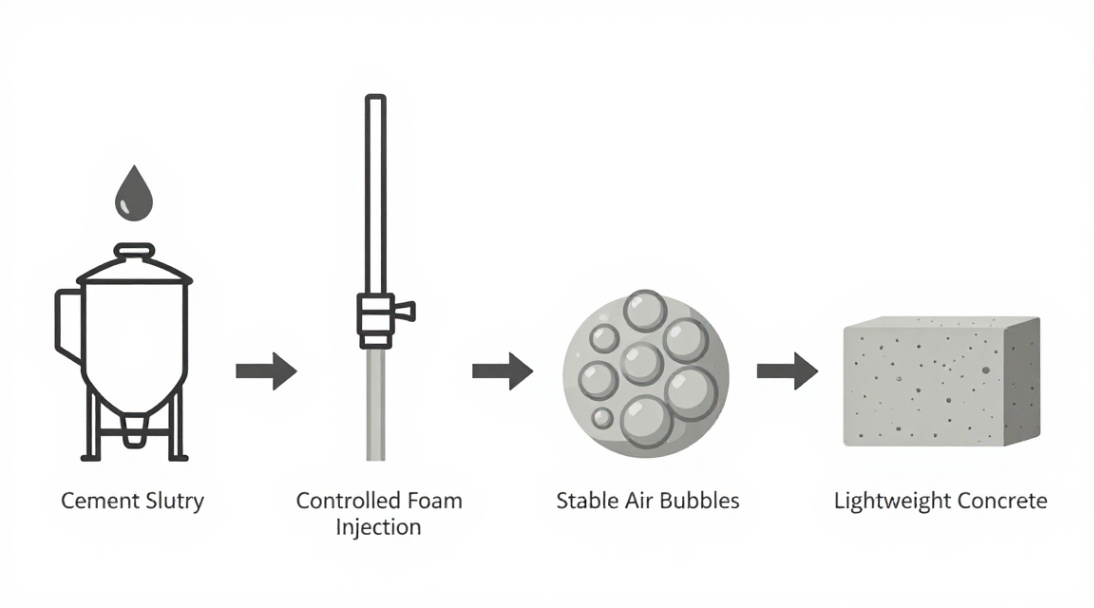
Your first batch of foamed concrete failed. The density was off by forty percent. The foam collapsed within minutes. This is not a materials problem. This is a sequence-of-operations problem. Most practitioners blame the foaming agent. They search for a better concentrate. They switch from synthetic to protein-based. They adjust dilution ratios. Yet the collapse persists. The root cause is almost never the chemical itself. It is how you introduce that chemical to the cement slurry. A concrete foaming agent does not create lightweight concrete on its own. It only generates stable air bubbles. Those bubbles must survive mixing, pumping, and placement. They must remain intact while the cement hydrates. If you break the bubbles at any point, you are not making foamed concrete. You are making heavy, expensive mortar with air voids. That is a structural defect waiting to happen.
1. The Fundamental Misunderstanding of Air Entrainment
Engineers frequently confuse air-entraining admixtures with concrete foaming agents. They are not interchangeable. An air-entraining admixture creates microscopic bubbles, typically below 0.3 millimeters. These bubbles are designed to improve freeze-thaw resistance, not to reduce bulk density. A concrete foaming agent, by contrast, produces bubbles between 0.5 and 2.0 millimeters. The foam volume is deliberate. You are replacing solid mass with gas. The density reduction is the goal, not a side effect. The first mistake is treating a foaming agent like a concrete water reducer or a superplasticizer. You cannot simply add it to the mixer and expect uniform cell structure. The foam must be pre-generated in a foam generator, then blended into the cement slurry. Direct injection into the mixer causes immediate bubble coalescence. The air leaves the system. You get nothing but wasted chemical. The machine matters more than the concentrate.
Your foaming equipment must deliver foam with a consistent bubble size distribution. A foam generator that pulses or fluctuates pressure produces irregular cells. Those large bubbles rise to the surface. They burst. You then pour the remaining heavy mix into a mold, expecting a light weight concrete block. The block ends up dense on the bottom, porous on the top. It fails strength testing. The inspector rejects the pour. The entire crew now believes the concrete foaming agent is defective. The agent is not the culprit. The equipment calibration is. Check your foam generator output before you change chemicals. Measure the wet density of the foam itself. It should fall within 70 to 90 grams per liter for most structural applications. If your foam density is above 100 grams per liter, you are not generating foam. You are generating soapy water.
The second mistake flows directly from the first: improper dilution rates. Every foaming agent concentrate has a recommended dilution range, typically 1:20 to 1:50 with water. But that range is a starting point, not a rule. The actual dilution must be adjusted for water temperature, foam generator back pressure, and the specific cement chemistry. Hard water with high calcium content kills foam stability. If your site water has elevated hardness, you must increase the concentrate ratio. Or you must use a chelating agent. Ignoring water chemistry is a slow, consistent error that erodes foam quality across every batch. You get variability. One pour passes density. The next fails. The operator changes the dilution randomly, chasing ghosts. Do not guess. Test the water. Adjust the dilution mathematically. Keep a log of every batch.
2. The Cement-Foam Compatibility Trap
Portland cement is highly alkaline. Fresh cement slurry has a pH above twelve. This aggressive environment destabilizes many foaming agents. Synthetic surfactants, especially those based on sodium lauryl ether sulfate, can hydrolyze in high-pH conditions. The foam collapses from the inside out. Protein-based agents, which are derived from hydrolyzed animal keratin, are more resistant. But they have their own problems. They smell. They attract insects. They have a narrower temperature operating window. The critical point here is that you cannot choose a concrete foaming agent without testing it against your specific special cement formulation. If you are using blended cements with fly ash or slag, the pH rise is slower. That can give the foam more time to stabilize. If you are using rapid-hardening cement, the heat of hydration accelerates foam collapse. You must compensate with higher foam dosage or a more stable surfactant. There is no universal agent. Every cement brand behaves differently. Test in a bucket first. Scale up only after three consecutive successful 10-liter trials.
Water-cement ratio is the third critical factor. Foamed concrete requires a higher water-cement ratio than normal concrete. The foam bubbles need water to lubricate the cell walls. Without sufficient water, the foam ruptures under the shear stress of mixing. But too much water creates bleeding. The water separates from the solids. It rises to the surface, carrying the foam with it. You get a weak, crumbly top layer and a dense bottom. The ideal water-cement ratio for foamed concrete typically ranges from 0.50 to 0.70. This is significantly more than the 0.35 to 0.40 used in high-strength concrete. You are sacrificing some compressive strength for density reduction. That is the tradeoff. Accept it. Do not try to reduce water content to gain strength. You will destroy the foam structure. Use a superplasticizer or concrete water reducer to maintain workability without adding more water. A high-range water reducer is standard practice in foamed concrete production. If you are not using one, you are fighting an uphill battle against physics.
3. Mixing Time: The Silent Killer of Foam
Mixing time is the most commonly mishandled variable. Operators are trained to mix normal concrete until the paste is uniform and cohesive. They apply the same logic to foamed concrete. This is catastrophic. Foamed concrete must be mixed gently and briefly. The goal is to incorporate the pre-generated foam into the cement slurry without breaking the bubbles. Over-mixing collapses the cellular structure. The bubbles shear into smaller fragments that quickly recombine into large voids. The result is an inconsistent, honeycombed matrix. The standard recommendation is to mix for 30 to 60 seconds after foam addition. That is it. Any longer, and you are degrading the product. Set a timer. Train your crew. Do not rely on visual inspection. The mix can look homogeneous while the foam is already breaking down internally. Measure the fresh density immediately after mixing. If the density is higher than your target, the foam is collapsing during mixing. Reduce mixing time. Or reduce mixer speed. A pan mixer operating at 20 to 30 revolutions per minute is ideal. A high-shear mixer will destroy foam in seconds.
Temperature control is equally neglected. Foamed concrete is sensitive to temperature swings. In hot weather, above 35 degrees Celsius, the foam stability drops sharply. The bubbles expand and burst. The mix loses volume. The yield decreases. You end up short on your pour. The remedy is to cool the mix water or use ice. In cold weather, below 5 degrees Celsius, the foam generation itself becomes erratic. The surfactant thickens. The foam generator struggles to produce consistent bubbles. The cement hydration slows down, leaving the foam unsupported for longer periods. The risk of foam collapse increases. The solution is to warm the mixing water to 20 to 25 degrees Celsius. Maintain the concrete temperature between 15 and 30 degrees Celsius throughout the process. This is not optional. It is process control. Treat temperature as a measured variable, not ambient background noise.
4. Additives: The Hidden Danger
You will be tempted to add fibers or early strength agents to improve the properties of foamed concrete. These additives can destabilize the foam if added incorrectly. Fibers, especially polypropylene or glass fibers, act as bubble breakers. They puncture the cell walls during mixing. The result is a loss of air content and a rougher surface finish. If you must use fiber reinforcement, add it to the cement slurry before the foam. Let the fibers hydrate and disperse. Then introduce the foam gently. The same principle applies to nano-modifiers and redispersible polymer powder. These fine particles can adsorb onto the bubble surface, stabilizing or destabilizing the foam depending on their charge. Always test the additive package with your chosen concrete foaming agent in a small batch. A 5-liter trial costs almost nothing. A truckload of failed material costs thousands.
A concrete defoamer is an entirely different issue. Some operators, frustrated by surface pitting, add a defoamer to break large surface bubbles. This is a mistake. A defoamer penetrates the entire mix. It does not selectively attack surface bubbles. It destroys the entire foam structure from within. Your density skyrockets. Your compressive strength changes unpredictably. You lose the very lightweight property you are trying to achieve. If you have surface pitting, the problem is likely your form release method, not the foaming agent. Use a proper concrete release agent on the forms. Adjust vibration times. Do not use a defoamer inside the mix.
5. Quality Control: Measuring What Matters
The single most reliable test for foamed concrete quality is fresh density measurement. You perform it in a container of known volume. You weigh the filled container. You calculate the density in kilograms per cubic meter. Compare that to your design target. If the measured density is more than 5 percent higher than the target, you must adjust the foam volume. Increase the foam proportion. If the measured density is lower, reduce the foam. This test takes two minutes. It prevents catastrophic failures. Yet many crews avoid it because it slows down production. They pay for that shortcut later with rejected panels, core tests that fail, and structural repairs. The compressive strength of foamed concrete is directly tied to its fresh density. You cannot have accurate strength without accurate density. Control the density. The strength will follow.
Foam drainage rate is the second key quality indicator. Fill a graduated cylinder with freshly generated foam. Measure the liquid that drains to the bottom over a 30-minute period. A well-stabilized foam should exhibit less than 10 percent drainage. Anything above 15 percent indicates an unstable foaming agent or improper dilution. Do not proceed with the pour. Adjust the dilution or change the chemical until the drainage rate improves. This test is simple, inexpensive, and brutally honest. Use it.
6. The Application Context Determines Your Selection
The selection of a concrete foaming agent depends entirely on the end use. For thermal insulation blocks, you need foam densities below 80 grams per liter. You require a synthetic foaming agent with high stability in thin cell walls. Protein-based agents can work, but they tend to produce heavier cells due to their higher solid content. For lightweight fill and void filling, density is less critical than pumpability. The foam must survive pumping distances of 50 meters or more. Here, a synthetic agent with a high molecular weight polymer additive performs better. For precast panels, you need consistent bubble size distribution for a uniform surface finish. A blended synthetic-protein agent often gives the best texture. For soil stabilization, the foam must tolerate mixing with wet, clay-rich soils. A protein-based agent, with its higher tolerance to contamination, usually wins. Each scenario requires a different chemical balance. Do not default to the cheapest foaming agent. Default to the one that matches your process parameters.
7. Safety and Storage: The Overlooked Costs
Concrete foaming agents are surfactants. They are generally non-toxic. But they can cause skin irritation with prolonged exposure. Protein-based agents can decompose in storage, releasing foul odors and attracting vermin. Store them in sealed containers, below 30 degrees Celsius, away from direct sunlight. Freezing destroys synthetic agents. Once frozen and thawed, the surfactant molecules aggregate and lose surface activity. A frozen agent will never regain its original foam capacity. Do not use it. Discard it. The cost of replacement is less than the cost of a failed structural pour. Potassium silicate and sodium silicate are sometimes added to foamed concrete to accelerate setting. These silicates are highly alkaline. They require separate storage and handling procedures. Incompatibility between silicates and certain foaming agents can cause immediate, violent foam collapse. If you combine them, test in a small volume first, away from the production line.
Here is the simplified decision matrix for your next project.
| Variable | Critical Action | Common Mistake |
|---|---|---|
| Foam generation | Pre-generate foam in dedicated generator | Adding agent directly to mixer |
| Dilution water | Test water hardness; adjust ratio accordingly | Using fixed dilution without testing |
| Water-cement ratio | Maintain 0.50 to 0.70 | Reducing water for strength |
| Mixing time | 30 to 60 seconds after foam addition | Mixing until visually uniform |
| Temperature | 15 to 30 degrees Celsius | Ignoring ambient temperature effects |
| Fresh density test | Perform every batch | Skipping to save time |
| Foam drainage test | Accept less than 10% drainage | Proceeding with unstable foam |
Foamed concrete is a forgiving material when the sequence of operations is correct. It is a ruthless teacher when it is not. The agent itself is rarely the problem. The problem is the operator who bypasses the foam generator. The problem is the crew chief who ignores water hardness. The problem is the engineer who demands lower water content without understanding foam mechanics. These seven mistakes cover more than 90 percent of field failures. Avoid them, and your light weight concrete will perform exactly as designed. Your foam will stay stable. Your density will hit the target. Your compressive strength will match the specification. You will no longer be fighting the material. You will be controlling it. That control begins with understanding that a concrete foaming agent is not a magic powder. It is a tool. Like any tool, it requires the correct process to deliver the intended result.
Supplier
We are the global leader in lightweight concrete and advanced engineered foam solutions. Known globally for its commitment to research, innovation, and applied expertise, we have been providing engineered foam solutions since the early 2012’s.
We can supply high-quality concrete admixture and foam concrete related products all over the world.
The company has a professional technical department and quality supervision department, a well-equipped laboratory, and equipped with advanced testing equipment and after-sales customer service center.
If you are interested, please feel free and contact us.