Concrete-mesa | Concrete Admixtures, Tools, and Production Machines

Why VAE-VeoVa RDP Powder Isn’t a Luxury. It’s a Corrective.
The Mortar that Cracked the Paradigm
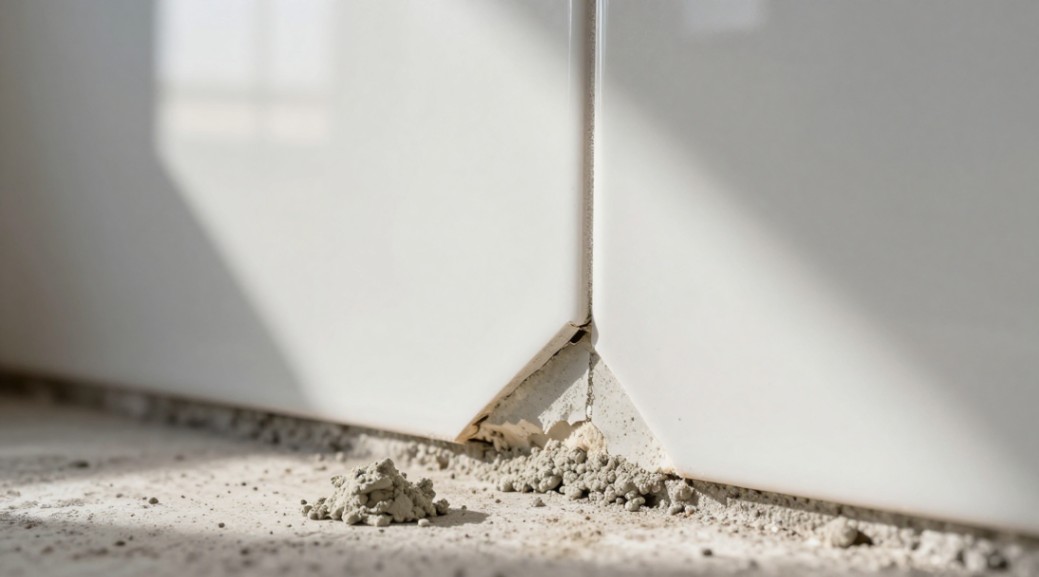
I remember the site visit vividly. A premium tile installation was failing. Tiles were popping, grout was crumbling. The contractor swore he followed the “standard” VAE powder spec to the letter. That was the problem. The “standard” was wrong for that substrate and thermal cycling. We replaced it with a formulation based on vinyl acetate veova redispersible polymer powder. The re-work held. More importantly, it taught me that most specifiers treat polymer powder as a simple additive. It’s not. It’s the chemical backbone of modern mortar performance. Choosing the wrong one isn’t a minor error; it’s building a latent failure into the structure.
1. The Chemistry of Compromise (And Why It’s Brilliant)
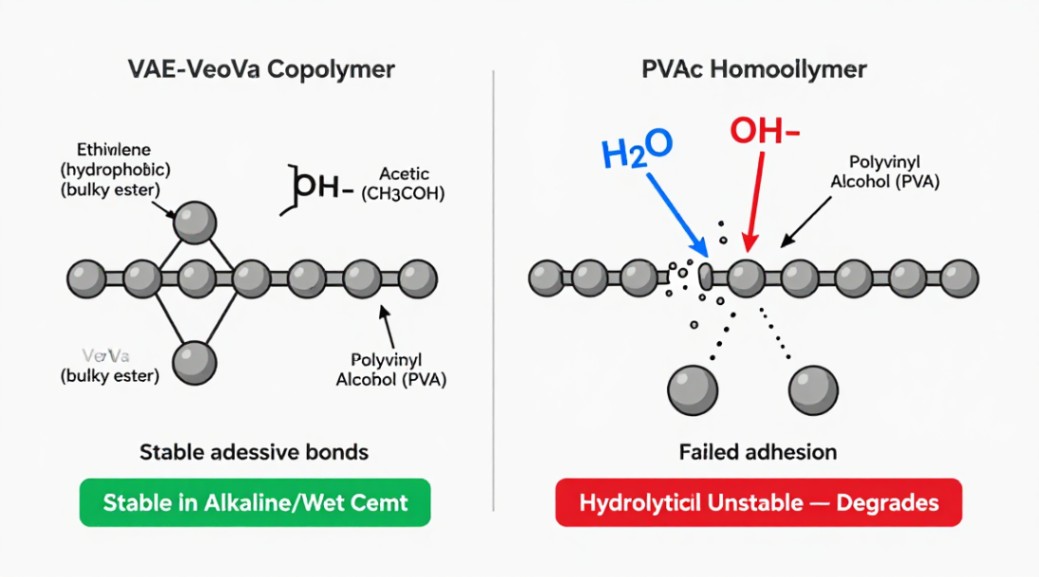
Stop thinking of vinyl acetate veova redispersible polymer powder as a single polymer. It’s a designed compromise. The vinyl acetate (VAc) half provides the core adhesion and film-forming strength. It loves to stick to mineral surfaces. The VeoVa (vinyl ester of versatile acids) monomer is the game-changer. Its long, branched hydrocarbon chain acts like a built-in plasticizer, but one that won’t migrate or wash out.
1.1. The Redispersion Magic Trick
This powder isn’t magic dust. It’s a latex, spray-dried with protective colloids. When you add water to a dry-mix mortar, you’re not just hydrating cement. You’re reconstituting that original polymer dispersion. The powder particles redisperse into billions of tiny polymer droplets, co-dispersed with the cement grains. As the mortar cures and dries, these droplets coalesce. They form a continuous, flexible polymer film that binds the entire cementitious matrix together. Think of it as a 3D plastic web reinforcing a crystalline stone structure.
2. Performance: More Than Just “Flexibility”
Most data sheets list properties. Let’s talk about real-world behavior.
- Hydrophobicity from Within: The VeoVa side chains are inherently water-repellent. This isn’t a surface coating. The polymer film itself resists water ingress, dramatically improving long-term adhesion in wet areas.
- True Flexibility Across Temperatures: Pure VAE powders can get brittle in cold weather. The VeoVa copolymer maintains flexibility at lower temperatures, critical for exterior applications and substrates prone to movement.
- Adhesion to the Problematic Surfaces: It adheres tenaciously to low-porosity, smooth, and even slightly contaminated substrates where pure VAE or VAC (polyvinyl acetate) powders struggle.
3. The Flawed Comparison: VAE-VeoVa vs. The Rest
Industry thinking is lazy. People see “VAE” and assume all powders are similar. They are not.
Versus Standard VAE: Standard VAE is the baseline. It improves cohesion and adhesion. But under thermal stress or prolonged water exposure, its limitations show. VAE-VeoVa is the upgrade for demanding conditions. It’s not always needed, but using standard VAE where VeoVa is required is a technical failure.
Versus VAC (PVAc): This is a critical distinction. Polyvinyl acetate powders are cheaper. They are also hydrolytically unstable. In alkaline, wet cement environments, they can revert to acetic acid and polyvinyl alcohol, losing their adhesive power. Using VAC powder in cementitious systems is a fundamental chemical mistake, yet it still happens.
4. Application is Everything (Dosage is a Starting Point)
A 2% dosage by weight of cement is a common starting point for a vinyl acetate veova redispersible polymer powder. But that’s all it is-a start. The correct dosage is a function of the application’s demands.
- Tile Adhesive (C2 class and above): Higher dosage (3-5%) for deformability, wetting, and sheer adhesion on critical substrates.
- Waterproofing Slurries: Maximize dosage. The polymer is the primary barrier. The cement provides the structure.
- Repair Mortars: Balance is key. Enough polymer for adhesion and impermeability, but not so much that it compromises early strength development.
Mixing is non-negotiable. The powder must disperse homogeneously in the dry mix before water addition. Inadequate dry blending creates weak spots.
5. The Quiet Sustainability Advantage
This isn’t greenwashing. Dry-mix mortars with vinyl acetate veova redispersible polymer powder slash waste and transport emissions compared to site-mixed wet products. They are low-VOC by their very nature-no solvents, no plasticizer emissions. The durability they provide directly translates to longer service life, the most profound form of sustainability. You’re not just building a wall. You’re building a wall that won’t need replacing in ten years.
6. Specifying Correctly: Look Beyond the Name
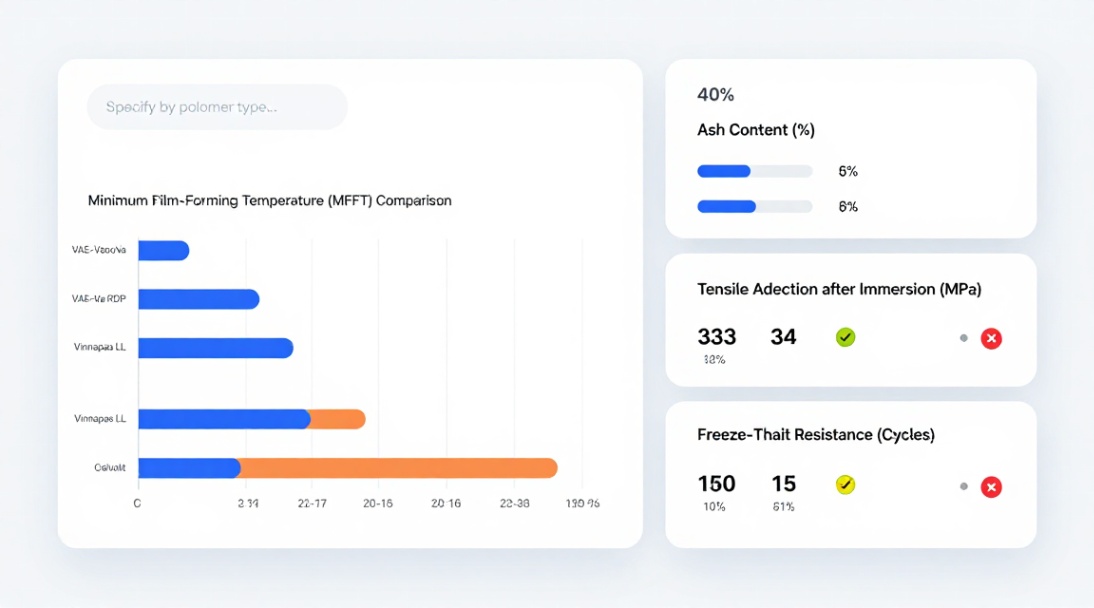
Leading manufacturers have their designations (like “Vinnapas LL” from Wacker or “Celvolit” from Synthomer). Don’t just ask for “polymer powder.” Specify the polymer type. Demand technical data sheets and insist on key test parameters: minimum film-forming temperature (MFFT), ash content, and most critically, the results of standardized tests for the final application-tensile adhesion strength after water immersion, freeze-thaw resistance, and flexibility.
The Unconventional Conclusion
If you are a formulator or specifier, your first question should no longer be “Should I use polymer powder?” It should be “Which polymer chemistry does this specific risk profile demand?” Treating vinyl acetate veova redispersible polymer powder as a generic performance enhancer is obsolete. It is a precision chemical tool. Its role is to correct the inherent brittleness, hydrophilicity, and weak substrate adhesion of plain cement. Use the standard VAE for standard jobs. But for conditions where water, movement, or temperature are factors, the VeoVa copolymer isn’t an option. It’s the correct technical answer. Your next step is simple: audit your current high-performance mortar specs. Does the polymer chemistry match the actual environmental and mechanical stress the system will face? If not, you have work to do.
Supplier
We are the global leader in lightweight concrete and advanced engineered foam solutions. Known globally for its commitment to research, innovation, and applied expertise, we have been providing engineered foam solutions since the early 2012’s.
We can supply high-quality concrete admixture and foam concrete related products all over the world.
The company has a professional technical department and quality supervision department, a well-equipped laboratory, and equipped with advanced testing equipment and after-sales customer service center.
If you are interested, please feel free and contact us.