Concrete4U | Concrete Admixtures, Tools, and Production Machines

Stop Making These 5 Costly Mistakes with Your Industrial Concrete Floors
The Floor Failure You Didn’t See Coming
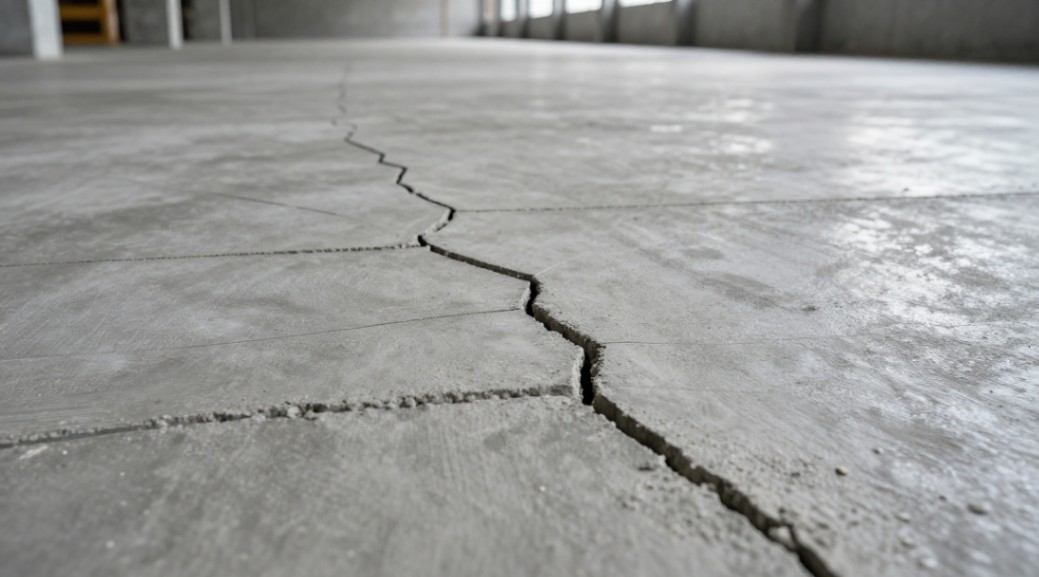
Have you ever watched a beautiful, freshly finished industrial floor develop a web of fine cracks just weeks later? We’ve been there. You specified the correct concrete strength, your contractor followed the plan, and the joint sawing looked perfect. Yet, the surface still cracks. The culprit often isn’t a major design flaw, but a misunderstanding of the plastic phase. This is where the right-and wrong-use of structural synthetic fiber for industrial floors makes all the difference.
What Are Structural Synthetic Fibers, Really?
Let’s clear up the biggest misconception. These aren’t your standard micro-fibers for fire protection or surface finish. Structural synthetic fibers are engineered polymers, like polypropylene or PVA, designed with a specific tensile strength and modulus of elasticity to bridge cracks in concrete after it has hardened. Think of them as millions of tiny, non-corrosive rebars dispersed randomly throughout the slab. Their primary job is to work after the concrete cracks, holding those cracks tightly together.
Critical Mistakes You MUST Avoid
1. Treating Fibers as a Direct Mesh Replacement (In Every Case)
This is the most common, and most expensive, error. Structural synthetic fiber for industrial floors is not a universal one-to-one swap for welded wire mesh (WWF). Here’s the logic: WWF provides continuous, localized reinforcement and is excellent for holding together large, predetermined cracks (like at joints). Fibers provide discontinuous, three-dimensional reinforcement that controls random cracking everywhere. For many industrial slabs, we use fibers to eliminate 90% of the random shrinkage cracks, and then use strategically placed WWF or rebar only at high-stress points like column lines. Using fibers alone for a high-rack storage floor is a recipe for joint failure.
2. Ignoring the Plastic Shrinkage Battle
Concrete is most vulnerable in the first few hours. As water evaporates from the surface, tensile stresses build and exceed the concrete’s near-zero tensile strength. Plastic shrinkage cracks form. Properly dosed structural synthetic fibers act immediately, creating a micro-reinforced network that resists this early-stage pull-apart force. The mistake is using too low a dosage. If you spec 3 lbs per cubic yard for a slab poured in hot, windy conditions, you’ve already lost. The dosage must match the environmental risk.
3. Sacrificing Mix Design for Convenience
Fibers are an additive, not a magic fix for poor concrete. Adding a high dosage of fibers to a poorly graded, harsh mix will lead to balling and terrible workability. The correct approach is to work with your ready-mix supplier. We adjust the sand content and often use mid-range water reducers to maintain slump without adding excess water. The fibers must disperse evenly. Poor dispersion creates weak zones, which defeats the entire purpose.
4. Overlooking Joint Strategy
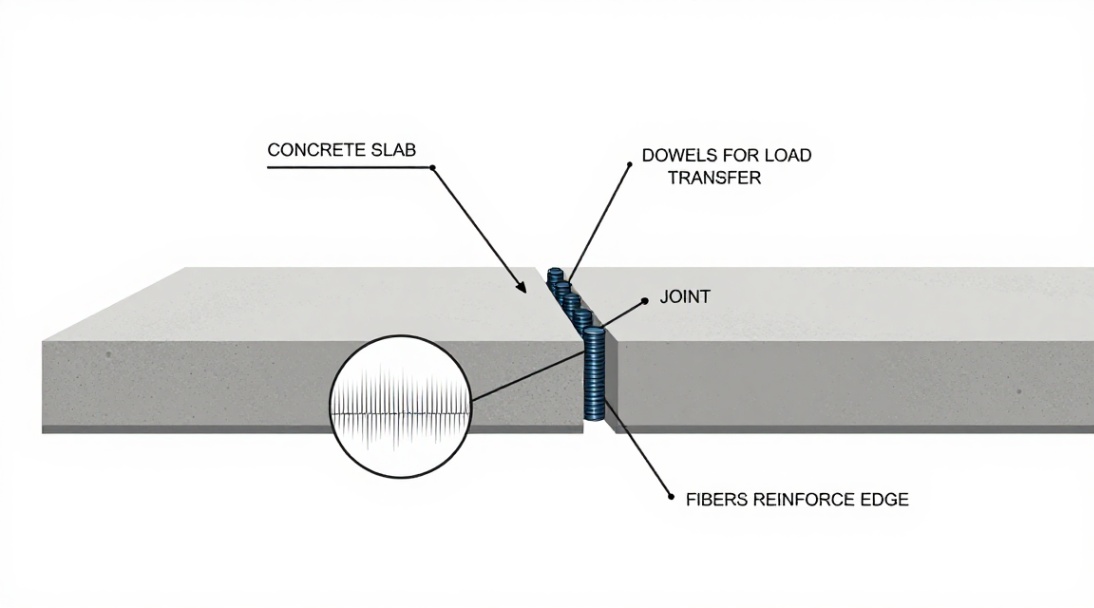
Fibers let you increase joint spacing. That’s a major benefit. But the critical mistake is increasing the spacing without a corresponding review of the joint design and load transfer. If you go from 15-foot to 25-foot bays, the movement at each joint is greater. You must ensure adequate load transfer via dowels or other methods. Furthermore, fibers dramatically reduce joint spalling and raveling by holding the concrete matrix together at the cut edge, but they don’t eliminate the need for timely, proper sealing.
5. Choosing on Price Alone
Not all fibers are equal. A low-modulus polypropylene fiber might control plastic shrinkage well but offer limited post-crack structural strength. For a structural synthetic fiber for industrial floors, you need a high-modulus fiber (like some PVA or engineered polyolefin blends) that has a stiffness closer to concrete. This allows it to engage and carry load effectively after cracking. The key selection criteria are: fiber type, length (typically 1.5 to 2 inches for industrial slabs), dosage (lbs/cy), and proven performance data. The cheapest bag per pound often costs the most in long-term repairs.
Making the Right Choice: A Simple Framework
Let’s be direct. Don’t just ‘add fibers.’ Follow this decision logic:
- Define the Goal: Is it solely plastic shrinkage control, or is it post-crack structural performance for reduced joint maintenance?
- Analyze the Loads: Static pallet storage? Dynamic forklift traffic? High-intensity racking? This dictates the required residual strength.
- Specify Precisely: In your specs, state the type, length, dosage (e.g., 7.5 lbs/cy of 1.75″ fibrillated high-modulus polypropylene), and require certified mill test reports.
- Plan the Pour: Inform the concrete plant. Plan for adequate mixing time (usually 5-8 minutes at high-speed mixing). Have field technicians cheque for dispersion during placement.
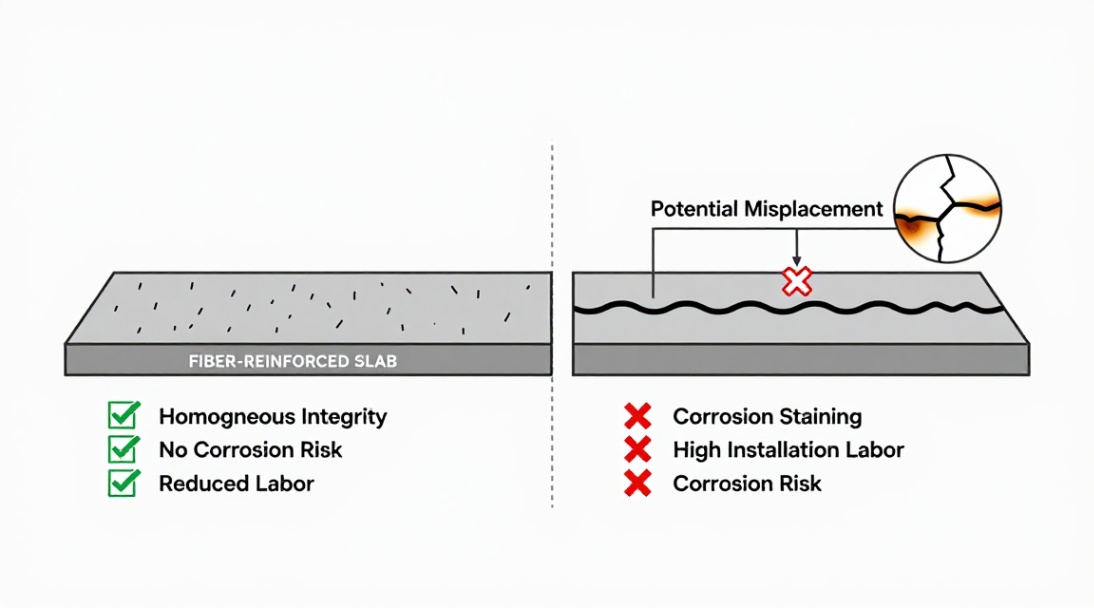
The real cost-benefit isn’t in the initial material cost versus mesh. It’s in the labour savings from not installing mesh, the reduced joint maintenance, the elimination of corrosion-related staining, and the vastly improved long-term surface integrity. A correctly designed fiber-reinforced floor is a unified, homogeneous slab. A mesh-reinforced floor relies on a single layer that can be mispositioned, and it will corrode over decades.
The Path Forward
The goal is a floor that lasts decades with minimal intervention. Structural synthetic fiber for industrial floors is a powerful tool to achieve that, but only if you understand its role. Don’t use it as a cheap substitute. Use it as a sophisticated, primary reinforcement system. Review your next project’s loads and environment. Talk to experienced material suppliers and engineers who have seen floors age over 10+ years. Your focus should be on total lifecycle performance, not just the day the pour finishes. That’s how we build floors that truly endure.
Supplier
We are the global leader in lightweight concrete and advanced engineered foam solutions. Known globally for its commitment to research, innovation, and applied expertise, we have been providing engineered foam solutions since the early 2012’s.
We can supply high-quality concrete admixture and foam concrete related products all over the world.
The company has a professional technical department and quality supervision department, a well-equipped laboratory, and equipped with advanced testing equipment and after-sales customer service center.
If you are interested, please feel free and contact us.