Concrete4U | Concrete Admixtures, Tools, and Production Machines

Hydroxyethyl Cellulose vs. Polyanionic Cellulose: A Drilling Fluid Viscosifier Decision Guide
Have you ever watched your carefully formulated drilling mud turn into a watery mess in a high-calcium brine, costing you thousands in wasted additives and downtime? Or fought to maintain viscosity in a hot well, only to have your fluid breaker down prematurely? If your answer is yes, you’re not alone. The choice of a viscosifier isn’t just about thickening; it’s a foundational decision that dictates your fluid’s stability, cost, and ultimate success downhole. For decades, the debate has simmered: stick with the industry-standard polyanionic cellulose (PAC) or pivot to the often-misunderstood hydroxyethyl cellulose (HEC). This isn’t about marketing hype. It’s a hard-nosed comparison of two polymers with very different personalities, designed to help you cut through the noise and select the right tool for the job.
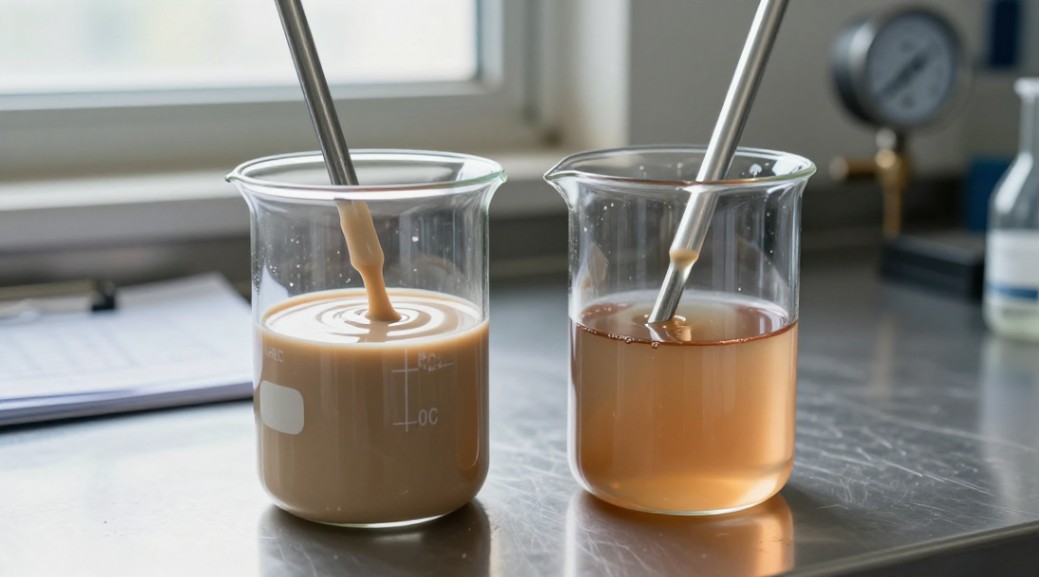
The Core of the Conflict: HEC vs. PAC
Let’s strip away the jargon. Both hydroxyethyl cellulose and polyanionic cellulose are water-soluble polymers derived from cellulose. Their job is to build viscosity, suspend cuttings, and help control fluid loss. That’s where the similarity ends. Their chemical nature creates a fundamental fork in the road. PAC is anionic-it carries a negative charge. This makes it fantastic at hydrating quickly in fresh water and interacting with positively charged clay particles. HEC is non-ionic. It carries no charge. This single difference dictates everything.
Think of it like this. PAC is a social butterfly, interacting with everything in the mud. HEC is a stoic loner, unaffected by the ionic chaos around it. This isn’t a metaphor; it’s the key to your decision.
The Decision Matrix: Where HEC Wins and Where It Doesn’t
You can’t just “prefer” one. Your well conditions command the choice. Let’s break it down.
The Unbeatable Niche: Monovalent & Divalent Brines
This is HEC’s championship arena. If your fluid is based on saturated NaCl, KCl, CaCl₂, or CaBr₂ brines, PAC and many other charged polymers will fail. The high ionic strength suppresses their hydration, causing them to curl up and lose effectiveness. HEC doesn’t care. Its non-ionic backbone hydrates independently of salt content. I’ve seen PAC completely precipitate out in a 14.0 ppg CaBr₂ brine, while HEC provided stable, shear-thinning viscosity for the entire job. For completion and workover fluids where you must avoid clay swelling, HEC in a clear brine is the only logical choice. The cost of a barrel of CaBr₂ dwarfs the polymer cost-using the wrong thickener is an expensive gamble.
The Compatibility Question: Shale Inhibition
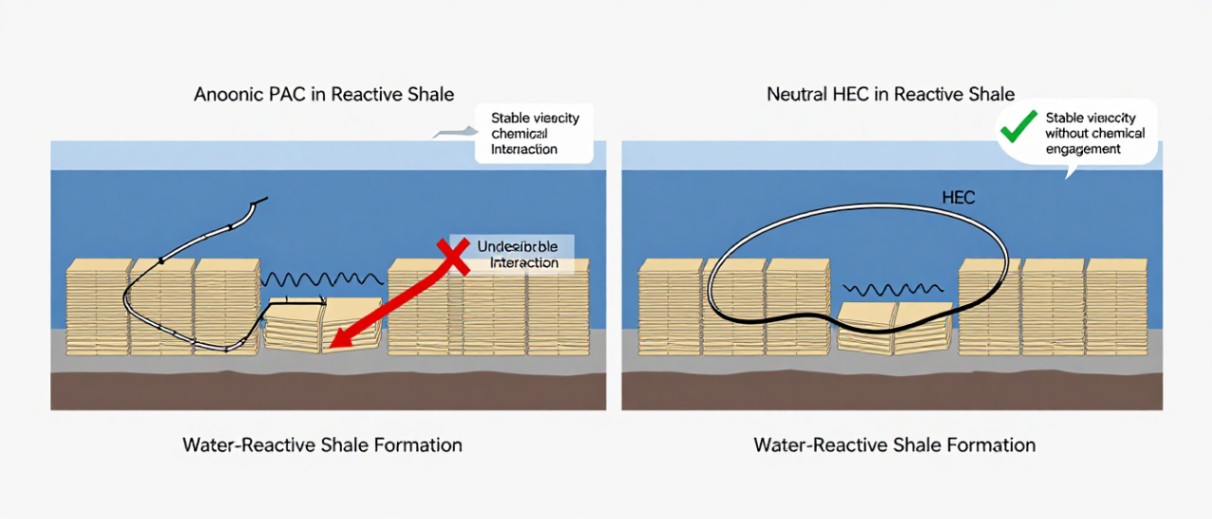
Here’s a counterintuitive truth. PAC’s anionic nature can be a liability in sensitive, water-reactive shales. While it helps build a filter cake, it can also interact undesirably. HEC, being neutral, provides viscosity without chemically engaging the formation. It’s an inert physical barrier. In many formulated shale-inhibitive systems, HEC acts as a stable viscosifier that doesn’t interfere with the primary inhibitors like amines or salts. Users on drilling forums often note: “Switched to HEC in our KCl/polymer mud for the troublesome Claymore section; saw a 15% reduction in dilution volume and better hole gauge.” That’s the inert advantage in action.
The Trade-Off: Fluid Loss Control & Temperature
Be honest about limitations. HEC is a superb viscosifier but a mediocre fluid loss control agent by itself. PAC, especially low-viscosity grades, excels at forming a thin, tough filter cake. In a standard freshwater or low-salinity bentonite mud where fluid loss control is paramount, PAC is usually the better primary additive. Furthermore, while HEC is stable to about 250°F (121°C), PAC derivatives can be formulated for slightly higher temperatures. For a 300°F+ geothermal well, neither might be your best first pick-you’d look toward synthetic polymers. Don’t force a square peg.
The Operational Reality: Mixing and Shearing
HEC has a reputation. It can form “fish-eyes”-gelatinous clumps that never fully hydrate if added incorrectly. This is a mixing problem, not a polymer problem. The procedure is non-negotiable: use a high-shear mixer (a 3000 RPM centrifugal pump is ideal), sprinkle the powder slowly into the vortex of the vigorously agitated brine. For a 100-barrel mix, aim to add 1.0 to 1.5 ppb over 30-45 minutes. Pre-blending with a non-hydrating powder like calcium carbonate can help. PAC is far more forgiving, often accepting a simple hopper addition.
The Practical Verdict: A Side-by-Side Comparison
Let’s make the choice visual. Forget vague claims; here are the decisive factors.
| Factor | Hydroxyethyl Cellulose (HEC) | Polyanionic Cellulose (PAC) |
|---|---|---|
| Chemical Nature | Non-ionic | Anionic |
| Primary Strength | Viscosity in high-salinity brines (CaCl₂, CaBr₂) | Superior fluid loss control in freshwater/low-salinity muds |
| Shale Compatibility | High (Inert, no chemical interaction) | Moderate (Can interact with charged clay surfaces) |
| Mixing Difficulty | High (Requires high-shear, controlled addition) | Low (Forgiving, easy to add) |
| Cost Driver | Polymer cost + mixing energy | Primarily polymer cost |
| Environmental Profile | Excellent (Biodegradable, non-toxic) | Excellent (Biodegradable, non-toxic) |
| Best-Suited Fluid System | Clear brine workover/completion fluids, high-salt muds | Freshwater/lignosulfonate muds, spud muds, where fluid loss is critical |
Your Action Plan
The industry leans on PAC because it’s easier. It’s the default. Challenge that. Look at your well programme. Is it a high-salinity environment? Are you using expensive divalent brines? Is shale stability your top concern? If yes, the mixing hassle of HEC is a worthy trade for guaranteed performance. Your fluid engineer might grumble about the mixing procedure-show them this. The cost of a failed fluid test or a stuck pipe incident far outweighs the time spent mixing correctly.

For your next well, make the decision proactive, not reactive. Specify HEC by name in your fluid programme for brine-based intervals. Audit your mixing equipment to ensure you have the shear capability. Run a simple compatibility jar test: mix 0.5 ppb of both HEC and PAC in your planned brine. The results will be stark and will make the decision for you. This isn’t about choosing the “best” polymer. It’s about choosing the right one. Your bottom line depends on it.
Supplier
We are the global leader in lightweight concrete and advanced engineered foam solutions. Known globally for its commitment to research, innovation, and applied expertise, we have been providing engineered foam solutions since the early 2012’s.
We can supply high-quality concrete admixture and foam concrete related products all over the world.
The company has a professional technical department and quality supervision department, a well-equipped laboratory, and equipped with advanced testing equipment and after-sales customer service center.
If you are interested, please feel free and contact us.