Concrete-mesa | Concrete Admixtures, Tools, and Production Machines

Protein vs. Synthetic Concrete Foaming Agent: The 2024 Decision Guide for Lightweight Concrete
Your Foaming Agent Choice Determines Your Concrete’s Success
If you want consistent, high-quality lightweight concrete, your choice of concrete foaming agent is the single most critical decision. Pick the wrong one, and you face foam collapse, weak cell structure, and failed density targets. The right agent gives you uniform air voids, predictable strength, and a smooth pour. This guide compares the two dominant types—protein-based and synthetic—so you can decide with confidence.
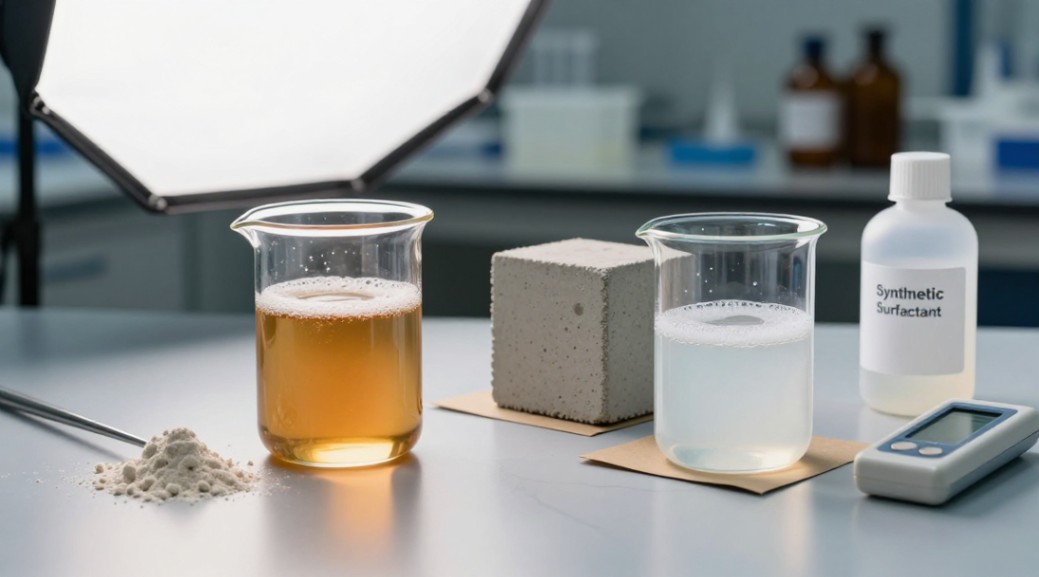
1. The Battle of Types: Synthetic vs. Protein-Based Agents
Every concrete foaming agent falls into one of two families. Understanding their core differences is your first step toward consistent results.
1.1. Synthetic Foaming Agents
These are man-made surfactants (usually sodium lauryl sulfate or alpha-olefin sulfonate). They produce a very light, airy foam with fine bubbles. Engineers choose synthetics when they need the lowest possible density—down to 300 kg/m³—for insulation fills or void filling. The foam is easy to generate with standard foaming equipment and a foam generator. However, the bubbles are less stable in high-alkaline environments. You must add the foam quickly after generation to prevent collapse.
1.2. Protein-Based Foaming Agents
Derived from hydrolyzed animal proteins (like keratin from hooves or horns), these agents thicken the foam and create large, robust bubbles. The cell structure is more rigid. Protein agents tolerate the high pH of cement paste better than synthetics, giving you longer working time. They are the go-to choice for precast blocks, floor screeds, and applications where you need density above 600 kg/m³ with higher compressive strength.
2. Head-to-Head Comparison Table
Let the data speak. This table puts the two concrete foaming agent types side by side across the performance criteria that matter most to your project.
| Parameter | Synthetic Agent | Protein-Based Agent |
|---|---|---|
| Foam Density Range (kg/m³) | 50 – 80 | 90 – 140 |
| Final Concrete Density Range (kg/m³) | 300 – 800 | 600 – 1800 |
| Bubble Size | Fine, uniform (0.1 – 0.5 mm) | Larger, irregular (0.3 – 2.0 mm) |
| Foam Stability in Cement Paste | Low to Moderate (use immediately) | High (stable for 3-5 minutes) |
| Compressive Strength (at same density) | Lower (more fragile cell walls) | Higher (rigid cell matrix) |
| Thermal Conductivity (W/m·K) | 0.08 – 0.15 | 0.15 – 0.30 |
| Biodegradability | Low (persistent in environment) | High (naturally degrades) |
| Cost per Liter of Concentrate | Lower | Higher |
| Dosage Rate (by weight of cement) | 0.2% – 1.0% | 1.0% – 3.0% |
3. The Mechanism: How a Concrete Foaming Agent Works
You cannot master lightweight concrete without understanding the foam generation process. It is a precise sequence.
3.1. Foam Generation
First, dilute your concrete foaming agent with water (typical dilution ratio: 1:20 to 1:40 by volume for synthetics, 1:5 to 1:15 for proteins). Feed this solution into a foam generator with compressed air. The generator shears the liquid into bubbles. Immediately check the foam’s wet density using a pre-weighed container of known volume. Target density: 70 g/L ± 5 g/L for synthetics, 110 g/L ± 10 g/L for proteins. Reject any foam that does not meet this range.
3.2. Mixing into the Cement Paste
Prepare your base mix: special cement (typically OPC or PPC), water, and a concrete water reducer or superplasticizer (0.2% to 0.5% by weight of cement). Add the foam slowly while the mixer runs at low speed. Do not overmix. Stop as soon as the foam is evenly distributed. Overmixing collapses the bubbles and raises density.
3.3. Stabilization and Pouring
Once mixed, you have a narrow window. For synthetic agents, pour within 3 minutes. For protein agents, you have up to 5 minutes. Pour directly into formwork or onto the screed area. Do not pump the mix—pumping destroys air voids. Instead, use gravity feed or a gentle conveyor system.
4. Application-Specific Recommendations
Your project type dictates the concrete foaming agent you should choose. Here are clear, actionable guidelines.
4.1. Insulation Fills and Roof Screeds
Choose synthetic agents. You need the lowest thermal conductivity. Use a dilution ratio of 1:30 and target a final concrete density of 400-500 kg/m³. Add nano-modifier at 0.1% to improve pore uniformity. Avoid fiber additions here—they can puncture the delicate bubbles. A concrete defoamer is your enemy in this scenario; do not let any defoamer residue near the mix.
4.2. Precast Blocks and Panels
Choose protein-based agents. The blocks must demold quickly and hold their shape. Use a dilution of 1:10 and target 800-1200 kg/m³. Add early strength agent (1.5% by weight of cement) to accelerate stripping. A small amount of redispersible polymer powder (0.5%) improves flexural strength. For improved workability, add hydroxypropyl methyl cellulose at 0.3% of cement weight.
4.3. Floor Screeds and Underlayments
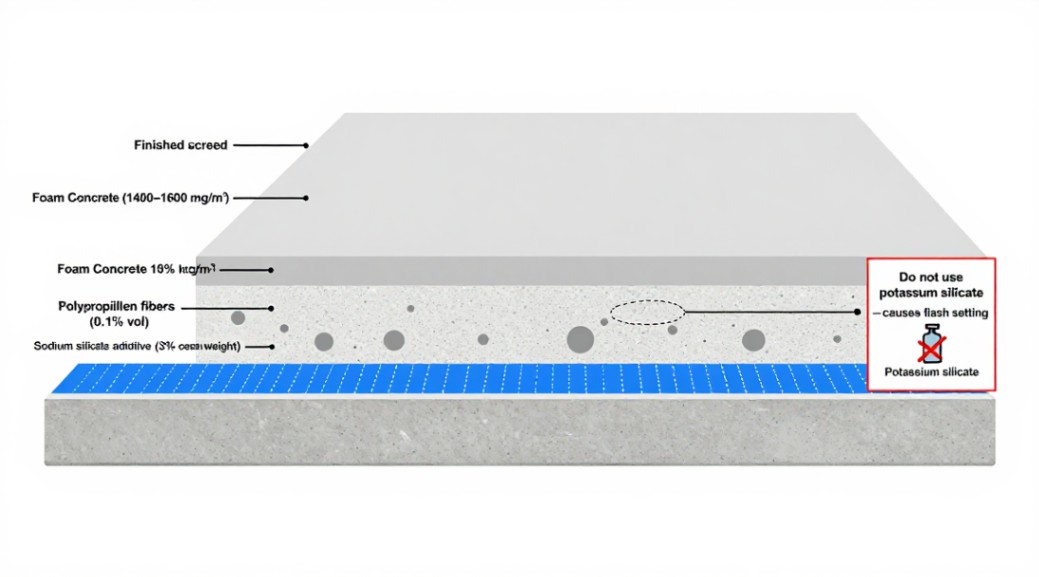
Again, protein-based agents win. Target a final density of 1400-1600 kg/m³ for good load-bearing. Use polypropylene fiber at 0.1% of total mix volume to control shrinkage cracking. Combine the foaming agent with sodium silicate (3% of cement weight) to reduce drying shrinkage. Do not use potassium silicate here—it reacts too fast with the cement and can cause flash setting.
5. Compatibility with Admixtures and Cement Types
A concrete foaming agent never works alone. You must check compatibility with other chemicals.
5.1. Cement Compatibility
Both agent types work with ordinary Portland cement (OPC) and Portland pozzolana cement (PPC). However, avoid high-alumina cements. They accelerate setting and collapse the foam. If you must use special cement (sulphate-resistant or white cement), pre-test foam stability in a small batch.
5.2. Admixture Conflicts
Never add concrete defoamer anywhere near a foaming agent mix. One part per thousand of defoamer destroys half your air content. Similarly, avoid excessive concrete water reducer. Use only a low dose of superplasticizer (maximum 0.3%). Too much liquefies the paste and the foam rises to the top.
5.3. Fibers and Fillers
Fiber (glass, polypropylene, or steel) can stabilize or destabilize foam. Short fibers (6 mm or less) at 0.05% to 0.1% volume improve crack control without harming bubbles. Longer fibers (12 mm or more) cut through the foam cells—avoid them. For fillers, use fine sand (passing 600-micron sieve) only. Coarse aggregates tear the foam structure.
6. Quality Testing on Site (Don’t Skip These)
You cannot rely on the foam concentrate alone. Test every batch. These three checks take ten minutes and save you from failure.
6.1. Foam Stability Test
Take a 1-liter sample of wet foam from the foam generator. Fill a graduated cylinder. Measure the volume of liquid that bleeds from the foam after 15 minutes. For synthetic agents, acceptable bleed is less than 100 ml. For protein agents, less than 50 ml.
6.2. Fresh Wet Density Check
Weigh a 1-liter container. Fill it with fresh foamed concrete, strike off the top, and weigh again. Subtract the container weight. Divide by 1 (the volume in liters) to get density in kg/m³. Compare to your target. If the density is 50 kg/m³ too high, reduce the amount of foam in the next batch.
6.3. Air Content Measurement
Use a pressure-type air meter. The air content of foamed concrete should be 20% to 60% by volume. Below 20%, you have too much paste—the mix is not lightweight. Above 60%, the foam cells are too crowded and the strength will be below 1 MPa.
7. Environmental and Safety Factors
Choose an agent that fits your site’s environmental policy. Protein-based agents are biodegradable and contain no VOCs. They emit a mild organic smell during mixing—ensure adequate ventilation in enclosed spaces. Synthetic agents are less biodegradable and some contain small amounts of residual solvents. Always check the Safety Data Sheet for VOCs. For both types, wear gloves and safety glasses. The alkaline cement paste is a skin irritant. Wash any spills from skin immediately with clean water.
For disposal, you can safely pour diluted protein agent solutions down the drain for municipal treatment. Synthetic agents may require on-site neutralization. Check local regulations for your concrete foaming agent waste.
Final Word: Your Move
You now have the data to make an informed choice. For thermal insulation and lowest density, choose synthetic agents. For structural strength, longer working time, and higher density, choose protein-based agents. Always run a small trial batch before your main pour. Test foam stability, then test concrete wet density. Adjust the dilution ratio or dosage until your foam meets the target. Your light weight concrete project will succeed when you match the right agent to the right application. Now go make that foam.
Supplier
We are the global leader in lightweight concrete and advanced engineered foam solutions. Known globally for its commitment to research, innovation, and applied expertise, we have been providing engineered foam solutions since the early 2012’s.
We can supply high-quality concrete admixture and foam concrete related products all over the world.
The company has a professional technical department and quality supervision department, a well-equipped laboratory, and equipped with advanced testing equipment and after-sales customer service center.
If you are interested, please feel free and contact us.