Concrete4U | Concrete Admixtures, Tools, and Production Machines

A Practical Guide to Designing Lightweight Concrete Floors That Won’t Crack Under Pressure
The Foundation of a Sound Floor
Have you ever faced the daunting task of specifying a floor system for an upper level renovation, only to be constrained by existing structural capacity? Or perhaps you’ve dealt with the frustration of a concrete pour that felt unpredictable, its workability shifting like sand through your fingers, leading to a compromised finish. The promise of lightweight concrete mix design for floors offers a compelling solution to these pervasive problems, but realizing that promise demands a methodical, disciplined approach. It is not merely swapping stone for pumice; it is a complete re-engineering of the material’s behavior from the batching plant to the finished slab. The goal is a floor that combines reduced structural burden with uncompromised durability, and achieving this begins with a deep, logical understanding of the components and their interactions.
Deconstructing the Mix: More Than Just Light Aggregates
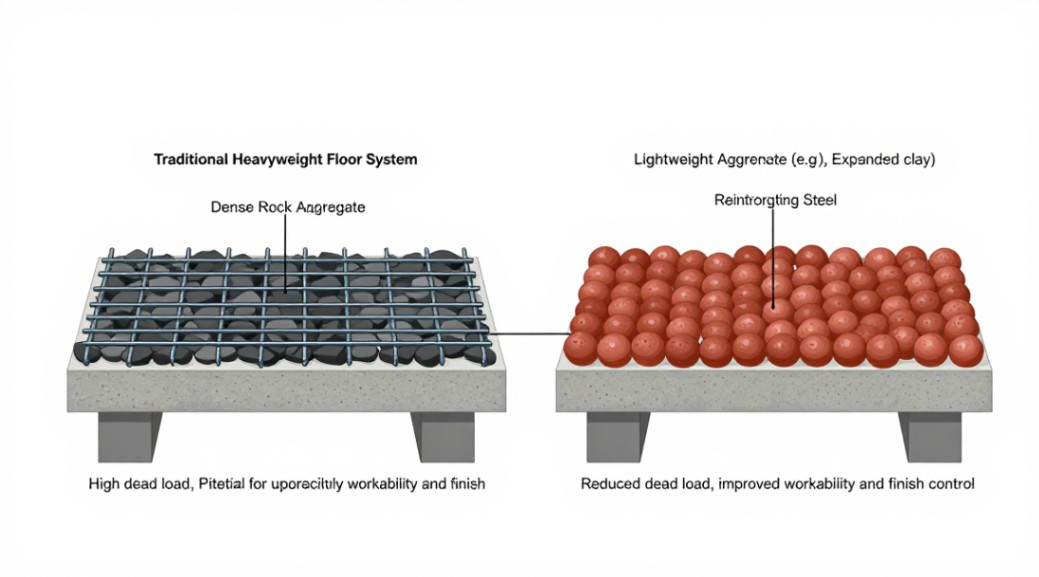
The core principle of any lightweight concrete mix design for floors is the substitution of normal-weight aggregate with a material of significantly lower density. This is your primary lever for weight reduction. Common choices include expanded clay, shale, or slate-materials processed in a kiln to create a hard ceramic shell surrounding countless tiny air voids. These voids are the source of both the benefit and the challenge. They drastically cut density, often bringing the concrete into the 90 to 120 pounds per cubic foot (pcf) range for structural applications, compared to 145 pcf or more for standard concrete. This reduction in dead load is substantial, potentially allowing for longer spans, smaller structural members, or additions to existing buildings where load capacity is a limiting factor.
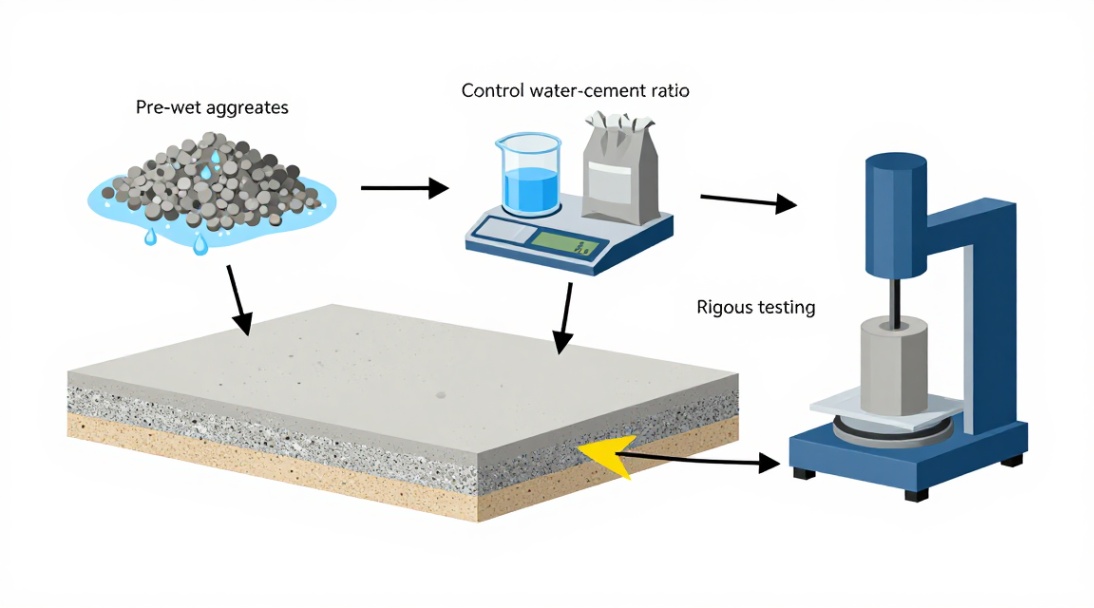
However, these porous aggregates behave differently. They are highly absorptive. If you use a standard water-cement ratio calculation, you will fail. The aggregate will steal mixing water from the paste, leading to poor workability, weak bonds, and a surface that is impossible to finish properly. The correct procedure is to pre-wet the lightweight aggregate. You must bring it to a near-saturated surface-dry condition before batching. This step is non-negotiable. It prevents the aggregate from acting as a sponge in the mix, ensuring the calculated water-cement ratio actually governs the consistency and ultimate strength of the cement paste that binds everything together. This paste quality is what delivers your required compressive strength, typically a minimum of 3000 psi for interior floors and higher for more demanding applications.
The Step-by-Step Process: From Design to Finished Slab
Let’s translate theory into actionable steps. A proper lightweight concrete mix design for floors follows a disciplined sequence.
Step 1: Define the Performance Parameters. You start not with a recipe, but with requirements. Determine the target oven-dry density, the required compressive strength at 28 days, and the necessary fire rating or thermal resistance. These are your fixed points.
Step 2: Select and Characterize the Aggregate. Obtain the absorption and specific gravity data for your chosen lightweight aggregate. Perform a trial batch to establish the pre-wetting time needed to achieve a saturated, surface-dry state. This data feeds all subsequent calculations.
Step 3: Establish the Cementitious Paste. Based on the strength requirement, select a low water-cement ratio, often between 0.40 and 0.50 by weight. Use this to determine the absolute volumes of cement and water needed to coat all aggregates and fill the voids between them. Consider supplementary cementitious materials like fly ash or slag to improve workability and long-term durability.
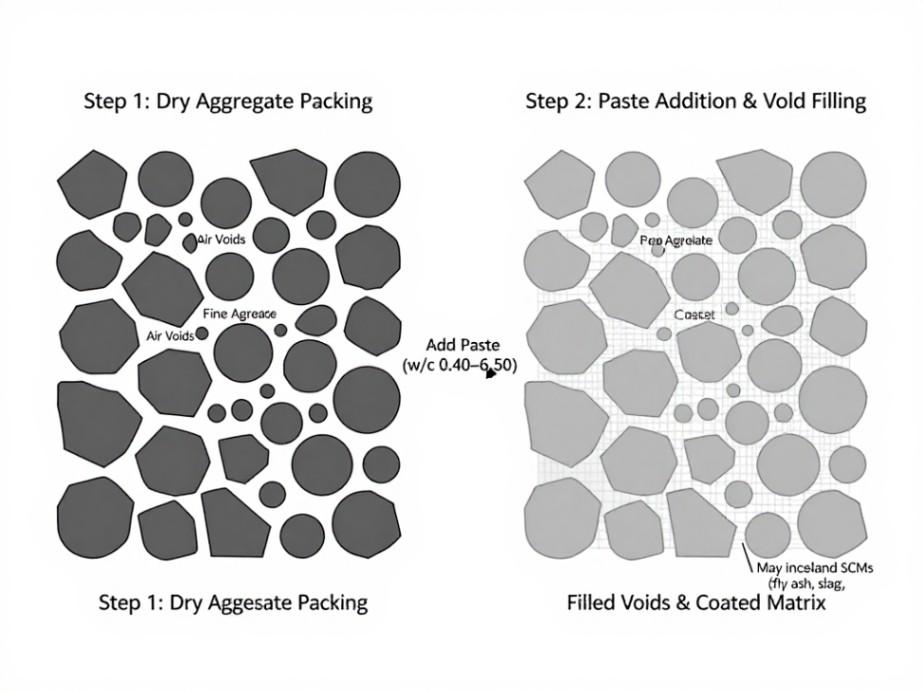
Step 4: Proportion the Mix. Using the absolute volume method, combine the volumes of pre-wetted lightweight aggregate, cement, water, and any admixtures. Admixtures are particularly useful here. A mid-range water reducer is almost essential to maintain workability at a low water-cement ratio. A shrinkage-reducing admixture can be a wise investment to mitigate the slightly higher potential for plastic and drying shrinkage in some lightweight mixes.
Step 5: Test and Adjust. Mix a trial batch. Measure the fresh density and workability (slump). Cast cylinders and cure them properly. Test for compressive strength and, crucially, for equilibrium density. Adjust the proportions-often the sand content-to hit your target density and strength before proceeding to the full pour.
Mastering Placement and the Economic Reality
Placing and finishing lightweight concrete requires a nuanced touch. The mix will feel different. It is less prone to segregation, but achieving proper consolidation is critical. Over-vibration is a genuine risk; it can cause the lighter aggregates to rise and the paste to sink, leading to a weak, porous surface layer. Use internal vibrators judiciously, inserting and withdrawing them quickly. Finishing operations can begin slightly sooner than with normal concrete, as the mix tends to lose bleed water rapidly. Power troweling is standard, but timing is everything. Start when the slab can support the weight of the operator leaving a ¼-inch footprint.
You must also confront the cost analysis directly. The per-cubic-yard material cost of a structural lightweight mix is typically 20% to 40% higher than standard concrete. This is the premium for the processed aggregate. The economic justification never comes from the concrete alone. It comes from the systemic savings: reduced structural steel, smaller foundations, less seismic load, and the enabling of projects on sites with poor load-bearing soils or for retrofits where adding load is prohibitively expensive. For the right application, the initial premium pays for itself many times over in downstream savings and expanded design possibilities.
The Logical Conclusion for Your Project
The development of a high-performance lightweight concrete mix design for floors is an exercise in controlled compromise. You trade raw density for enhanced efficiency, but you must compensate with superior mix design discipline. The path to success is clear and logical: pre-wet your aggregates, fiercely control your water-cement ratio, and validate everything with rigorous testing. The result is a floor system that is not just lighter, but smarter-contributing to a more efficient, resilient, and buildable structure. The theoretical benefits of reduced load and improved insulation are only realized through meticulous execution at every phase.
Do not leave the performance of your floor to chance or generic advice. The variables are too specific, the stakes too high. For projects where structural efficiency and material performance are paramount, you require a mix design derived from first principles and validated by data. If your next project involves a suspended slab, a renovation with strict load limits, or simply demands the highest standard of built performance, the strategic use of engineered lightweight concrete is not just an option; it is the mark of sophisticated design. To implement this correctly, you need a partner with deep expertise. Contact our specialist engineering team today for a consultation on your specific lightweight concrete floor requirements. We will provide a custom mix design and placement protocol to ensure your project achieves its full potential, without compromise.
Supplier
We are the global leader in lightweight concrete and advanced engineered foam solutions. Known globally for its commitment to research, innovation, and applied expertise, we have been providing engineered foam solutions since the early 2012’s.
We can supply high-quality concrete admixture and foam concrete related products all over the world.
The company has a professional technical department and quality supervision department, a well-equipped laboratory, and equipped with advanced testing equipment and after-sales customer service center.
If you are interested, please feel free and contact us.