Concrete-mesa | Concrete Admixtures, Tools, and Production Machines

Why My Concrete Driveway Lasts Decades: The Hidden Logic of Fiber Reinforcement
The Driveway That Broke My Back
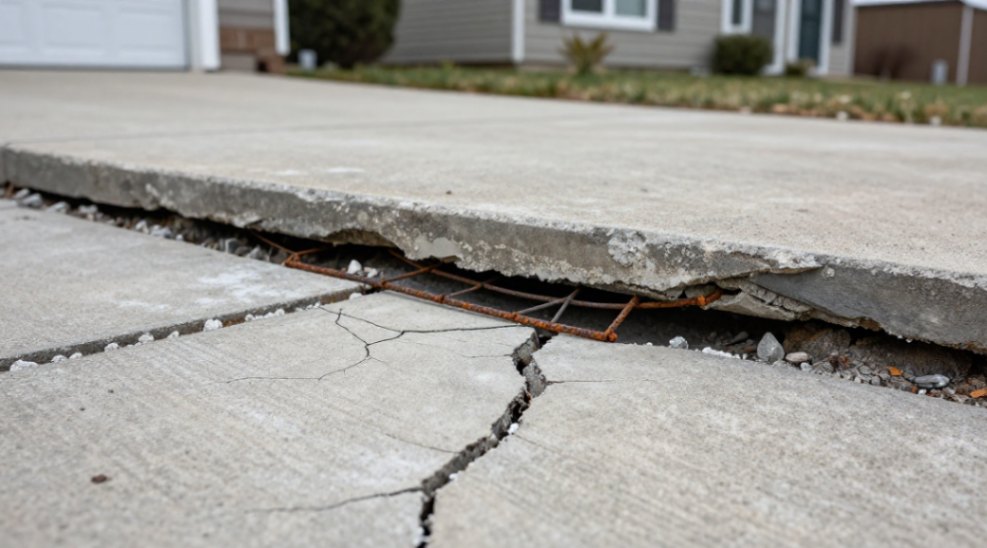
I spent a weekend twenty years ago breaking up a failing driveway. It wasn’t old. The contractor had used a typical 4-inch slab with wire mesh. Yet, there it was: a spiderweb of shrinkage cracks, one corner heaved from frost, and a deep rut where a truck had parked. That labor was my tuition. It taught me a simple truth. Concrete is strong in compression but brittle in tension. The real world subjects a driveway to bending, twisting, and pulling forces. Traditional steel rebar or mesh addresses some of this, but they sit passively, waiting for cracks to find them. Concrete reinforcement fiber for driveways works differently. It integrates directly into the concrete matrix, creating a three-dimensional network that resists cracking from the moment the concrete sets. My next driveway, built with this knowledge, remains intact today. This is not a product pitch. It is a logical framework for building better.
The Core Principle: Distributed Resistance
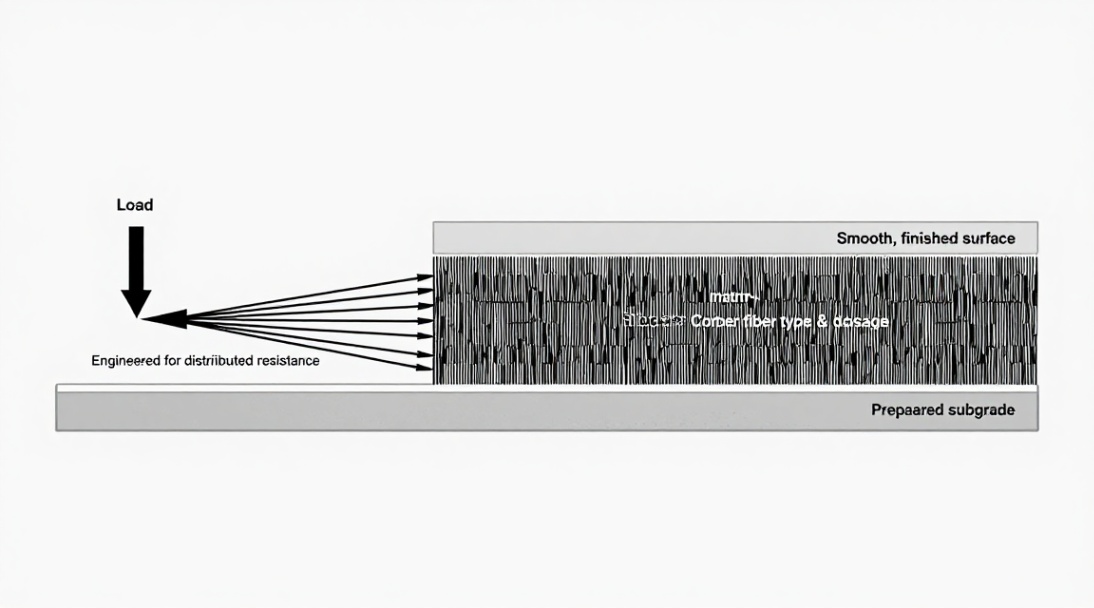
Think of unreinforced concrete as a pane of glass. A single focused stress shatters it. Wire mesh is like a few steel bars glued to the back of the glass; the crack must grow large enough to engage the steel. Fiber reinforcement, however, transforms the material. Millions of discrete fibers, whether synthetic, glass, or steel, disperse uniformly throughout the mix. They act like internal stitching. When micro-cracks begin to form from plastic shrinkage, thermal contraction, or load stress, these fibers bridge the tiny fissures. They hold the concrete together. This mechanism significantly improves fracture toughness-the material’s ability to absorb energy and resist crack propagation. For a driveway, this translates directly to fewer visible cracks, reduced spalling at joints, and superior resistance to impacts from dropped tools or freeze-thaw scaling.
Choosing the Right Fiber: A Logic Tree
The choice is not random. It follows a clear decision path based on expected stress. For most residential driveways carrying passenger vehicles, synthetic macro-fibers (polypropylene or nylon) are the default, rational choice. They are corrosion-proof, easy to mix, and effectively control plastic shrinkage and thermal cracking. If you anticipate heavier loads-frequent delivery trucks, RVs, or small tractors-steel fibers offer higher tensile strength and better load distribution. Glass fibers are suitable for very thin applications but require careful attention to mix design to prevent alkali-silica reaction. The dosage, measured in pounds per cubic yard of concrete, is critical. Too little provides no benefit. Too much can compromise workability and finish. Follow the manufacturer’s specifications precisely; this is a material science addition, not a guess.
The Step-by-Step Process: From Bag to Slab
The efficacy of concrete reinforcement fiber for driveways depends entirely on correct execution. This is a procedural roadmap.
Step One: Proportioning and Batching. Order your concrete mix specifying fiber reinforcement. A standard 4,000 psi mix is adequate. The fiber must be added at the batch plant or in the truck drum during initial mixing, not thrown on top at the site. This ensures homogeneous dispersion. Verify the fiber bags are on-site and will be added per the ordered dosage.
Step Two: Placement and Consolidation. Pour the fiber-reinforced concrete as you would any other. Use vibratory screeds and hand vibrators to consolidate the mix. The fibers do not impede proper consolidation. In fact, the enhanced cohesion can reduce bleed water and segregation. The goal is to achieve a dense, uniform matrix with fibers oriented in all directions.
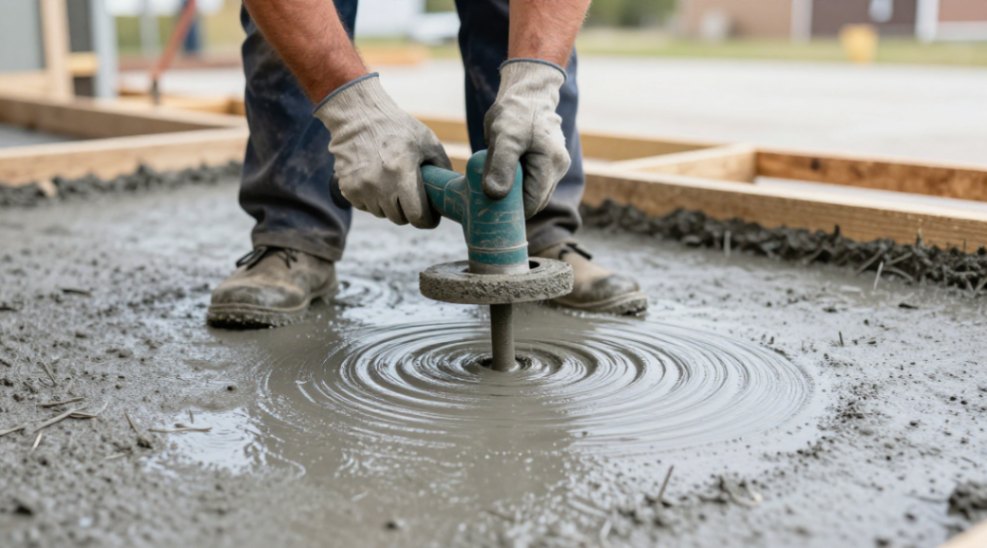
Step Three: Finishing. This is where practice diverges. The fibers, especially steel, can be brought to the surface by overworking the concrete with a steel trowel. You must time your finishing passes correctly. Start floating when the concrete has shed its surface water and can support the float’s weight. Use a magnesium or bull float for the initial pass. For the final hard-troweled finish, wait until the surface is considerably stiffer. You may see a few fiber ends; this is normal and does not indicate failure. Do not attempt to trowel them back in. A broom finish is more forgiving and effectively hides any fiber presence.
Step Four: Curing. The importance of curing is magnified. Fibers control cracks, but they do not replace the need for proper hydration. Apply a curing compound or use wet burlap immediately after finishing to retain moisture. A minimum seven-day moist cure is non-negotiable for developing full strength and durability.
Dispelling Myths and Making the Rational Choice
A common misconception is that fiber replaces all other reinforcement. Logic dictates otherwise. Fibers are superb for controlling random shrinkage cracking and improving impact resistance. They do not provide the same level of structural, load-bearing capacity as rebar in a situation with a concentrated point load or unstable subgrade. For most flatwork on a stable, compacted base, fibers are sufficient. For driveways with known soft spots or extreme load requirements, a hybrid approach using both fibers and a light wire mesh or rebar grid can be the most robust solution. The long-term economic analysis is clear. The marginal upfront cost of fiber reinforcement is offset by drastically reduced maintenance. You are not repairing cracks or spalled edges for decades. The driveway withstands freeze-thaw cycles with less scaling because the surface is held together internally.
The final decision rests on a simple hierarchy of needs. Define the expected loads. Specify the correct fiber type and dosage. Execute the placement and finishing with disciplined technique. Control the curing environment. The result is not just a slab of concrete. It is a system engineered for distributed resistance, a direct application of material science that pays for itself in silent, enduring performance.
Your next step is analytical. Review your project specifications. Consult your ready-mix supplier on their fiber options and proven mix designs. Then, plan your pour around the finishing requirements. The information is your tool. Use it to build something that lasts.
Supplier
We are the global leader in lightweight concrete and advanced engineered foam solutions. Known globally for its commitment to research, innovation, and applied expertise, we have been providing engineered foam solutions since the early 2012’s.
We can supply high-quality concrete admixture and foam concrete related products all over the world.
The company has a professional technical department and quality supervision department, a well-equipped laboratory, and equipped with advanced testing equipment and after-sales customer service center.
If you are interested, please feel free and contact us.