Concrete4U | Concrete Admixtures, Tools, and Production Machines

Stop EIFS Failure: A Pro’s Step-by-Step Guide to Using RDP for Unbreakable Walls
The Harsh Truth About EIFS: Why RDP is the Only Choice
Think your EIFS adhesion is good enough? It probably isn’t. The industry-standard method of using a bonding agent troweled onto insulation board is a legacy of convenience, not performance. For exterior insulation and finish systems that refuse to fail, Redispersible Polymer Powder (RDP) is the only professional choice. It transforms a simple cementitious base coat into a flexible, tenacious, and waterproof armor. This isn’t an upgrade; it’s a fundamental correction to how durable walls are built. Forget what the old-timers say. We’re solving problems, not repeating them.
Your EIFS RDP Q&A: Direct Answers, No Fluff
What exactly is RDP and why does EIFS need it?
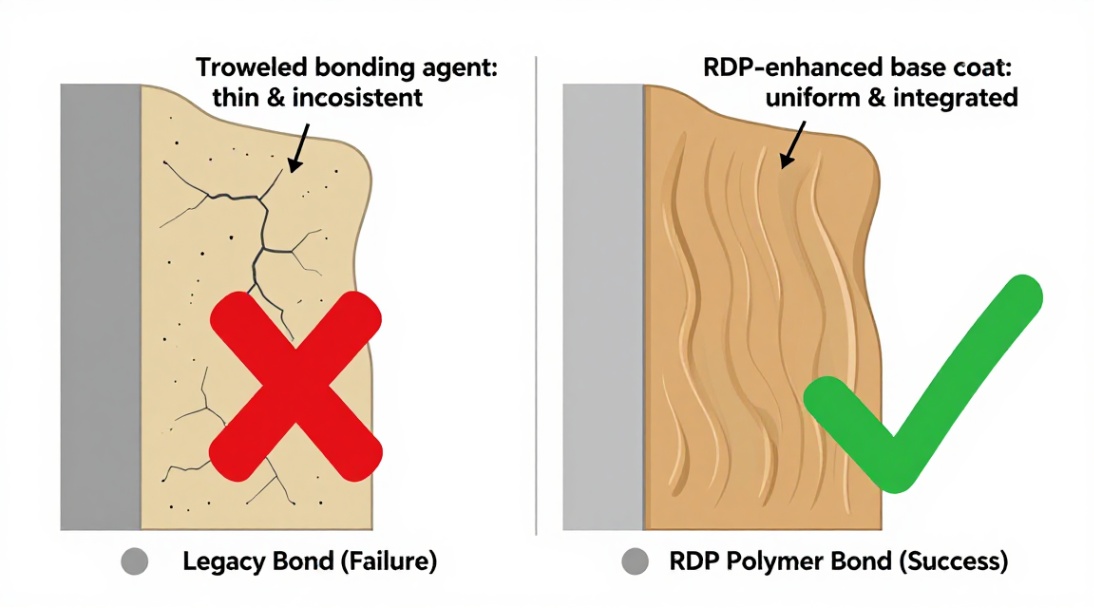
RDP is a polymer powder you mix into the base coat mortar. It re-disperses in water, forming a flexible polymer film within the cement matrix. This fusion creates a composite material with superior adhesion, flexural strength, and crack resistance. Your base coat stops being brittle cement and becomes a tough, glue-like skin. It chemically bonds to EPS, XPS, and mineral wool, gripping the mesh, and creating a monolithic barrier against water and stress.
RDP vs. Standard Bonding Agents: What’s the real difference?
The difference is total system integrity versus a point of failure. A brushed-on bonding agent creates a discrete, often uneven, adhesive layer. It’s a separate material. RDP is integrated throughout the entire base coat. There is no weak interface. The bond is the material itself. This eliminates delamination. On Reddit and professional forums, installers report that failure investigations almost always point to adhesive failure, not RDP-integrated base coat failure.
How does RDP actually prevent cracks and improve impact resistance?
It adds flexibility. Plain cement is rigid and cracks under thermal expansion, substrate movement, or impact. The polymer filaments in the cured RDP base coat act like microscopic rebar. They absorb and distribute energy. The base coat bends slightly instead of breaking. This drastically improves impact resistance (ASTM C1629) and eliminates the spider-web cracking that plagues cheap EIFS jobs. The wall moves as a single, flexible unit.
What is the non-negotiable surface prep before applying RDP base coat?
Surface preparation is 90% of the job. Fail here, and the best RDP won’t save you. First, the substrate (concrete, masonry, sheathing) must be structurally sound, clean, and dry. Remove all dust, oil, and form release agents. Prime it with a manufacturer-approved primer. This is critical for regulating suction and ensuring a chemical bond. For EPS and XPS boards, ensure the factory skin is intact and the boards are fully adhered with approved adhesive or mechanical fasteners per the system design.
Give me the exact step-by-step guide to mixing and applying RDP for EIFS.
Follow this sequence precisely. Deviations cause weak spots.
- Mixing Water: Use clean, potable water at 15-25°C (59-77°F). Measure it.
- Dry Mix: Pour the pre-bagged base coat powder containing RDP into the mixer. Do not add anything else.
- Wet Mixing: Add about 75% of the specified water. Mix for 2-3 minutes at low speed until homogeneous. Scrape the sides and bottom.
- Adjustment: Add the remaining water gradually while mixing. Aim for a creamy, lump-free consistency that holds on a trowel at a 45-degree angle.
- Slaking: Let the mix sit (slake) for 5 minutes. This lets the RDP fully hydrate.
- Final Mix: Re-mix for 1 minute. Do not add more water after this point.
- Application: Apply the base coat to the insulation board within 20 minutes of final mix. Use a stainless steel trowel. Apply a consistent layer of 3-4 mm (1/8 inch). Immediately embed the fiberglass mesh with full mechanical key, applying a second thin coat to fully cover it. Total thickness over mesh: 4-6 mm.
The table below summarizes the critical steps and specs:
| Step | Key Action | Critical Specification |
|---|---|---|
| 1. Water Prep | Use clean water | 15-25°C (59-77°F) |
| 2. Dry Mix | Add powder to mixer | Use full bag, no partial mixes |
| 3. Initial Mix | Add 75% water, mix | 2-3 minutes, low speed |
| 4. Consistency Adjust | Add remaining water slowly | Trowel-held at 45° angle |
| 5. Slaking | Let mix rest | 5 minutes minimum |
| 6. Final Mix | Brief re-mix | 1 minute, no added water |
| 7. Application & Embed | Trowel base coat, embed mesh | 3-4mm layer, total 4-6mm over mesh |
Is RDP compatible with all insulation boards and finishes?
Yes, when you use a complete, tested system. Major RDP-fortified base coats are formulated for compatibility with Expanded Polystyrene (EPS), Extruded Polystyrene (XPS), and mineral wool boards. The key is using the finish coat specified by the same system manufacturer. Don’t mix and match components from different brands. The chemistry is designed to work as a unit for moisture management and adhesion.
How does RDP address moisture in a wall? Does it trap water?
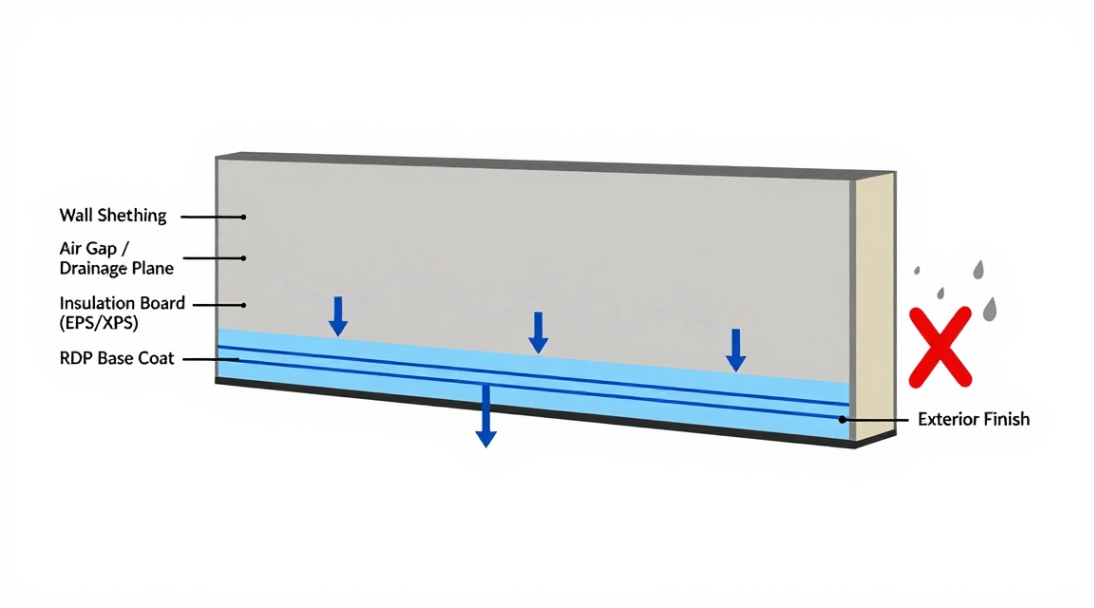
Properly applied, it manages moisture brilliantly. The RDP-enhanced base coat is water-resistant but not a vapor barrier. It allows incidental moisture to diffuse out. In a drained EIFS system, the primary drainage plane is behind the insulation board. The RDP layer acts as a secondary weather barrier. It stops driven rain penetration at the exterior surface, which is exactly where you want to stop it.
What’s the real long-term performance of RDP-based EIFS?
Decades of trouble-free service. Systems using high-quality RDP have 30+ year track records in harsh climates. The polymer resists UV degradation (it’s buried in the coat), freeze-thaw cycles, and thermal cycling. The enhanced adhesion prevents the progressive failures-edge lifting, panelization-that doom traditional systems. Your maintenance costs plummet.
What are the top 3 installation mistakes that ruin an RDP job?
1. Incorrect Mixing: Adding too much water destroys the polymer-to-cement ratio, killing adhesion and strength. Use a drill-powered paddle mixer and a bucket. Never guess water amounts.
2. Poor Mesh Embedment: The fiberglass mesh must be fully encapsulated in the base coat, not laid on top. This creates the reinforcing grid. Lazy embedment means zero crack resistance.
3. Applying to a Dirty/Wet Surface: Dust or moisture on the insulation board breaks the bond. The surface must be clean, dry, and primed if specified. This step is free but often skipped.
How do I ensure my RDP EIFS meets building codes?
Follow the ESR. For any recognized EIFS system, the manufacturer holds an Evaluation Service Report (ESR) from ICC-ES or similar. This document is your legal and technical bible. It details the approved substrates, fasteners, thicknesses, and, crucially, the required RDP-modified base coat. Your inspector will ask for it. Build exactly to the ESR and the manufacturer’s printed installation guide. No substitutions.
Is the extra cost of RDP in EIFS worth it?
Absolutely. The material cost increase for an RDP-fortified system is 10-15%. The risk reduction is 100%. Compare that to the cost of a single call-back to repair delamination or cracking-labor, scaffolding, material, and reputation damage. RDP is cheap insurance. It’s the difference between a project that gets you sued and one that gets you referred.
What about the environmental impact of using RDP polymers?
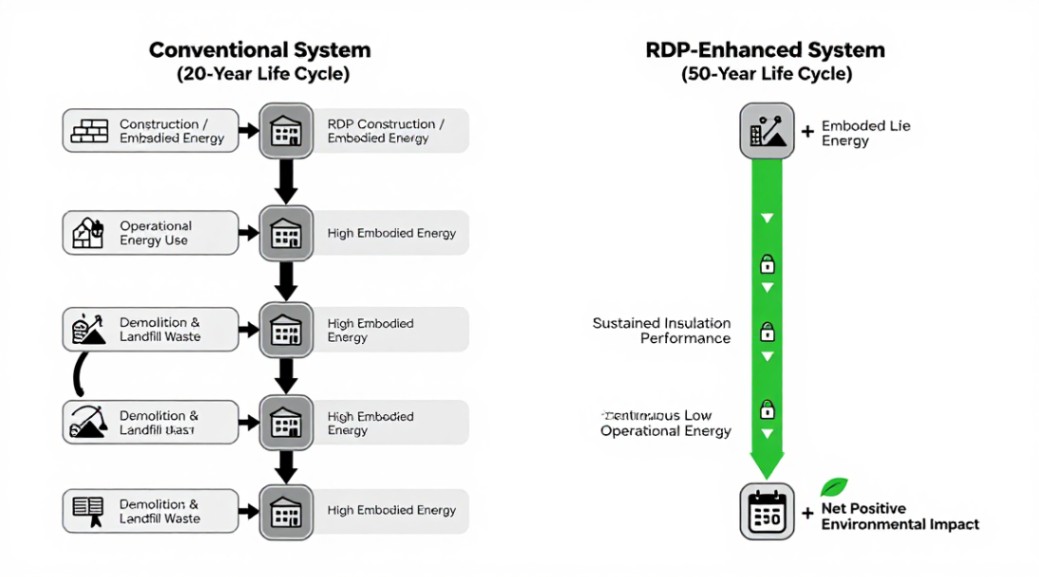
It’s a net positive. The durability argument wins. A wall system that lasts 50 years instead of 20 has a dramatically lower lifetime environmental impact, even considering polymer production. You avoid multiple re-claddings, landfill waste, and embodied energy from new materials. Furthermore, the insulation performance remains intact for the life of the building, saving continuous operational energy.
The Final Step: Move Past Guesswork
Stop treating EIFS as a cosmetic coating. It’s a structural weather barrier. The choice to use a proper RDP-enhanced system isn’t optional for performance; it’s mandatory. Your next step is to abandon generic specifications. Demand the technical data sheet and ESR for the system you’re using. Verify the RDP content and performance specs. Then, execute the steps here with discipline. The result is a wall that performs, permanently. That’s how you build a reputation.
Supplier
We are the global leader in lightweight concrete and advanced engineered foam solutions. Known globally for its commitment to research, innovation, and applied expertise, we have been providing engineered foam solutions since the early 2012’s.
We can supply high-quality concrete admixture and foam concrete related products all over the world.
The company has a professional technical department and quality supervision department, a well-equipped laboratory, and equipped with advanced testing equipment and after-sales customer service center.
If you are interested, please feel free and contact us.