Concrete4U | Concrete Admixtures, Tools, and Production Machines

How RDP Base Coats Fix the Hidden Weakness in Your EIFS Cladding
The Silent Compromise in the Modern Wall
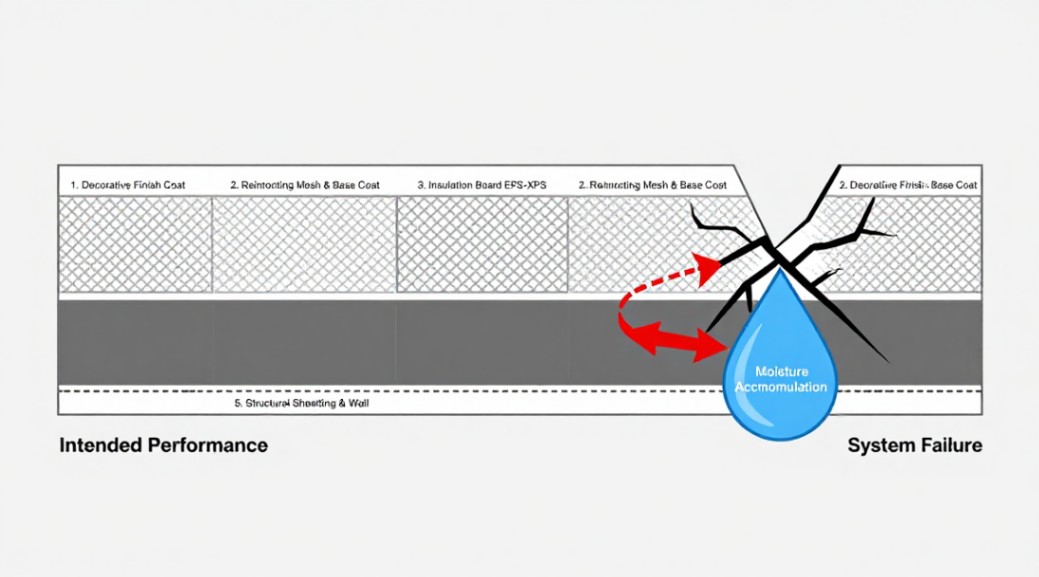
Have you ever watched a newly installed exterior insulation and finish system develop hairline cracks within the first few seasons? Or perhaps you’ve investigated a call-back where moisture readings behind the finish were inexplicably high, despite a perfect-looking surface? These are not random failures. They are symptoms of a fundamental compromise in the wall assembly, a disconnect between the insulation’s promise and the base coat’s performance. For decades, the conversation around EIFS revolved almost exclusively around the insulation board and the decorative finish. The critical middle layer-the base coat-was often treated as a commodity, a simple adhesive. That perspective is a profound and costly mistake. The evolution towards polymer-modified, cementitious RDP for exterior insulation and finish systems represents a conscious correction of that error. This shift is not about following a trend; it’s a logical response to the physical demands placed on a continuous insulation cladding by thermodynamics, structural movement, and water.
Energy Efficiency Creates a New Set of Problems
The primary driver for EIFS adoption is undeniable: superior thermal performance. By wrapping a building in a continuous blanket of insulation, you eliminate the thermal bridges inherent in stud-framed construction. Energy models show significant savings, and occupant comfort improves. But this very success alters the physics of the wall. The insulation board, typically EPS or mineral wool, now becomes the plane where the exterior temperature differential is most acute. The surface temperature of that board can swing violently with sun exposure and weather. A traditional, brittle base coat simply cannot accommodate that thermal expansion and contraction. It cracks. Every crack, no matter how fine, is a potential pathway for liquid water. Once water infiltrates, it is trapped against the sheathing by the very insulation that makes the system so efficient. This is the central paradox. The system designed for performance can, if poorly detailed, create a perfect environment for concealed moisture damage. The industry’s answer has been a material engineered for this specific challenge: a RDP base coat.
RDP: The Engineered Transition Layer
Think of RDP-Redispersible Polymer Powder-not as glue, but as a multifunctional membrane. At its core, it is a blend of hydraulic cement and polymer particles. When mixed with water, these particles re-disperse and, upon curing, form a coherent polymer film that binds the cement matrix. This fusion creates a composite material with hybrid properties. The cement provides compressive strength, alkalinity, and fire resistance. The polymer imparts flexibility, tensile strength, and most critically, adhesion. The material properties and mix design are precisely calibrated for exterior conditions. The polymer content is high enough to ensure the cured film can stretch and recover, accommodating movement without fracturing. The cement content is sufficient to provide a rigid, impact-resistant substrate for the finish coat. This is not a one-size-fits-all product; a proper RDP for exterior insulation and finish systems is formulated for extended open time, superior workability in vertical applications, and consistent curing even in less-than-ideal humidity.
The Protocol of Performance: From Substrate to Mesh
Material science alone is insufficient. Performance is a protocol. It begins with proper surface preparation and priming. The insulation board must be clean, dust-free, and mechanically sound. A primer is often specified, not as a luxury, but as a necessity. It ensures a uniform surface energy, controls suction, and creates a chemical bridge for the RDP to achieve its designed adhesive strength. The application techniques are methodical. The mixed RDP base coat is applied at a specified thickness, typically 2-3mm, using a notched trowel. This thickness is non-negotiable; it is the minimum mass required to embed the reinforcing fiberglass mesh completely. The mesh is then pressed into the wet base coat, followed by a second embedding coat. The key is full encapsulation of the mesh. Any mesh floating on the surface creates a plane of weakness. This integrated composite-RDP and mesh-is what provides the system’s long-term durability and crack resistance. It becomes a continuous, reinforced, flexible shell.
Detailing is Where Systems Succeed or Fail
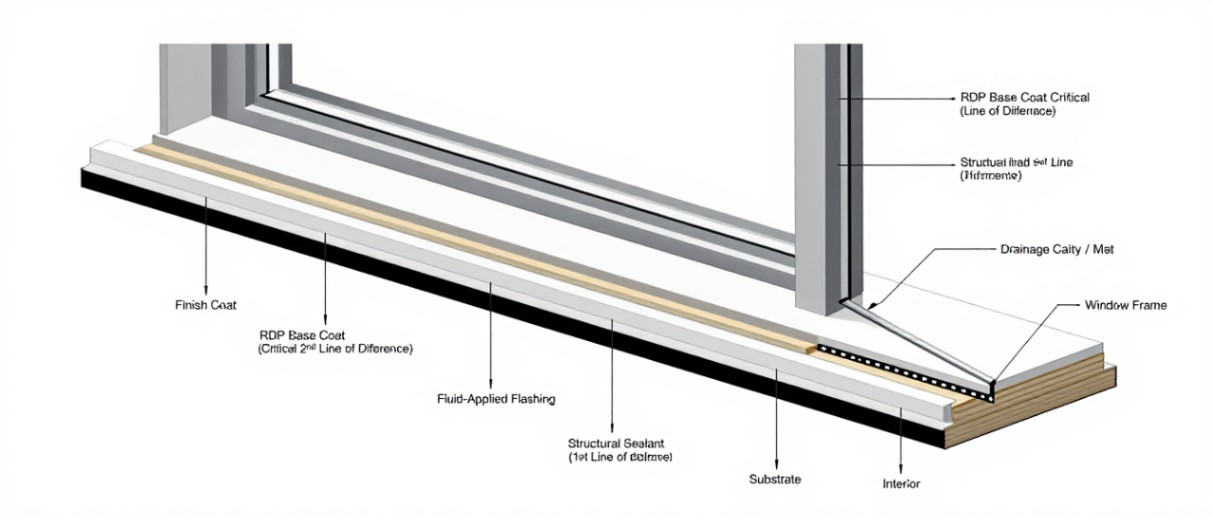
The broad field application is straightforward. The true test of any EIFS assembly occurs at the transitions. Ensuring proper detailing at windows, doors, and penetrations separates professional installations from problematic ones. At these junctions, the RDP base coat must be integrated with fluid-applied flashings, sealants, and drainage mats. It must be tooled into corners and terminations with precision. The logic is simple: water management is a hierarchy. The first line of defence is the finish coat and sealants. The second, and final, line of defense is the water-resistant barrier created by the properly applied RDP layer and its integration with flashing. If water bypasses the first line, the RDP layer must channel it away from sensitive substrates. This demands not just a good material, but a thorough understanding of how it interfaces with every other component in the wall’s anatomy.
Beyond Alternatives: A Rational Choice
When comparing RDP to alternative base coat materials, the analysis is clear. Traditional cementitious adhesives lack the necessary flexibility and bond strength, leading to delamination and cracking. Some purely polymer-based adhesives may offer flexibility but sacrifice compressive strength and vapor permeability, potentially creating a vapor trap. RDP occupies the optimal middle ground. It complies with the key building codes and industry standards for EIFS, such as ASTM E2568 and the requirements of the EIFS Industry Members Association (EIMA), because it was engineered to meet them. Its performance is predictable and quantifiable. The choice, therefore, is not a matter of brand preference, but of risk mitigation. Specifying a high-performance RDP base coat is the most direct method to ensure the long-term integrity of the insulation investment.
The Invisible Layer Demands Visible Attention
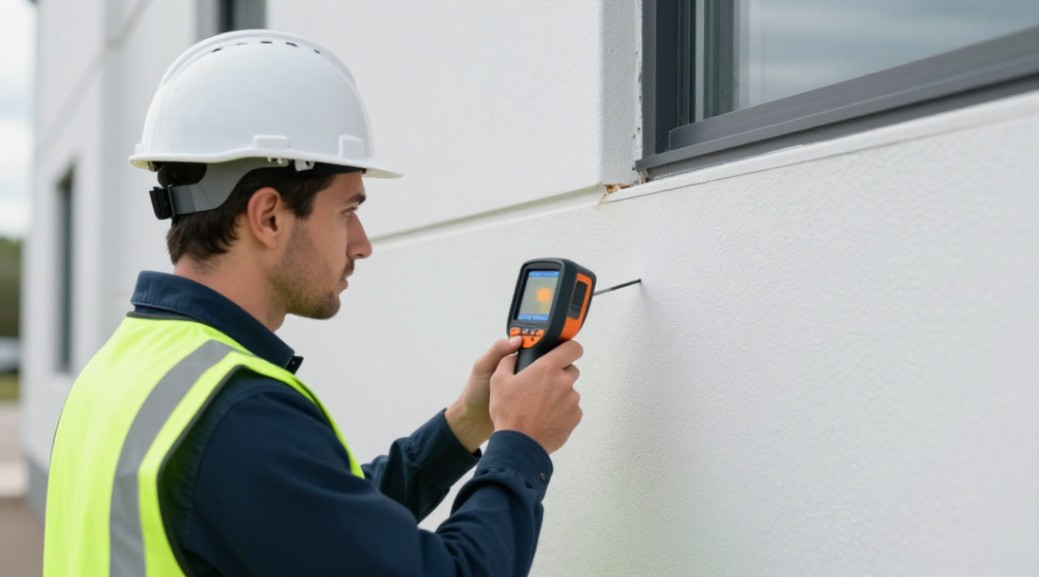
The final irony of a high-performance EIFS is that when it functions perfectly, its most critical component is invisible. You see the insulation thickness and the aesthetic finish. The RDP layer is hidden. This leads to the common oversight in maintenance and inspection considerations for RDP-backed EIFS. Inspections must go beyond looking for cracks in the finish. They must involve checking for soft spots that indicate debonding, assessing sealant joints at all perimeters, and verifying that drainage paths remain clear. The system is durable, but it is not maintenance-free. A proactive inspection regimen, focused on the transitions and terminations protected by the RDP, will identify minor issues long before they become catastrophic failures.
The Logical Conclusion for Your Project
The data from field performance and the logical demands of building physics lead to one conclusion. If you are investing in the energy efficiency and design flexibility of an exterior insulation and finish system, you must invest equally in its structural and moisture integrity. The single most effective way to do that is to specify and ensure the proper application of a high-quality RDP for exterior insulation and finish systems. Do not allow it to be value-engineered out. Treat it as the essential, non-negotiable component it is. Your building’s longevity depends on it. To secure that longevity, you need a product that meets the highest material standards and an installer trained in the precise protocols it requires. We provide both. For your next project, move beyond basic adhesives. Specify a true polymer-modified RDP base coat system. Review our technical data sheets and application guidelines to understand the specification difference, and contact our technical team for a project-specific consultation. The integrity of your wall assembly is too critical to compromise.
Supplier
We are the global leader in lightweight concrete and advanced engineered foam solutions. Known globally for its commitment to research, innovation, and applied expertise, we have been providing engineered foam solutions since the early 2012’s.
We can supply high-quality concrete admixture and foam concrete related products all over the world.
The company has a professional technical department and quality supervision department, a well-equipped laboratory, and equipped with advanced testing equipment and after-sales customer service center.
If you are interested, please feel free and contact us.