Concrete4U | Concrete Admixtures, Tools, and Production Machines

Beyond Sticking: How the Right Water Retention Agent Transforms Modern Construction
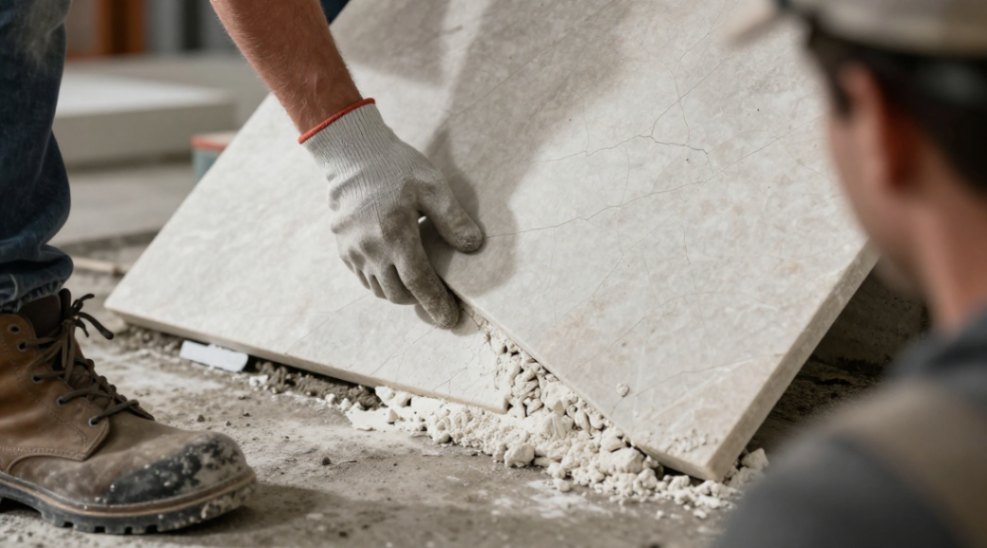
I remember the first time I saw a crew walking off a job, the foreman’s face tight with frustration. The thin-set mortar for the lobby’s expensive stone tiles was dusting off like chalk, a fine powder coating their boots. They had mixed it perfectly, followed the bag’s instructions to the letter. Yet, the cement never truly got the chance to become cement. It was thirsty. It sucked the water from the mix the instant it touched the porous substrate, leaving behind a weak, crumbly skeleton instead of a strong, bonded adhesive. That moment, two decades ago, cemented for me the most overlooked variable in construction chemistry: time. Not clock time, but the critical window a mix has to hold onto its lifeblood-water. This is the story of how we learned to control that window, and why hydroxypropyl methyl cellulose as a water retention agent became the silent, indispensable partner in modern building.
The magic isn’t in adding strength directly, like steel rebar. It’s in enabling strength to develop. Think of hydroxypropyl methyl cellulose, or HPMC, as a temporary guardian. When you add it to the mix, its long, chain-like molecules disperse in the water. They don’t just sit there. They get to work, thickening the aqueous phase and, most importantly, migrating to the air-water interfaces within the paste. As the mix is applied, these molecules align and form an incredibly thin, continuous colloidal film around the cement particles and aggregate. This film is the barrier. It dramatically slows the physical loss of water to dry substrates or thirsty air. The water isn’t locked away; it’s politely asked to stay for the crucial party-the chemical reaction of hydration.
This single mechanism unlocks a cascade of benefits we now take for granted. Complete hydration means maximum strength development. The mortar gains its full potential. Workability improves radically; the mix stays smooth and buttery for 30, 60, even 90 minutes, eliminating the panic of a setting bucket and allowing for meticulous, careful application. That improved workability directly translates to better adhesion. The mortar can be tooled properly, achieving full contact with the tile or substrate without dragging or tearing. And perhaps most visibly, it slashes shrinkage cracks. When water leaves too quickly, the matrix contracts violently, creating a network of fine cracks. By retaining water, HPMC allows for a more gradual, controlled drying process, giving the matrix time to gain strength and resist these tensile forces. The result is a denser, more coherent, and durable surface.
You’ll find this logic applied wherever controlled water management is non-negotiable. In tile adhesives, it prevents substrate suction from robbing the bond. In self-levelling compounds, it ensures consistent flow and a level surface without premature skinning. For exterior insulation and finish systems (EIFS), it’s the key to allowing the base coat to cure slowly and uniformly behind the insulation boards, preventing stresses that lead to delamination. The dosage isn’t a guess. It’s a balance. For most general mortar applications, we work in a range of 0.1% to 0.5% by weight of cement. But we adjust. Higher temperatures, lower humidity, or highly absorbent substrates like aerated concrete? We nudge the dosage toward the higher end of that spectrum. The goal is always to provide just enough protection to complete the job, as excess can over-thicken and trap air.
HPMC rarely works alone. Its synergy with redispersible polymer powders (RDP) is textbook. HPMC manages the water, ensuring full cement hydration and building the mineral skeleton. The RDP, once redispersed, forms a flexible polymeric film that interlocks with this skeleton. Think of it as HPMC providing the time and conditions for a strong body to be built, while RDP adds the tendons and ligaments that provide flexibility, adhesion, and impact resistance. The combination is greater than the sum of its parts. When we compare it to other cellulose ether water retention agents, the choice often comes down to the specific substitution pattern. Methyl cellulose (MC) is simpler but offers less tolerance to high temperatures. Hydroxyethyl cellulose (HEC) is excellent in pure polymer systems but doesn’t always play as nicely with cement’s high pH. HPMC strikes a robust, reliable middle ground with good thermal gelation properties, making it the default workhorse for cementitious systems.
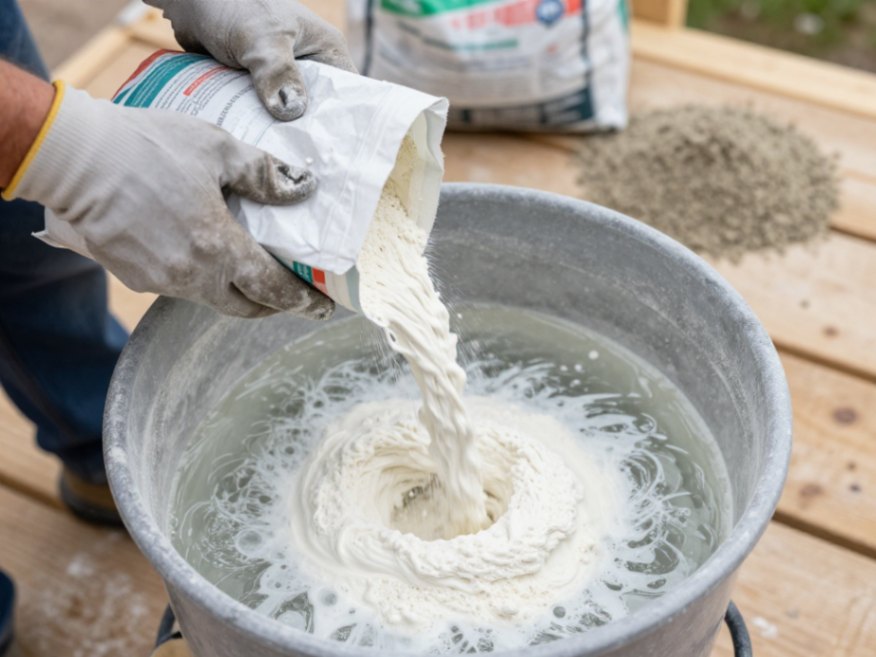
For the contractor on the deck, the theory boils down to practice. Mixing is critical. Always add the HPMC powder to the water while the mixer is running. Let it disperse fully for a minute or two-you’re hydrating the powder, creating that protective colloid in the water *before* you introduce cement and sand. A common mistake is dry-blending it with the cement; this often leads to fish-eyes, those frustrating gelatinous lumps that never fully disperse. Once your base slurry is smooth, add your aggregates and other powders. The mix will thicken. That’s expected. Adjust with small amounts of water patiently, knowing you’ve built in a safety net against rapid water loss.
The Practical Guide to HPMC Selection and Use
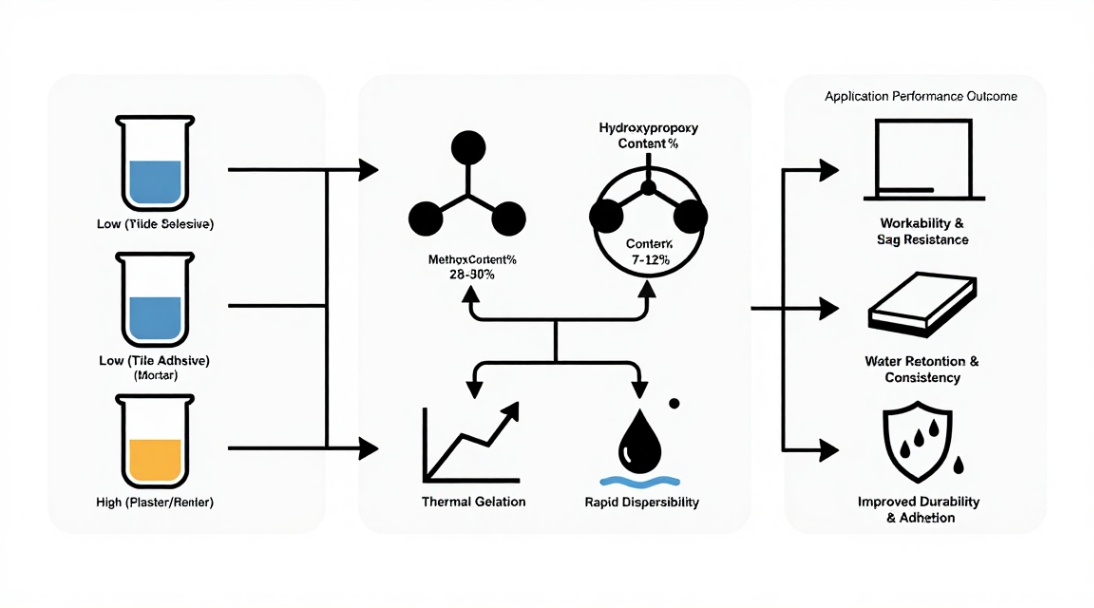
Selecting the right grade isn’t about finding the cheapest white powder. It’s about matching a molecular profile to your environmental and performance needs. Viscosity is the first dial we turn. A lower viscosity grade (like 400 mPa·s in a 2% aqueous solution) gives you good workability without being too sticky, ideal for spray applications or renders. A higher viscosity grade (15,000 to 80,000 mPa·s) provides thicker body and exceptional water retention, perfect for thick-bed tile adhesives or vertical applications. The methoxy and hydroxypropoxy substitution levels govern the thermal gelation point-the temperature at which the solution starts to gel. In hot climates or for exterior work in summer, you need a grade with a higher gel point, otherwise, your mortar can become unworkably thick in the bucket. It’s a specification conversation, not just a commodity purchase.
Here is a consolidated view of the key operational steps and considerations we’ve discussed:
| Stage | Action | Key Details & Rationale |
|---|---|---|
| 1. Selection | Choose HPMC grade based on application. | – Viscosity: 400-2,000 mPa·s for renders/ECC; 10,000-80,000 mPa·s for tile adhesive. – Gel Point: Higher (65-75°C) for hot climate/exterior work. |
| 2. Dosing | Weigh HPMC as % of cementitious binder. | Typical range: 0.1% to 0.5% by weight. Start at 0.2%. Increase for high absorption, high temp, low humidity. |
| 3. Mixing | Pre-disperse HPMC in water. | Add powder to water with mixer running. Hydrate for 1-2 minutes until smooth slurry forms. Never dry-blend with cement first. |
| 4. Formulation | Combine with other additives. | Add cement, sand, RDP, etc. to the HPMC slurry. HPMC’s water retention enhances RDP film formation. |
| 5. Adjustment | Fine-tune consistency. | Mix thoroughly. Add water in small increments (e.g., 0.1-0.2 L per batch) if needed. HPMC thickening is not instantaneous. |
So, what do you do with this? You start paying attention to the powder behind the performance. When you next specify a bag of thin-set or a base coat, look past the brand name and ask about the cellulose ether inside. Is it HPMC? What’s its viscosity? Its gel point? Request a data sheet. Better yet, get a sample and run a simple test: make two small batches of a cement paste, one with a pinch of a quality HPMC and one without. Spread them on a dry concrete block. Watch. Wait. The difference in surface cracking and final hardness after 24 hours will tell you more than any datasheet ever could. That test, more than any complex theory, shows why we’ve relied on hydroxypropyl methyl cellulose as a water retention agent for decades. It doesn’t just make the job easier. It makes the build last.
Supplier
We are the global leader in lightweight concrete and advanced engineered foam solutions. Known globally for its commitment to research, innovation, and applied expertise, we have been providing engineered foam solutions since the early 2012’s.
We can supply high-quality concrete admixture and foam concrete related products all over the world.
The company has a professional technical department and quality supervision department, a well-equipped laboratory, and equipped with advanced testing equipment and after-sales customer service center.
If you are interested, please feel free and contact us.