Concrete4U | Concrete Admixtures, Tools, and Production Machines

Mastering Foamed Concrete Density for Fill: Your Complete Guide to Stability & Efficiency
Stop Guessing Your Fill Density
Are you tired of backfilling trenches only to watch the material settle and fail? Have you struggled with the crushing weight of conventional fill on sensitive underground pipes or old retaining walls? You are not alone. Many engineers and contractors face these exact problems. The solution lies not just in the material, but in its precise, engineered density. This guide cuts through the confusion and explains foamed concrete density for fill applications.
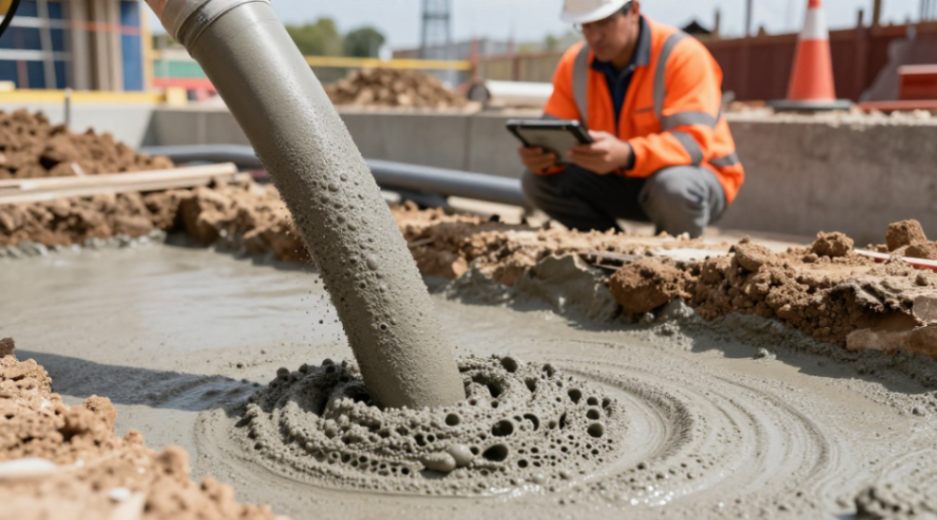
What is Foamed Concrete Density for Fill?
For fill applications, foamed concrete density is the engineered unit weight of the material, typically measured in pounds per cubic foot (pcf) or kilograms per cubic meter (kg/m³). It is the single most important property defining its behavior. This is not standard concrete. It’s a lightweight, flowable mix created by blending a cementitious slurry with a pre-formed foam. The foam introduces millions of microscopic air bubbles, displacing heavier aggregate and water to achieve a controlled, low density.
Why Density is Your Control Knob for Performance
Choosing the right density directly dictates the success of your fill project. Think of density as your primary control knob for these key characteristics:
- Weight (Dead Load): Lower density means less weight. This reduces stress on underlying soils, adjacent structures, and buried utilities.
- Strength: Density and compressive strength have a direct, proportional relationship. Higher density usually means higher strength.
- Flowability & Placement: Properly designed low-density foam concrete flows like a thick liquid. It fills complex, irregular voids without vibration or compaction.
- Thermal & Acoustic Insulation: The air voids provide inherent insulation properties, which improve as density decreases.
The Sweet Spot: Target Density Ranges for Fill
For most fill and void-filling projects, the target density range falls between 20 pcf to 50 pcf (320 kg/m³ to 800 kg/m³). This is the operational sweet spot that balances critical properties. Let’s break it down:
Ultra-Lightweight Fill (20-35 pcf / 320-560 kg/m³)
Use this for the most weight-sensitive applications. It’s perfect for filling abandoned pipes, tanks, and tunnels, or backfilling against historic masonry walls. Strength is low, but the weight savings are massive.
Standard Structural Fill (35-50 pcf / 560-800 kg/m³)
This is the workhorse range for general backfill, trench reinstatement, and foundation support. It provides adequate strength for most sub-grade conditions while remaining significantly lighter than compacted soil or aggregate.
Foamed Concrete vs. Traditional Fill: A Clear Winner
Let’s compare foamed concrete to common alternatives. The advantages become obvious.
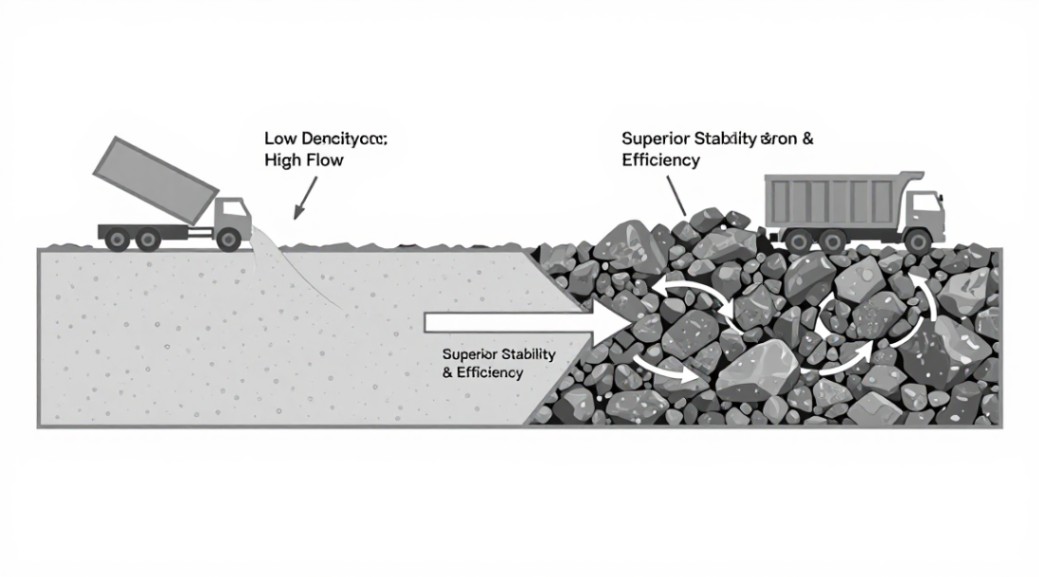
Compared to Compacted Soil or Aggregate
- Weight: Foamed concrete can be 75% lighter. This drastically cuts lateral load on retaining walls.
- Labour & Time: No need for expensive compaction equipment or layer-by-layer testing. You pour it and it’s done.
- Settlement: Engineered foam concrete does not settle. Compacted soil often does, causing pavement cracks and utility failures.
Compared to Controlled Low-Strength Material (CLSM)
- Density Control: Foamed concrete offers precise, repeatable density control. CLSM density is largely a function of its aggregate.
- Weight: Even “lightweight” CLSM is typically heavier than foamed concrete.
- Excavatability: Low-density foam concrete remains easily excavatable if future access is needed, unlike high-strength CLSM.
How to Specify and Control Density on Your Project
Success requires a clear specification and verification plan. Do not leave it to chance.
- Define the Requirement: Your project specs must state a target wet density (e.g., 40 pcf ± 2 pcf) and a minimum compressive strength at that density (e.g., 50 psi at 28 days).
- Mix Design is Key: The supplier adjusts density by varying the volume of foam injected into the base slurry. More foam equals lower density. Cement content and additives fine-tune strength.
- Test, Don’t Guess: Field technicians should perform simple wet density checks using a calibrated container (like a 1 cubic foot box) for every truckload or major placement area.
- Choose the Right Placement Method:
For most fill work, you will pump the material directly into the void or trench. For large, open areas, conveyor placement or simple pouring works. The material self-levels.
Real-World Proof: What Contractors Are Saying
The feedback from the field is consistent. On professional forums, project managers share notes: “We used 30 pcf foam concrete to backfill behind a failing 100-year-old wall. Zero movement since. Traditional methods would have required a complete rebuild.” Another supervisor commented, “Our trench reinstatement time dropped by 60%. No compaction, no testing, just pour and pave the next day.” This material solves real problems.
Your Next Step: Stop Compromising on Your Fill
Stop fighting with heavy, unpredictable, labour-intensive fill materials. Engineered foamed concrete density gives you control over weight, stability, and cost. The data is clear. The field results are proven.
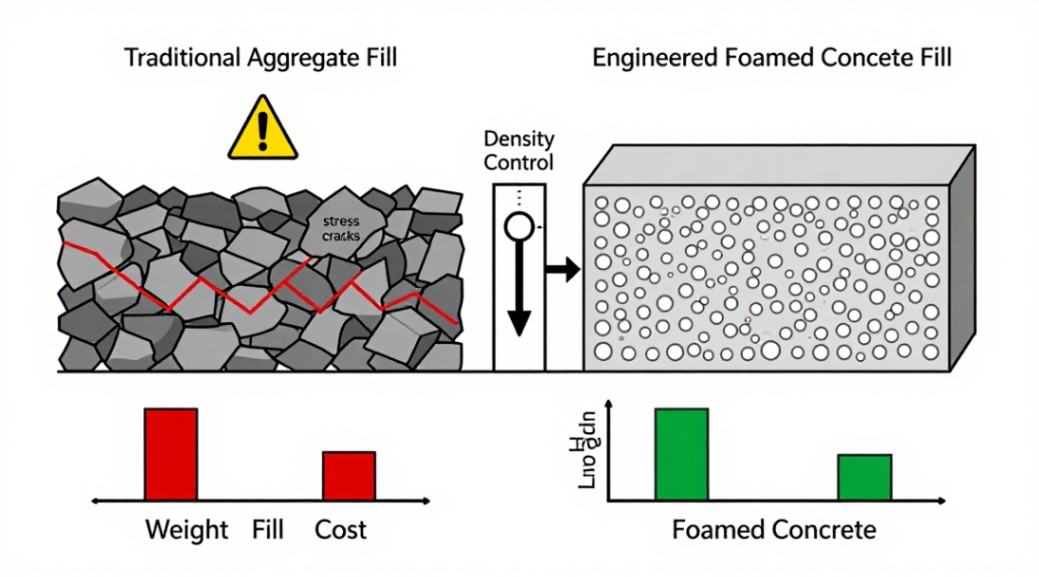
Controlled density and stability versus the unpredictability of traditional fill. Do not design another fill application without getting a professional foamed concrete consultation. Contact a specialized foamed concrete supplier today. Provide them with your project drawings and load requirements. Request a mix design proposal and a site demonstration. See for yourself how precise density control transforms difficult fill problems into simple, permanent solutions. Make the call now.
Supplier
We are the global leader in lightweight concrete and advanced engineered foam solutions. Known globally for its commitment to research, innovation, and applied expertise, we have been providing engineered foam solutions since the early 2012’s.
We can supply high-quality concrete admixture and foam concrete related products all over the world.
The company has a professional technical department and quality supervision department, a well-equipped laboratory, and equipped with advanced testing equipment and after-sales customer service center.
If you are interested, please feel free and contact us.