Concrete4U | Concrete Admixtures, Tools, and Production Machines

HEC for Water Based Adhesives: The Silent Thickener That Can Make or Break Your Formula
A Cautionary Tale from the Lab
Let me share a story. A few years back, a formulation chemist I was mentoring called me, frustrated. Their new adhesive had perfect viscosity in the bucket but sagged on vertical surfaces. The bond strength was inconsistent. After a week on the shelf, viscosity plummeted. They suspected the resin or additives. The real culprit? How they were using their Hydroxyethyl Cellulose (HEC). They were adding it wrong. I’ve seen this exact scenario play out dozens of times. It’s a silent formula killer. This article is my guide to help you steer clear of those same costly errors with HEC for water based adhesives and sealants.
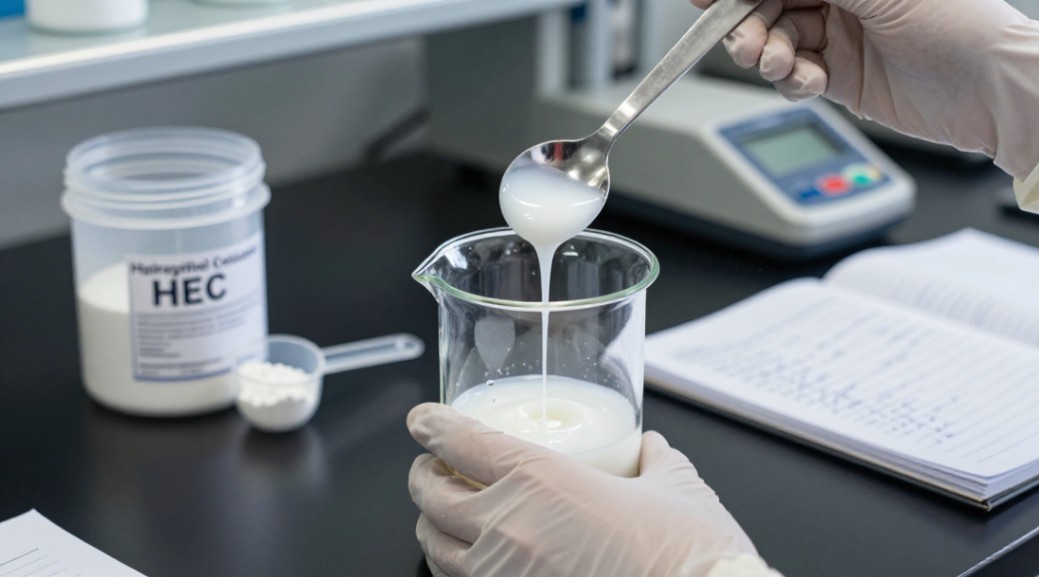
HEC Warning Flags: Common Mistakes You Must Avoid
1. What’s the BIGGEST mistake formulators make with HEC?
Hands down, improper dispersion. NEVER dump dry HEC powder directly into water. It will form insoluble gel clumps, or “fish-eyes.” These lumps never fully hydrate. They create weak spots in your adhesive film and cause erratic viscosity. You’ll see terrible sag resistance and inconsistent application. Many users on technical forums like Reddit’s r/Chempros have echoed this pain point, reporting batches ruined by this single, avoidable error.
2. How do I correctly add HEC to my water based adhesive?
You must create a high-shear vortex. Here’s the detailed, step-by-step method:
- Add your water to the mixing vessel first. Use at least 80% of your formula’s total water content.
- Start agitation. Use a high-speed mixer (e.g., a Cowles blade) and create a strong, deep vortex.
- Slowly sift the HEC powder into the “eye” of the vortex. The shear force immediately pulls particles apart. Maintain high shear for 2-3 minutes after all powder is added.
- Reduce to medium agitation and let the mixture hydrate fully. This takes 15-30 minutes. Patience is key.
- Add the remaining formula ingredients (resins, plasticizers, fillers) only after the HEC solution is clear and lump-free.
Follow these steps precisely. I’ve compiled them for quick reference:
| Step | Action | Key Parameter |
|---|---|---|
| 1 | Add Base Water | ≥80% of total water |
| 2 | Start High-Shear Mixing | Create a deep vortex |
| 3 | Sift in HEC Powder | Into the vortex, slowly |
| 4 | High-Shear Mixing | 2-3 minutes post-addition |
| 5 | Hydrate | 15-30 mins, medium agitation |
| 6 | Add Other Ingredients | Only after full hydration |
3. Is all HEC the same? What grade should I use?
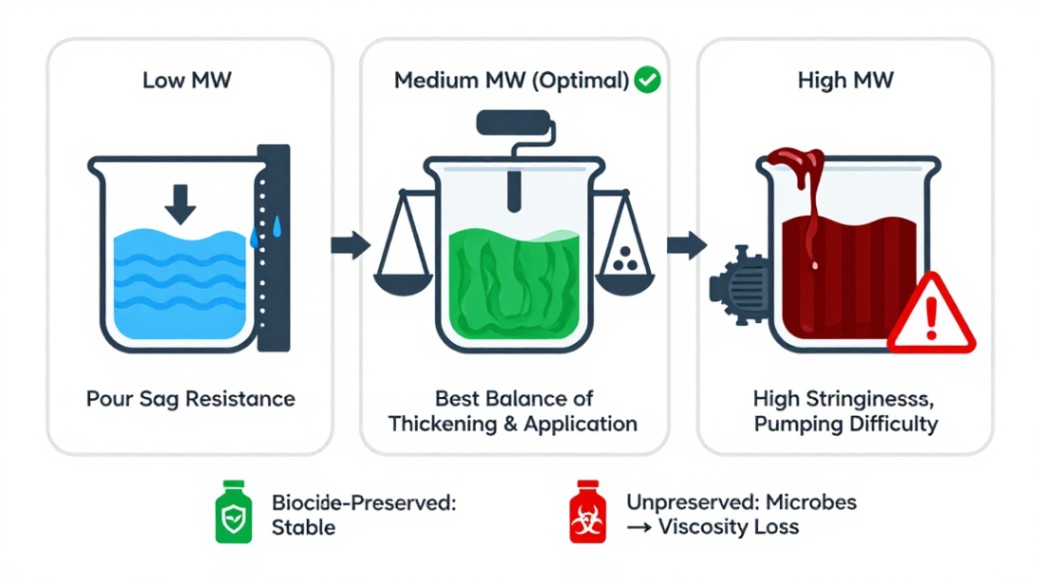
Absolutely not. Using the wrong molecular weight (MW) grade is a critical error. Low MW HEC gives you poor sag resistance. High MW HEC can be too stringy and difficult to pump. For most water based adhesives, a medium MW grade (like 90,000 to 130,000 mPa·s for a 2% solution) offers the best balance of thickening and application. For sealants, where anti-sag is paramount, lean towards a higher MW grade. And this is non-negotiable: always use a biocide-preserved HEC grade. Unpreserved HEC is food for microbes. They will break down the polymer chain, causing catastrophic viscosity loss and foul odors in your finished product.
4. Why does my adhesive dry too fast and lose bond strength?
This often points to poor water retention. HEC’s superpower is holding water within the adhesive matrix. If you use too little HEC, or a low-quality grade, water evaporates into porous substrates (like wood or drywall) before the adhesive can form a proper bond. The result? A weak, starved joint. HEC’s inert nature also means it doesn’t interfere with your primary adhesive resin. It just holds water in place, extending your open time and improving substrate wetting for a stronger, more reliable bond.
5. Can I just swap HEC for a newer associative thickener?
Be very careful here. Associative thickeners (like HEUR or HASE) are great for high-gloss paints but can be problematic in water based adhesives and sealants. They work by forming temporary bonds with particles and themselves. This mechanism is highly sensitive to surfactants, solvents, and fillers in your formula. Add too much of something else, and the thickening effect can collapse overnight. HEC, in contrast, thickens by simple chain entanglement in water. It’s robust and predictable. For consistent, shelf-stable viscosity that won’t surprise you, HEC is your safe bet.
6. What’s a good starting usage level for HEC in my formula?
Start low and adjust based on rheology. For a general-purpose adhesive, begin at 0.2% to 0.8% by total weight. For a high-viscosity, non-sag sealant, you might need 0.8% to 1.5%. Always make small pilot batches. Measure the viscosity after 24 hours to ensure stability. Remember, HEC contributes to clarity and low shrinkage in the final film, which is a huge benefit for clear adhesives and sealants.
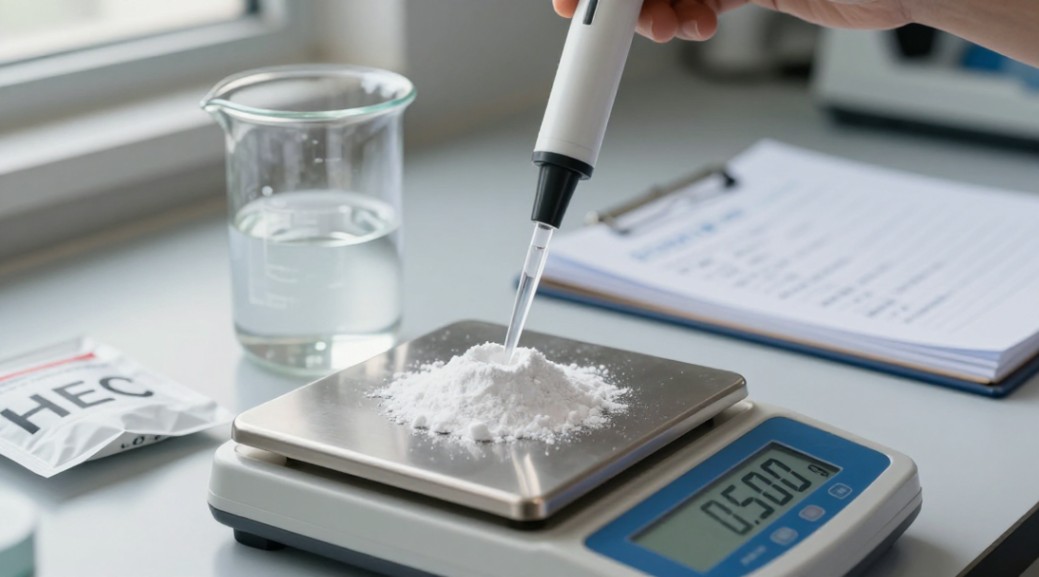
Don’t Experiment. Use a Proven Solution.
After 20+ years, I don’t gamble with raw materials. I use what works. The pitfalls I’ve outlined here are real. They cost time, money, and product reputation. If you want a reliable, high-performance HEC for water based adhesives and sealants that is easy to disperse and preserved against microbes, you need a trusted source. I recommend Ashland’s Natrosol™ or Dow’s CELLOSIZE™ HEC grades. These are industry standards for a reason. Their technical data is accurate, their quality is consistent, and their preserved grades protect your investment.
My direct advice to you: Stop struggling with viscosity drops and sag. Visit the Ashland or Dow chemical website today. Download the technical datasheets for their preserved HEC grades. Order a sample. Test it using the dispersion method I provided. See the difference that using the right material, the right way, makes. Your next batch will be your best batch.
Supplier
We are the global leader in lightweight concrete and advanced engineered foam solutions. Known globally for its commitment to research, innovation, and applied expertise, we have been providing engineered foam solutions since the early 2012’s.
We can supply high-quality concrete admixture and foam concrete related products all over the world.
The company has a professional technical department and quality supervision department, a well-equipped laboratory, and equipped with advanced testing equipment and after-sales customer service center.
If you are interested, please feel free and contact us.