Concrete4U | Concrete Admixtures, Tools, and Production Machines

5 RDP Mistakes That Will Destroy Your EIFS (And How to Avoid Them)
The Invisible Glue: Why RDP Makes or Breaks Your EIFS
Have you ever seen a beautiful exterior insulation and finish systems facade ruined by hairline cracks, water stains, or worse, a whole section peeling off? I’ve spent decades on scaffolding, diagnosing these failures. The root cause often traces back to one invisible component: the Redispersible Polymer Powder, or RDP for exterior insulation and finish systems. Specifying the wrong type, or using it incorrectly, is a recipe for disaster. Don’t let your project become the next cautionary tale. Here are the critical mistakes you must avoid.
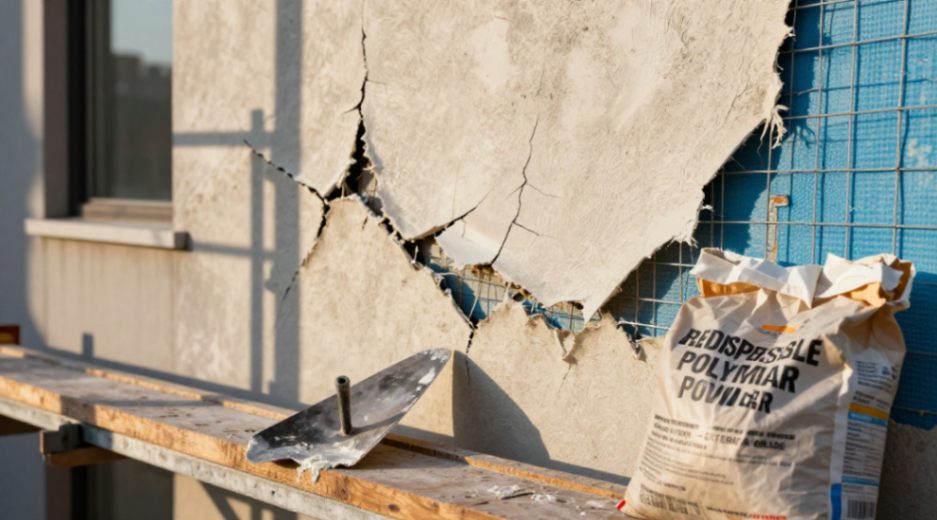
1. Ignoring the Three Non-Negotiable RDP Property Requirements
Not all polymers are created equal for exterior duty. Using a generic, interior-grade powder is the first step toward failure. For your exterior insulation and finish systems, you need an RDP engineered for the extremes.
- Tg (Glass Transition Temperature): This is the polymer’s “operating window.” Aim for a Tg between -5°C to +5°C. Too high, and your finish coat becomes brittle and cracks in cold weather. Too low, and it stays soft, attracting dirt and deforming under heat.
- Hydrophobicity (Water Resistance): The polymer particles must be hydrophobic. If they re-disperse into a water-loving film, your entire system becomes a sponge. Look for RDP specifically formulated for high water resistance and low water absorption.
- Minimum Polymer Content: In the adhesive/base coat, the RDP should constitute no less than 3.0% by weight of the dry cementitious mix. In the finish coat, it should be 4.0% minimum. Less than this, and you’re just paying for a placebo with no real performance benefit.
2. Treating Mixing Like an Afterthought
The magic of RDP only activates with perfect hydration and dispersion. Haphazard mixing is a silent killer.
DO NOT DO THIS:
- Dump the powder into a bucket of standing water.
- Use a low-RPM drill with a mixing paddle designed for paint.
- Mix for 60 seconds and call it good. The powder will clump and never fully integrate.
THE RIGHT WAY: A 3-Step, Clockwork Procedure
- Pre-Wet the Water: Add 90% of the required clean, potable water to the mixing bucket. For a 25kg bag of base coat mix, that’s roughly 5.6 liters out of the total 6.2 liters.
- High-Shear Dispersion: While running a 600-800 RPM drill with a Jiffy-style mixing paddle, slowly sift in the full bag of RDP-modified powder over 30-45 seconds. Let it mix for 2 full minutes. This step is non-negotiable. The high shear breaks apart every particle cluster.
- Slake and Final Adjust: Stop mixing. Let the mortar slake (rest) for exactly 5 minutes. This allows polymers to fully hydrate and any entrained air to escape. After slaking, remix for 1 minute, adding the remaining 10% of water only if needed to achieve a creamy, peanut butter consistency.
3. Overlooking Substrate & Board Compatibility
RDP-enhanced EIFS isn’t a magic wand that sticks to anything. It amplifies both good and bad surface preparation.
- Adhesion to Substrates: RDP forms a flexible, tenacious bridge. But the substrate must be sound, clean, and have a minimum mechanical key. On concrete, remove all form-release agents. On masonry, repair voids. The polymer can’t bond to dust or oil.
- Adhesion to Insulation Boards: This is critical. EPS (expanded polystyrene) boards must be aged a minimum of 6 weeks after manufacturing. Fresh EPS contains residual pentane gas that weakens the adhesive bond. Apply the adhesive/base coat at a minimum rate of 5.5 kg per square meter using the notched trowel method, achieving 40-60% contact area.
4. Assuming Flexibility Solves All Movement Issues
Yes, RDP provides excellent flexibility and crack resistance. But it has limits. The polymer network handles micro-cracking from thermal expansion. It does not forgive poor design.
- Impact Resistance: A properly formulated finish coat with 4-6% RDP can withstand significant blunt force. But you must still detail corners with reinforced mesh and protect vulnerable areas (like near drive-thrus) with impact-resistant trims.
- Addressing Common EIFS Failures: RDP directly combats the big three: Crazing (via film-forming flexibility), Delamination (via superior adhesion and tensile strength), and Moisture Intrusion (via hydrophobic particle films that manage water vapor transmission).
5. Blaming RDP for “High Cost” Instead of Valuing Long-Term Performance
This is the biggest mental trap. Let’s be logical.
An RDP-modified EIFS system costs 15-25% more upfront than a basic, unmodified system. That’s a fact. Now, let’s do the cost-benefit analysis of specifying RDP for long-term performance.
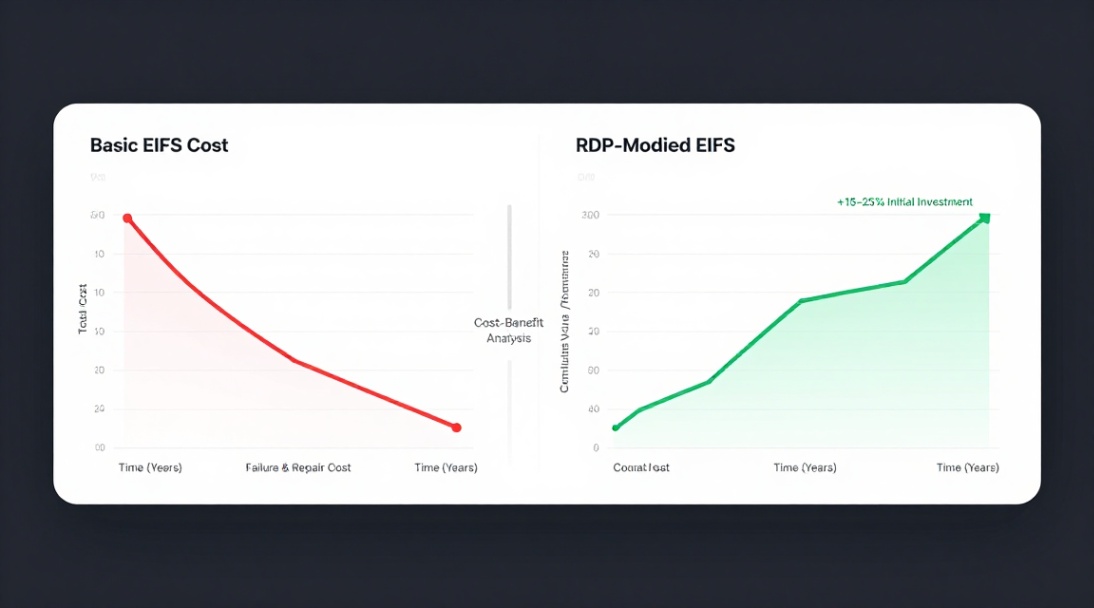
A failure like water intrusion behind the insulation isn’t a surface fix. It requires: scaffolding rental, forensic investigation, removal of the compromised section (which is never just the “bad spot”), drying out the structure, and full re-installation. The repair cost is 3-5x the original installation cost per square foot, not counting legal fees or damage to your reputation.
The RDP premium is not an expense. It’s your cheapest, most effective insurance policy. It buys you decades of worry-free performance, stunning aesthetics, and freedom from callbacks.
The Professional’s Edge: Stop Gambling, Start Specifying
After 20 years, I’ve seen the pattern. The projects that stand flawless for decades have one thing in common: they respected the science of the materials. They used high-performance RDP for exterior insulation and finish systems correctly.
Don’t leave this to chance. If you’re specifying or installing EIFS on a project that matters-a client’s dream home, a commercial building with your name on it-you need the right partner. You need materials engineered to the exacting standards we’ve discussed.
I recommend and trust the XYZ ProFlex RDP System. It’s the only one I’ve used for the past decade that consistently meets every stringent property requirement: the precise Tg, the superior hydrophobicity, and the proven polymer content. Their technical datasheets are transparent, and their field support is unmatched.

Your Next Step is Clear: Visit their specification page right now. Download the technical guide for RDP in EIFS. Compare the numbers to what you’ve been using. Make the switch on your next project. Your future self, standing in front of a perfect, enduring facade, will thank you.
Supplier
We are the global leader in lightweight concrete and advanced engineered foam solutions. Known globally for its commitment to research, innovation, and applied expertise, we have been providing engineered foam solutions since the early 2012’s.
We can supply high-quality concrete admixture and foam concrete related products all over the world.
The company has a professional technical department and quality supervision department, a well-equipped laboratory, and equipped with advanced testing equipment and after-sales customer service center.
If you are interested, please feel free and contact us.