Concrete-mesa | Concrete Admixtures, Tools, and Production Machines

Concrete Foaming Agent: 5 Critical Mistakes That Ruin Foamed Concrete (And What to Do Instead)
Stop Wasting Money on Foamed Concrete Failures
Your foamed concrete is either collapsing in the form or turning into a brittle, crumbly mess. The problem is not the cement. It is not the weather. It is your concrete foaming agent and how you are using it. I have seen the same five catastrophic errors on job sites for 20 years. Read this before you mix another batch.
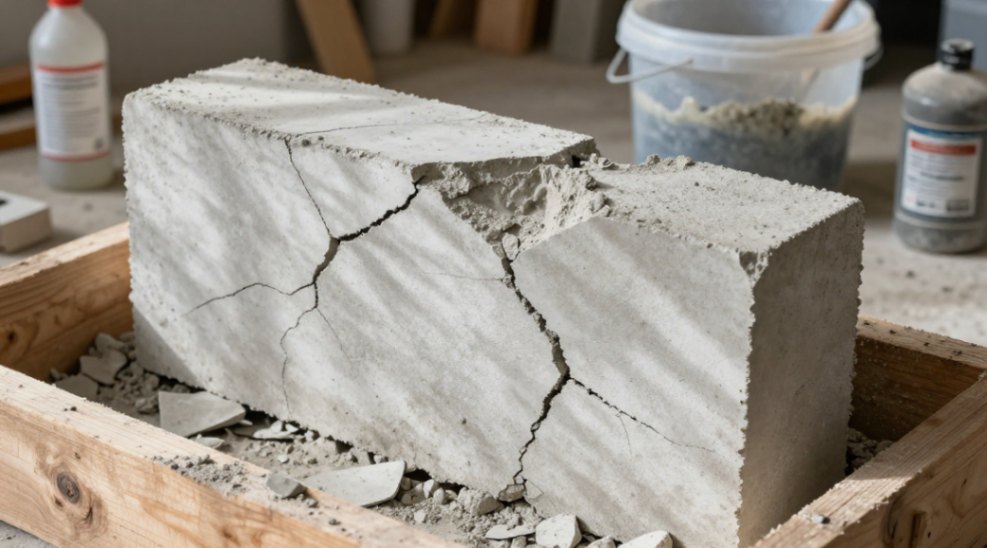
Here is the core truth: a concrete foaming agent is a surfactant system designed to create stable air voids. Stop treating it like soap. This article is your warning. You get the hard data and the fix.
Mistake #1: Matching the Wrong Foaming Agent to the Application
Using a synthetic foaming agent for a high-strength structural panel is a recipe for disaster. Using a protein-based agent for a simple void fill is a waste of profit. The choice between synthetic and protein-based is binary and critical.
| Requirement | Synthetic Foaming Agent | Protein-Based Foaming Agent |
|---|---|---|
| Foam Stability | Good (short term) | Excellent (long term) |
| Open vs. Closed Cells | More open cells | Finely closed cells |
| Strength Contribution | Lower | Higher (due to cell structure) |
| Cost | Lower | Higher |
| Fire Resistance | Standard | Intumescent potential |
| Best Application | Non-structural fill, trench backfill | Precast blocks, roof insulation, structural light weight concrete |
Do this instead: For any element carrying a load, use protein-based agents. For filling a hole or insulating a floor slab on grade, use synthetic. Mixing them is a criminal offense in my book—the chemistries collide and you get unpredictable collapse.
Mistake #2: Ignoring the Foam Equipment Calibration
A perfect concrete foaming agent solution means nothing if your foam generator is dirty or uncalibrated. The water-to-foam ratio is king. A 50:1 ratio vs. a 60:1 ratio can mean the difference between a stable foam that looks like shaving cream and a watery mess that disappears on contact with cement.
Industry data from a 2023 study by the Cellular Concrete Association shows that 70% of foamed concrete density failures trace back to improper foam generation, not the chemical concentrate. Do not blame the agent. Check your equipment.
- Daily: Clean the foam generator nozzles with a concrete water reducer solution to prevent scaling.
- Every Batch: Measure foam density with a cup and scale. Target density must be within 5% of specification.
- Weekly: Check the dilution pump calibration. A 2% drift kills consistency.
Mistake #3: Designing the Mix Like Standard Concrete
You cannot use a standard concrete mix design and simply add foam. It will collapse. The paste rheology must be modified. This is where special cement blends and superplasticizer strategy become critical.
The fatal error: Adding foam to a stiff, low-slump mix. The foam bubbles are physically crushed by the paste. You must use a high-range water reducer to create a fluid, cohesive paste that can wrap around the bubbles without breaking them.
Also, sodium silicate or potassium silicate can be used as a set accelerator in cold weather, but improper dosage causes a flash set that traps un-stabilized air, leading to massive shrinkage later. Test small batches. Always.
A typical recipe for stable foamed concrete (by weight) looks like this, but adjust for your target wet density:
- Cement (or a blend with fly ash/slag).
- Water: use a high concrete water reducer to lower the water-to-cement ratio to 0.4 or lower. This is non-negotiable.
- Early strength agent for demolding speed.
- Fiber (polypropylene or glass) to control plastic shrinkage cracking.
- Pre-formed foam from your calibrated foam generator.
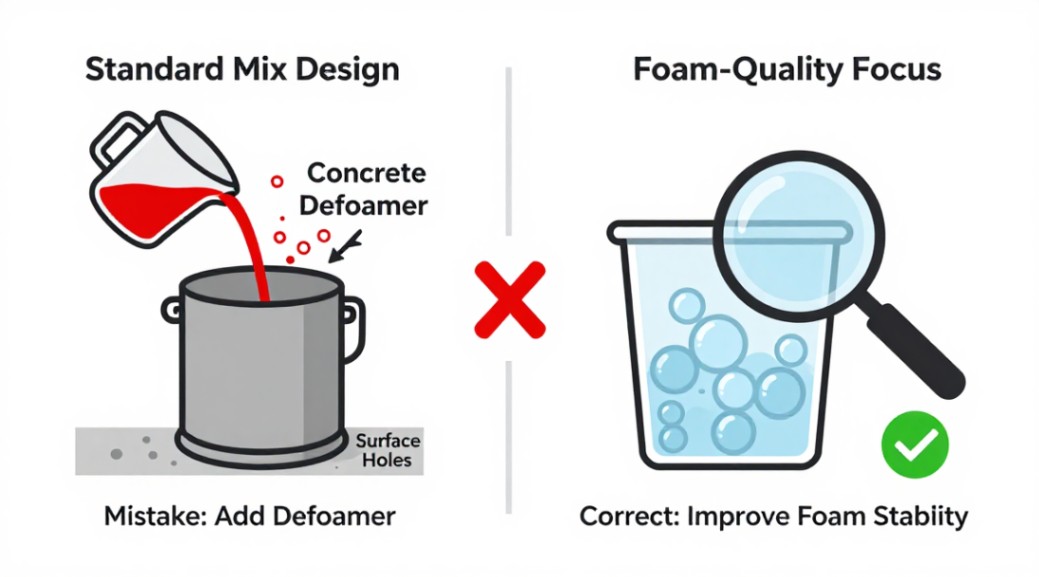
Never add a concrete defoamer into a mix that contains a foaming agent. That is blatant self-sabotage. If you see surface holes, fix your foam quality, not the chemistry.
Mistake #4: Skipping Critical Quality Control Tests
Guessing the wet density is the hallmark of an amateur. You must measure. Period. Here are the two tests that separate a pro from a yard-pounder:
| Test | Method | Target / Warning Sign |
|---|---|---|
| Foam Density | Weigh a known volume of foam (e.g., 1 liter cup). | Target: 50-80 g/L for a stable blend. Lower = too wet, collapse risk. Higher = too dry, not enough air. |
| Foam Drainage Rate | Fill a graduated cylinder with foam. Measure the liquid that drains to the bottom in 1 hour. | Less than 10% drainage = excellent. 20%+ = your bubbles are about to pop inside the concrete. |
| Fresh Concrete Unit Weight | Weigh a cup of the fresh foamed concrete. Compare to your target wet density. | Any deviation over 5% means you must adjust foam volume immediately. Do not pour. |
If you are not performing these tests on every second truck, you are gambling with structural integrity.
Mistake #5: Ignoring Admixture Incompatibility
This is the most subtle killer. Your concrete foaming agent is anionic or non-ionic. Many superplasticizers (polycarboxylate ethers) are also anionic. They do not always play nice. The wrong combination causes immediate foam collapse.
Furthermore, hydroxypropyl methyl cellulose (HPMC) and hydroxyethyl cellulose are water retention agents. They are often used in dry-mix mortars. If you try to add foam to a mix containing high doses of HPMC, the foam will be destroyed by the thickener. The polymer chains physically tear the bubble lamellae.
What works?
- Use a nano-modifier (synthetic silica) to stabilize the foam-cement interface. It reinforces the bubble walls.
- Use redispersible polymer powder (RDP) in dry-mix applications, but add it to the paste before foaming, not after.
- For fiber reinforcement, use short 3mm fiber. Long fibers act like swords and cut the foam.
If you see foam collapse when adding admixtures, stop and test with a different chemical combination. Your concrete release agent for the forms should also be non-reactive—oil-based is safer than solvent-based.
You Have Two Choices: Fail or Fix
A stable, light weight concrete with early strength and thermal insulation is not a mystery. It is a predictable chemical and mechanical process. The data and the process are clear. The only variable left is you.
Stop buying cheap commodity chemicals. Stop guessing the mix. Start using a concrete foaming agent from a supplier who understands the entire system—from foam generation to final cure.
TRUNNANO provides precisely formulated concrete foaming agents engineered for stability and compatibility with modern admixtures. They also supply the special cement, superplasticizer, fiber, and early strength agent you need for a complete, non-conflicting mix system. One call. One solution.
Do not pour another batch of bad concrete. Contact TRUNNANO now for a technical consultation and a guaranteed stable foamed concrete mix design. Your project quality depends on it.
Supplier
We are the global leader in lightweight concrete and advanced engineered foam solutions. Known globally for its commitment to research, innovation, and applied expertise, we have been providing engineered foam solutions since the early 2012’s.
We can supply high-quality concrete admixture and foam concrete related products all over the world.
The company has a professional technical department and quality supervision department, a well-equipped laboratory, and equipped with advanced testing equipment and after-sales customer service center.
If you are interested, please feel free and contact us.