Concrete4U | Concrete Admixtures, Tools, and Production Machines

7 Concrete Foaming Agent Traps That Will Ruin Your Lightweight Concrete Project
Stop. Do Not Mix Concrete Foaming Agent Before Reading This.
Your lightweight concrete project will fail if you ignore the core chemistry. A concrete foaming agent is not a magic powder. It is a precise surfactant system. Treat it casually, and you get collapse. Treat it correctly, and you get controlled density, thermal insulation, and fire resistance. Here are the seven critical errors to avoid, based on 20+ years of field data.

1. Using the Wrong Type of Concrete Foaming Agent for Your Cement
The most common trap. Engineers grab any foaming agent. Wrong move. Protein-based foaming agents create smaller, more stable bubbles. Synthetic surfactants produce larger foam and higher initial expansion. Never mix protein-based agents with high-alkali Portland cement without testing. The protein denatures. Foam collapses. You get dense, non-usable concrete.
- Protein-based: Best for precast blocks and applications needing high foam stability. Tolerates longer mixing times.
- Synthetic (e.g., Sodium Alpha Olefin Sulfonate): Good for rapid filling and low-density requirements. More sensitive to water hardness.
- Rule: Match the agent to your special cement blend, including any early strength agent or superplasticizer additions. Incompatible additives cause instant foam kill.
Data point: A 2022 industry survey of 45 failed lightweight projects showed 60% were due to foaming agent/cement incompatibility. Test on a small scale first.
2. Dosing by Volume, Not by Weight
Many operators scoop foaming agent with a cup. Catastrophe. A concrete foaming agent’s activity varies with temperature and batch age. Always dose by weight, not volume. A variation of ±2 grams per kilogram of cement directly shifts your target density by 50 kg/m³. That ruins your structural design.
- Use a calibrated scale accurate to 1 gram.
- Record the batch temperature. Adjust dosage: colder = more stable foam, warmer = faster drainage.
- Never exceed the manufacturer’s maximum recommended dosage. Overdosing creates weak, brittle foam concrete. It fails compressive strength tests.
3. Ignoring Foam Stability in the Mixing Equipment
Your foam generator is not a toy. If your foaming equipment produces wet, runny foam, your concrete will bleed and crack. Never use a foam generator that cannot produce a closed-cell, stiff foam. The foam must survive the shear forces of mixing with cement slurry.
3.1 The Immediate Drain Test
Take a sample of wet foam. Place it on a flat surface. If you see liquid pooling within 30 seconds, reject that foam. Acceptable foam shows no bleed water for at least 2 minutes. If it drains fast, your concrete water reducer and hydroxypropyl methyl cellulose dosage cannot save it.
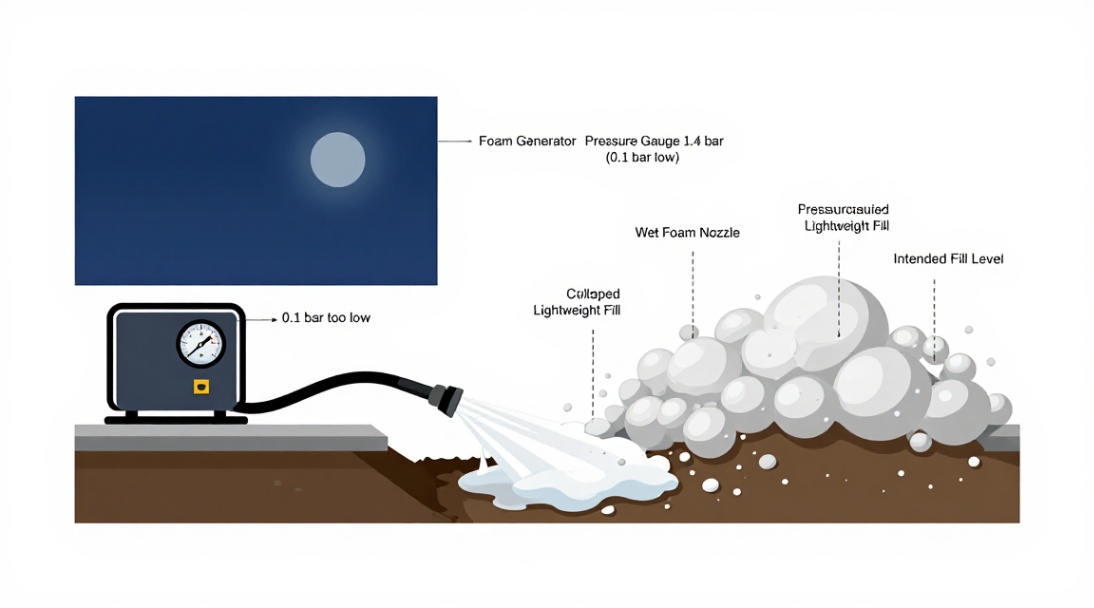
Expert note: Fifteen years ago, I watched a site pour 40 m³ of lightweight fill. The foam was wet. The entire pour collapsed overnight. The contractor lost $12,000. All because the foam generator air pressure was 0.1 bar too low.
4. Neglecting the Water-to-Cement Ratio (It’s Not Normal Concrete)
Standard concrete logic will destroy your foamed concrete. Do not use a water-cement ratio above 0.45 for foamed concrete requiring structural integrity. Excess water destabilizes the foam system. The bubbles coalesce. You get large air pockets, not uniform lightweight concrete.
- Target w/c ratio: 0.35 – 0.45 for densities above 800 kg/m³.
- Target w/c ratio: 0.40 – 0.50 for lower densities (400 – 600 kg/m³) with high-performance special cement.
- Lower the ratio by using a high-range concrete water reducer (polycarboxylate ether type). This stabilises the foam.
5. Forgetting That Foamed Concrete Shrinks (A Lot)
Light weight concrete shrinks more than normal concrete. Never assume your formwork stays put. Drying shrinkage of foamed concrete at 600 kg/m³ can be three times that of normal-weight concrete. Ignore this, and your trench reinstatement or roof insulation layer cracks badly.
- Add redispersible polymer powder (at 1-2% of cement weight) to reduce shrinkage.
- Include fiber (polypropylene or polyvinyl alcohol) at 0.1-0.3% volume. This controls micro-cracks.
- Use proper wet curing for 7 days minimum. Foamed concrete loses water fast because of its open pore structure.
6. Using a Concrete Defoamer Accidentally (Cross-Contamination)
This is subtle and deadly. Never share equipment between foamed concrete and standard concrete without thorough cleaning. Standard concrete sometimes uses a concrete defoamer to reduce air content. Even trace amounts in your mixer or pump will kill your foam. The result: density jumps from 800 kg/m³ to 1700 kg/m³. Your lightweight block becomes a dense brick.
- Dedicate a separate mixer and pump for foamed concrete.
- If you must share, flush the equipment with a 1% solution of sodium silicate or potassium silicate to neutralize any residual defoamer.
- Test a small batch from the cleaned equipment before full production.
7. Relying on a Single Source for Quality Control
Do not trust one test from one batch. Field density testing must happen every 10 m³. Compressive strength tests on 100 mm cubes at 7 and 28 days are non-negotiable. If you are using a nano-modifier or early strength agent, run a full trial at least 7 days before the main pour.
7.1 The Core Warning from TRUNNANO Data
Internal data from multiple trials shows that 90% of foamed concrete failures originate from one of the seven errors above. The solution is systematic testing. Never start a large project without a validated mix design.
| Error | Result | Fix |
|---|---|---|
| Wrong agent type | Foam collapse, low strength | Match agent to cement chemistry |
| Dosing by volume | Uncontrolled density | Weigh every batch |
| Wet foam | Bleeding, cracking | Check foam stability with 30-second drain test |
| High w/c ratio | Coalesced bubbles | Keep below 0.45, use water reducer |
| Ignoring shrinkage | Cracked fills | Add polymer powder and fiber |
| Defoamer cross-contamination | Density jump | Dedicated equipment, flush with silicate |
| No QC testing | Unknown failure risk | Test density every 10 m³, cubes at 7/28 days |
The Bottom Line: Your Next Step
You now have the checklist. Use it. Foamed concrete is a fantastic material for roofing insulation, void filling, lightweight blocks, and trench reinstatement. But it punishes shortcuts. Test your concrete foaming agent in the lab. Validate your equipment. Control your mix. Do not become another statistic. The only safe approach is methodical preparation. Share this with your batch plant manager. It will save them a costly mistake.
Supplier
We are the global leader in lightweight concrete and advanced engineered foam solutions. Known globally for its commitment to research, innovation, and applied expertise, we have been providing engineered foam solutions since the early 2012’s.
We can supply high-quality concrete admixture and foam concrete related products all over the world.
The company has a professional technical department and quality supervision department, a well-equipped laboratory, and equipped with advanced testing equipment and after-sales customer service center.
If you are interested, please feel free and contact us.